

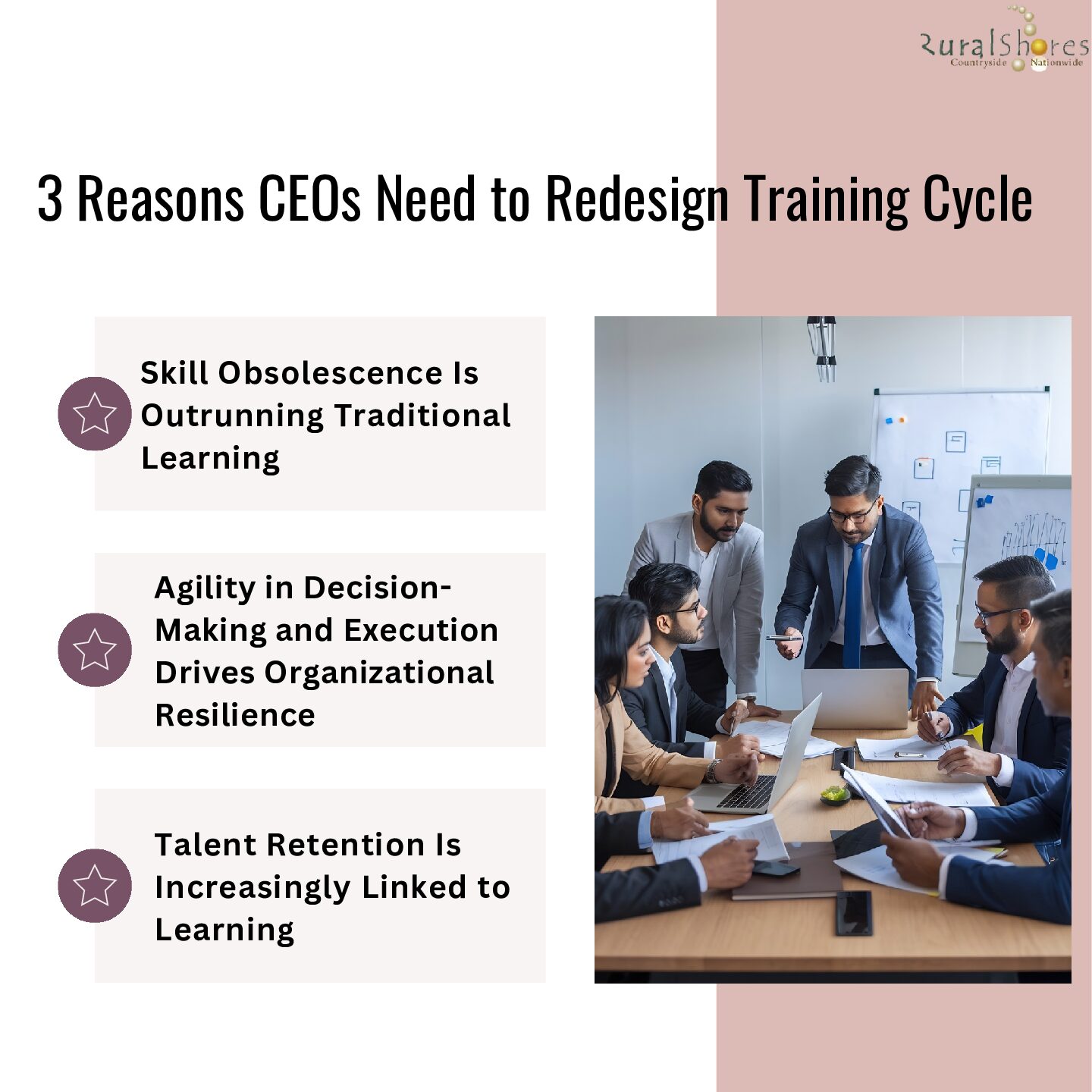
The shelf life of skills has never been shorter. With AI, automation, and market disruptions rewriting industries overnight, what was once considered a “core skill” can lose relevance in less than two years – studies show that nearly 50% of skills in today’s workforce are expected to be outdated within this timeframe. For CEOs, CXOs, and business leaders, this is no longer just a talent challenge – it is a strategic risk that directly affects speed to market, innovation capacity, and organizational resilience. Traditional training cycles, designed for stable environments, cannot deliver the speed, adaptability, or business outcomes organizations now require.
Here are three reasons CEOs must urgently rethink and redesign the training cycle:
1. Skill Obsolescence Is Outrunning Traditional Learning
In the past, organizations refreshed skills through annual programs or role-based certifications. Today, that cadence is obsolete. By the time a cycle is complete, the skills taught may already be outdated. Emerging technologies, shifting business models, and new regulatory frameworks demand faster pivots.
According to The European House – Ambrosetti, over 450 million workers across six countries will require AI upskilling by 2030, highlighting the rapid pace at which skills are becoming outdated.
CEO Insight: To stay ahead of change, we must replace slow, episodic training with continuous, embedded learning systems that evolve as fast as the market does. Embedding real-time learning into daily workflows—through AI-enabled coaching, micro-learning apps, and project-based learning tied to live business challenges—keeps our workforce current as skills expire.
2. Agility in Decision-Making and Execution Drives Organizational Resilience
The most resilient companies can make decisions quickly, adapt strategies, and implement changes effectively when markets shift. Slow, outdated training slows this ability, leaving businesses exposed to lost opportunities, operational delays, and competitive risks. By equipping teams with real-time learning, cross-functional problem-solving, and scenario-based simulations, companies can respond decisively to disruption—no matter their size.
CEO Insight: To avoid being slowed by disruption, we must turn training into a strategic resilience lever—equipping employees to pivot and act instantly. Using scenario-based simulations, cross-functional projects, and internal talent marketplaces, we can hardwire agility into how people make decisions and execute in volatile conditions.
3. Talent Retention Is Increasingly Linked to Learning
High performers no longer stay for paychecks alone. They stay where growth is continuous, personalized, and aligned with career aspirations. A stale training cycle signals stagnation and fuels attrition. Conversely, a culture of adaptive learning drives engagement, loyalty, and innovation.
LinkedIn’s 2023 Workplace Learning Report found that 94% of employees would stay longer at a company if it invested in their career development, showing a clear link between learning opportunities and retention.
CEO Insight: Redesign training cycles into learning ecosystems – personalized, flexible, and career-enabling. This not only future-proofs the workforce but also strengthens the employer brand. Examples include peer-learning platforms, internal talent marketplaces, and personalized career pathways that align with employee aspirations.
CEO Insight: To keep top talent engaged, we must transform training into personalized learning ecosystems that align with career growth. By deploying career-pathing platforms, peer-learning cohorts, and mentorship programs, we demonstrate that employee development is ongoing, which strengthens loyalty and reduces costly attrition.
The CEO Imperative
Redesigning the training cycle is no longer an HR initiative; it is a boardroom priority. The shift is clear: from annual training events to continuous capability building – not as a feel-good exercise, but as a driver of faster product launches, stronger customer satisfaction, lower attrition costs, and a healthier innovation pipeline.
Organizations that act now will not just keep pace with disruption – they will outpace it, turning learning agility into competitive advantage.
The question is no longer “Can we afford to change our training cycle?”
It is: “Can we afford to delay growth, innovation, and market leadership by not changing it?”
Authored By: Abhinav Bajaj