

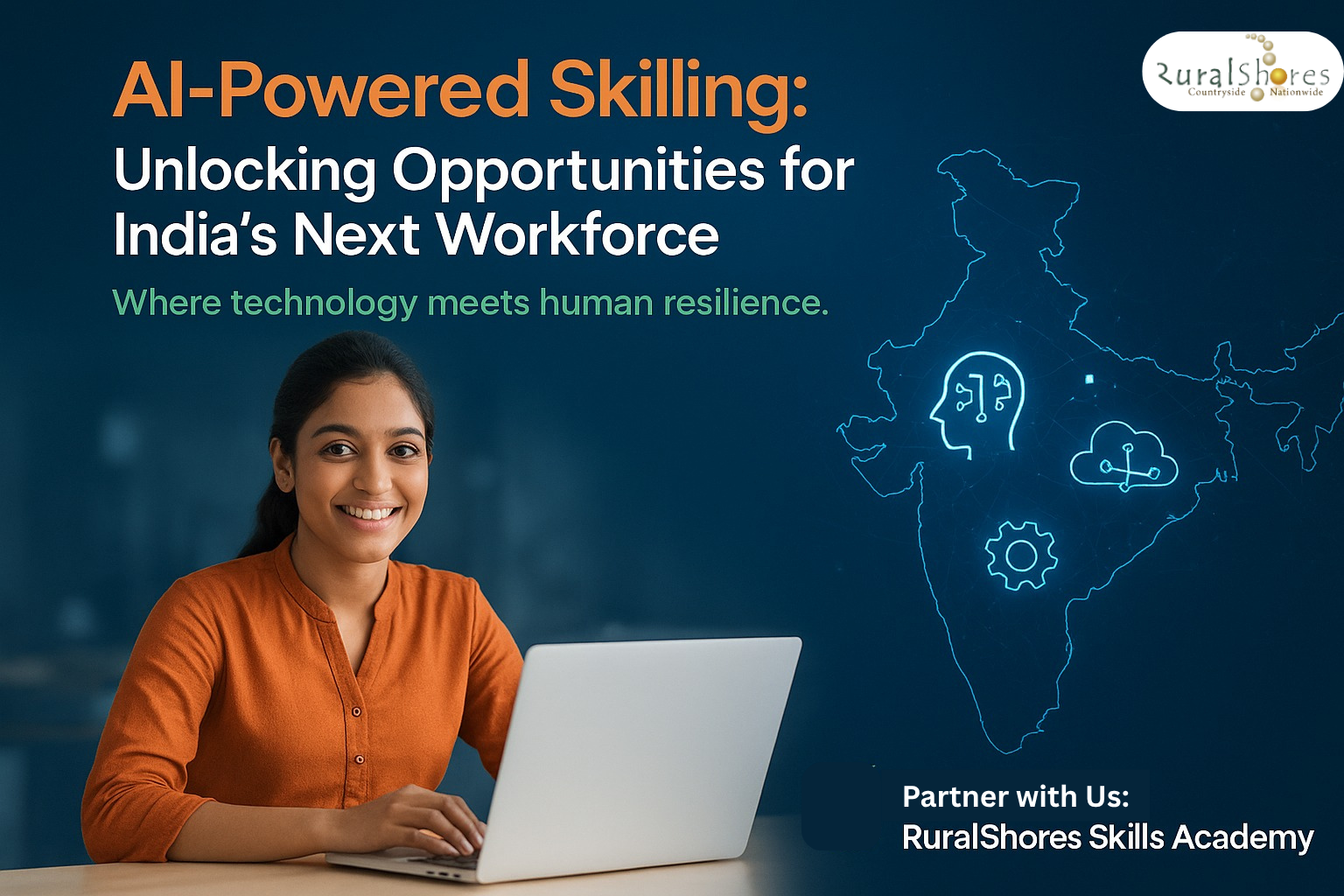
AI is reshaping industries, but real opportunity lies in preparing workers with adaptive skills to thrive in AI enabled jobs.
In the era of digital transformation, the strategic focus must shift from technology for its own sake to people who can harness it. For corporate leaders and social impact investors, the critical question is not only how to deploy AI but how to build a workforce that is ready for an AI-enabled tomorrow. A major share of India’s growth opportunity lies in its rural and semi-urban youth. They are often overlooked by traditional hiring practices, yet they bring strong values, resilience, and a commitment to long-term careers. Their unique strengths – from problem-solving to customer-focused behavior – make them ideal for industries where trust and service matter most. By empowering this talent pool, businesses can unlock deeper market reach and build a more inclusive, future-ready workforce for India.
Consider the model and results of RuralShores Skills Academy (RSA). With operations across India and a growing network of trainers, RSA has trained more than 777,738+ people from rural and semi-urban regions. Their programs focus on high-demand sectors such as BFSI, digital marketing, customer service and logistics. Training is delivered in regional languages and in centers close to learners’ homes, supported by AI-enabled learning tools that help personalize training and build job-ready skills. This ensures learning remains accessible, faster, and fully aligned with real industry needs
The business case is strong. When rural youth are trained on digital tools, customer systems, and AI-assisted learning platforms before joining, they become productive faster and require less hand-holding at the workplace. Employer partners working with RSA have seen up to a 60 percent reduction in attrition, 40 percent shorter time to productivity, and 25–35 percent cost savings in hiring and onboarding. This shows that digitally empowered talent from rural India can deliver performance and efficiency at scale – making this investment a strategic business advantage.
The AI shift adds urgency and opportunity. As businesses integrate AI into customer engagement, logistics, data analysis, and operational decision-making, the need for talent who can confidently use digital tools becomes critical. Rural talent offers unique strengths including a strong work ethic that comes from real responsibility early in life – supporting family livelihoods, helping in farms or shops, and managing tasks with limited resources.
This builds discipline, accountability and the habit of completing work without excuses. Combined with stability and deep cultural understanding, they are well-positioned to support companies expanding into Tier 2 and Tier 3 locations. For example, rural youth trained through industry-linked programs have been placed in corporate roles in non-metro towns and proven their adaptability. Companies have successfully hired rural candidates for back-office and support functions, showing rural workforces can deliver at scale and meet quality expectations. Increasingly, employers are realizing that when rural youth receive practical, hands-on training aligned to industry needs, they can deliver results quickly – proving that skills and adaptability matter more than degrees alone.
To fully realize this advantage at scale, companies must rethink how they skill and integrate rural talent into AI-enabled roles. Now, leaders across industries need a clear roadmap to prepare rural youth for the future of work and ensure businesses benefit from this growing talent pool. The following CEO Playbook for AI-Powered Skilling outlines practical actions that businesses can adopt to unlock rural potential and ensure that AI becomes a driver of inclusion rather than displacement:
CEO Playbook for AI-Powered Skilling
To unlock the full potential of India’s rural talent in an AI-enabled economy, CEOs must take focused action:
- Prioritize adaptive skills and AI literacy
Design modular pathways that build digital basics, AI awareness, and domain-specific applications. Workers must be empowered to adapt rather than be replaced. - Create employer-linked career pathways
Partner with industry to co-design training that directly maps to real job roles. When skilling is tied to interviews, internships, or apprenticeships, placement outcomes improve dramatically. - Blend delivery and measure outcomes
Use a combination of local training centers, short online modules, and practical simulations. Measure success through placement rates, productivity, and employer satisfaction, not just course completion.
The CEO Imperative
The workforce of the future will succeed not by simply using technology but by applying it with judgment and human insight. AI creates efficiency. People create value. Business leaders who combine AI adoption with strategic skilling investments will turn disruption into long-term competitive advantage. By empowering rural talent with modern skills, we unlock a powerful source of loyalty, resilience, and growth.
The future of India’s workforce will rise from places that were once ignored. If we invest in this potential today, we build an economic transformation that includes every community and strengthens every organization.
Let us power AI with human capability. Let us grow with purpose. Let us grow together.
Authored By – Neha Babbar