

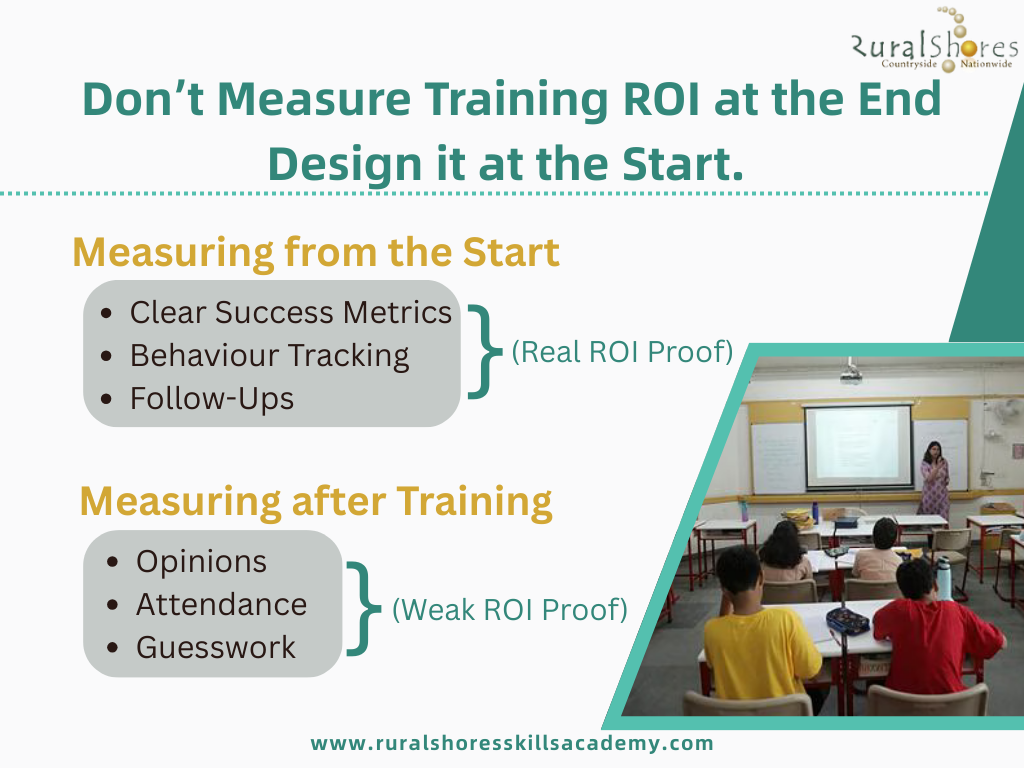
The boardroom question is inevitable: “What return are we getting on our learning investments?” Too often, L&D leaders scramble to piece together post-training surveys, completion rates, and anecdotal success stories-metrics that fail to convince CFOs or demonstrate genuine business impact. The fundamental flaw isn’t in the measurement itself, but in its timing. When organizations wait until after training concludes to ask “did it work?”, they’ve already lost the game.
Effective training ROI measurement doesn’t begin when participants exit the classroom or complete the final module. It begins weeks or months earlier, during program design, when we define with uncomfortable specificity what success will actually look like in the workflow. This isn’t about setting vague aspirations like “improved customer service” or “better leadership skills.” It’s about identifying the precise, observable changes in behavior and business outcomes that will signal training has translated into performance.
The Creative Challenge: Defining Observable Change Before Training Begins
Measuring training impact demands creative, rigorous thinking about the delta between current state and desired future state. Here are five critical considerations that transform training from an event into an accountable business intervention:
1. Translate Skills into Workflow Behaviors, Not Just Competencies
The problem with most training objectives is they stop at skill acquisition. “Participants will understand consultative selling techniques” tells us nothing about what actually changes at work. Creative measurement thinking asks: What will this salesperson do differently on Monday morning? Will they ask three discovery questions before presenting solutions? Will they document client pain points in the CRM before generating proposals? Will they request peer review on complex quotes?
These specific behaviors become your measurement checkpoints. Define them before training starts, establish baseline frequencies, and you create a measurement framework that reveals whether learning transferred to application. Without this granular specificity, you’re measuring whether people liked the training, not whether it changed anything.
2. Identify the Upstream and Downstream Indicators of Behavior Change
Training outcomes don’t exist in isolation-they create ripples. A customer service training might immediately affect call handling time (upstream indicator), but its real value appears in reduced escalations, improved CSAT scores, and decreased churn (downstream indicators). Creative ROI thinking maps this causal chain before training begins.
For a sales negotiation program, upstream indicators might include the frequency of using pricing tiers in proposals or conducting post-win analysis. Downstream indicators could be improved margin preservation, shorter sales cycles, or reduced discounting. By defining both sets of indicators upfront, you create early warning signals of impact and longer-term validation of business results-not as afterthoughts, but as designed measurement points.
3. Build Measurement into the Learning Design, Not Around It
When measurement is retrofitted after training, it becomes an administrative burden disconnected from learning. When it’s embedded from the start, it becomes a performance support tool. Consider a manufacturing supervisor training on root cause analysis. Rather than measuring abstractly, design the training so participants bring real production issues, apply the methodology during sessions, and commit to implementing solutions within 30 days.
The measurement isn’t separate-it’s the structured 30-day and 90-day follow-up where supervisors report on implementation, results, and obstacles. This approach serves triple duty: it reinforces learning, provides job support, and generates ROI data. The creative insight is recognizing that measurement infrastructure can simultaneously drive application and capture evidence of impact.
4. Define “Good Enough to Count” Thresholds
Vague success criteria doom ROI measurement. “Improved communication” means nothing. Does it count if a manager holds one additional team meeting per month? What if they hold meetings but team members report feeling unheard? Creative measurement demands defining the minimum viable change that constitutes success-and the quality threshold that separates activity from impact.
For a project management training, you might specify: “Within 60 days, participants will have initiated at least one project using the planning template, with stakeholder sign-off documented, and at least two checkpoint reviews completed.” This specificity enables binary tracking: did they do it or not? At scale, this produces defendable ROI data. Without these thresholds defined pre-training, you’re left with subjective assessments that crumble under scrutiny.
5. Create Participant Accountability Through Transparent Measurement
The most creative ROI measurement systems don’t just track learners-they engage them as partners in demonstrating value. When participants know before training starts exactly what behaviors and outcomes will be measured, and when those metrics are visible to them and their managers, application rates soar.
Imagine a leadership program where each participant publicly commits to three specific leadership behaviors they’ll demonstrate in the next 90 days, with monthly self-reporting and manager validation. The transparency creates accountability, the specificity enables measurement, and the process itself drives application. The measurement system becomes the intervention that ensures training sticks-but only if designed before training begins, not added afterward.
Three Real-World Failures of Retrospective Measurement
Situation 1: The Sales Enablement Training That Couldn’t Prove Impact
A mid-sized technology company invested heavily in sales enablement training for 150 sales representatives, focusing on value-based selling and solution positioning. The training received strong satisfaction scores (4.2/5.0), and post-training assessments showed 85% competency in the frameworks taught. Six months later, when the VP of Sales asked the learning team to demonstrate ROI, they had no answer.
They hadn’t established baseline metrics for the specific behaviors the training was meant to change. Were reps supposed to conduct more discovery calls? Shorten sales cycles? Improve win rates on competitive deals? No one had defined success before training started. When the team tried to retroactively analyze CRM data, they found dozens of variables that could explain any changes in performance-new products launched, territories reorganized, a competitor’s pricing change. Without pre-defined metrics and control groups, the INR 20,00,000 training investment became a cautionary tale about “soft skills training” rather than a demonstrable business asset.
Situation 2: The Leadership Development Program with Invisible Outcomes
A healthcare organization launched an ambitious leadership development program for 50 mid-level managers, addressing delegation, performance conversations, and strategic thinking. The 9-month program included workshops, coaching, and action learning projects. Post-program surveys showed participants felt more confident and valued the experience.
When the CHRO presented to the board, she was asked a simple question: “What changed?” She couldn’t answer with specificity. Had these managers reduced turnover in their teams? Were they handling performance issues earlier? Were their direct reports more engaged? The organization measured employee engagement annually but hadn’t isolated these leaders’ teams for tracking. They measured promotion rates but hadn’t defined whether leadership program graduates should be promoted faster.
The program cost INR 30,25,000 and countless leadership hours, but because measurement was conceived as an afterthought, its value remained a matter of faith rather than evidence. The following year’s budget allocated those funds to operational priorities with clearer returns.
Situation 3: The Compliance Training That Measured Everything Except Compliance
A financial services firm rolled out mandatory compliance training following regulatory updates. The training reached 2,000 employees, achieved 98% completion, and included knowledge checks that employees passed at an 89% average. The learning team reported these metrics as success.
Eighteen months later, an audit revealed continuing compliance violations in specific transaction types-the very behaviors the training addressed. When leadership questioned why training hadn’t prevented the issues, the L&D team discovered they’d measured completion and knowledge retention but had never tracked whether employees actually changed how they processed transactions.
They’d never defined what correct application looked like in the workflow, never established which transaction flags should trigger the trained protocols, and never measured whether those protocols were being followed. The training had been designed around content delivery, not behavior change. When measurement started after the program ended-and only measured program completion-it was blind to the only metric that mattered: were people actually doing the right thing differently?
The Path Forward: Measurement as a Design Principle
The shift from retrospective to prospective measurement requires more than earlier planning-it requires a fundamental re-conception of what training is for. Training isn’t for learning only; it’s for performance change that drives business results. When this truth moves from slogan to operating principle, measurement shifts from an evaluation activity to a design requirement.
Before any training program launches, three questions must have specific, documented answers:
What exact behaviors will change? Not skills, not knowledge, not attitudes-behaviors. Observable, countable, verifiable actions that participants will perform differently after training than before.
What business metrics will move as a result? Revenue, cost, time, quality, risk, compliance-whichever matters to your organization. Define the expected impact magnitude and timeline.
How will we know the training caused it? Control groups, baseline measurements, attribution models-what evidence will you gather that makes the causal connection defendable?
These questions are uncomfortable because they demand precision where ambiguity has been acceptable. They require L&D professionals to think like business operators, not program administrators. They force difficult conversations about whether proposed training can actually deliver measurable value-and sometimes the answer is no, which is valuable information to have before spending six months and half a million dollars.
The organizations that master this approach don’t have just better training programs-they have better measurement systems that make training better. They design with the end in evidence, knowing that accountability drives rigor, and rigor drives results. When the CFO asks about training ROI, they don’t scramble to compile post-hoc justifications. They present a measurement framework established before training began, data collected throughout implementation, and business impact visible in operational metrics.
This is what defensible training ROI looks like: not a report generated after the fact, but a measurement system so integral to training design that ROI isn’t calculated-it’s engineered.
Authored by: Neeraj Agarwal