

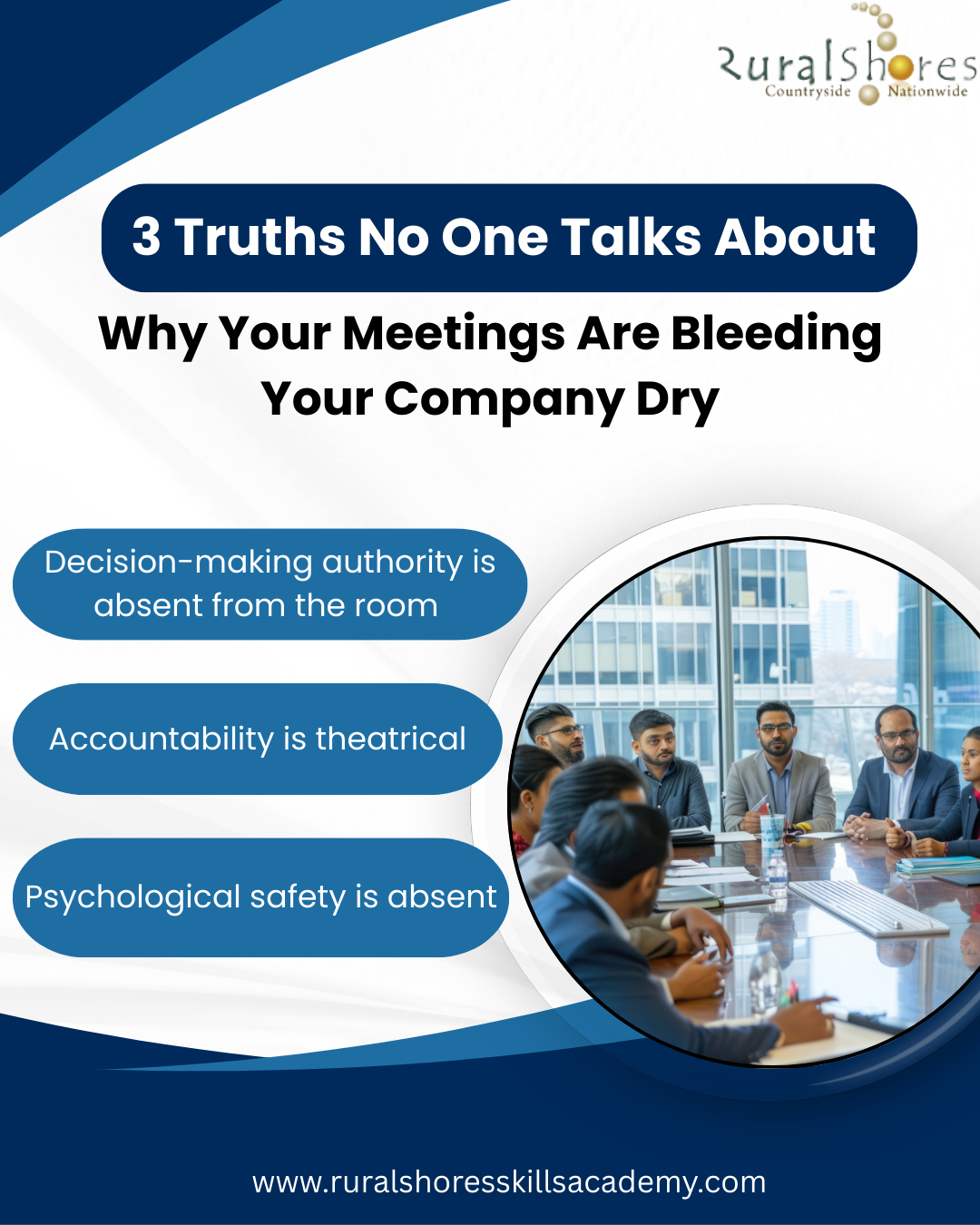
After 40 years in boardrooms, factories, and rural skill centres, I can tell you the real reason corporate India keeps running in circles.
By the CEO, RuralShores Skills Academy · March 2026 12 min read
“We had a very productive meeting.” I have heard these words thousands of times. And almost every time, nothing of consequence followed. That phrase has become the corporate world’s most expensive lie.
Let me be direct with you. McKinsey estimates that organisations spend 15% of their total collective work time in meetings – and between 25% to 50% of that time produces nothing of value. In monetary terms, that translates to roughly $37 billion lost annually in the United States alone. In India’s rapidly scaling corporate sector, with its armies of middle managers, the proportional waste is no less alarming.
In 40 years of working across sectors – from legacy industries to rural skilling initiatives – I have sat in thousands of meetings. I have watched sharp minds circle the same problem for months without resolution. I have seen brilliant people go silent in a room full of the wrong people. And I have watched organisations lose their best talent not to rivals, but to sheer, grinding futility.
Research by McKinsey, Gallup, and Harvard Business Review has now given us numbers to match the intuition most leaders already carry. And those numbers point, overwhelmingly, to three root causes – each hiding in plain sight, each far more consequential than the symptoms most companies treat.
01
THE FIRST AND MOST DAMAGING TRUTH
Decision-making authority is absent from the room – and everyone knows it
61%of executives say their decision-making time is ineffective (McKinsey)
~70%of significant decisions get quietly re-litigated after the meeting ends
5×faster – the speed of decisions in high-clarity organisations vs. low-clarity ones
McKinsey surveyed senior executives across industries and found that 61% felt their decision-making time – the majority of which happens inside meetings – was being wasted. Not occasionally. Routinely. The reason is almost never a lack of intelligence or commitment. It is a structural flaw: the people who must say yes or no are rarely in the room.
This is what I call the proxy problem. Organisations fill meetings with representatives of decision-makers – smart, well-prepared people who nonetheless arrive with a silent instruction: “Listen, discuss, but do not commit.” Every insight offered is conditional. Every resolution is provisional. The meeting ends with a follow-up meeting scheduled to confirm what could have been decided then and there.
THE HIDDEN COST
Each deferred decision triggers an average of 2–3 additional meetings, emails, and review cycles. In an organisation of 1,000 managers, deferral is not an inconvenience – it is a tax on every project, every quarter, every year.
REAL-WORLD EXAMPLE 1
The infrastructure project that needed 18 months to do a 3-month job
A mid-sized Indian infrastructure company I know convened a steering committee for a Rs. 120-crore project. Every fortnightly meeting involved project managers, regional heads, and consultants – but the CMD attended only “when absolutely necessary.” Result: 14 out of 22 meetings produced no binding decisions. The project overran by 8 months and Rs. 34 crores. When the CMD began attending every third meeting with explicit decision rights, the remaining phase was completed in half the projected time.
REAL-WORLD EXAMPLE 2
Amazon’s “two-pizza and one decider” rule
Jeff Bezos institutionalised something most companies consider radical: every meeting must have a single, named decision-maker – not a committee, not a consensus. Bezos called decisions made by large groups “disguised non-decisions.” Amazon’s speed of execution became a competitive moat. Its meeting discipline was as important as its logistics infrastructure. The lesson is not about small teams; it is about clear authority in the room.
The analogy that sharpens this best: imagine a surgery theatre where the lead surgeon is absent and three senior residents are present, each technically capable, each waiting for the other to make the call. The patient is on the table. This is precisely what happens in corporate decision-meetings every day – except the patient is your quarter’s performance, and the waiting happens every week, not once.
The most expensive five words in corporate life are: “Let us take this forward.”
02
THE STRUCTURAL ROT AT THE CENTRE
Accountability is theatrical – the follow-through system simply does not exist
$37B lost annually in unproductive meetings in the US alone
103 hrs per year – the average knowledge worker spends in unnecessary meetings (McKinsey)
209 hrs per year lost to duplicated work caused by lack of meeting follow-through
McKinsey’s workplace research reveals a pattern that is at once obvious and catastrophically underestimated: the average knowledge worker loses 103 hours per year in unnecessary meetings, and then spends another 209 hours redoing work because the outcome of those meetings was never properly closed. That is 312 hours – nearly eight full working weeks – evaporating every year, per person.
Why does this happen? Because most organisations treat the meeting as the finish line when it is only the starting block. Minutes are circulated, sometimes weeks later. Action items are listed with vague ownership (“team to review,” “HR to look into”). Follow-up is entirely voluntary. And the next meeting begins not with accountability for what was promised, but with a fresh agenda that politely ignores the wreckage of the previous one.
THE ANALOGY MOST LEADERS MISS
A cricket match with no scoreboard. Every delivery is bowled, every shot is played – but no one tracks the runs. The team plays with energy and apparent purpose. But at the end of the day, no one can tell you if you’re winning. Most corporate meetings operate precisely this way.
REAL-WORLD EXAMPLE 1
The Japanese “Nemawashi + Kaizen” method – accountability built into culture
Toyota’s legendary production system does not separate meetings from accountability. Every meeting concludes with a visible, public action board – not emailed minutes, but a physical board that stays in the workspace. Every action item has a single name, a date, and a status colour. Red means overdue and it is never comfortable to be red. This single mechanism – radical transparency of commitment – is credited by Toyota’s own historians as a primary driver of the company’s defect reduction from 300 per million parts to under 10. The meeting isn’t the event. The board is.
REAL-WORLD EXAMPLE 2
India’s own proof point – the Delhi Metro
E. Sreedharan’s management of the Delhi Metro project is a masterclass in accountability culture. Every Monday morning review had a standing rule: no new agenda until every action item from the previous week was reported and closed – or formally escalated with a reason. The project, involving 65,000 workers and multiple international contractors, was completed ahead of schedule and under budget. Not because of superior technology, but because every meeting produced binding commitments that were tracked without exception.
There is a telling data point that few leaders have absorbed: Gallup’s 2025 State of the Global Workplace found that employees who feel their work “connects to a larger purpose with visible outcomes” are 4.6 times more likely to perform at their best. Yet most meeting follow-through systems sever exactly that connection – tasks disappear into inboxes, ownership dissolves, and individuals genuinely cannot see whether their effort mattered. The accountability failure is not moral. It is systemic.
The meeting is not where work happens. It is where work is promised. The system that tracks those promises is where results live or die.
03
THE INVISIBLE PANDEMIC INSIDE YOUR ORGANISATION
Disengagement and the absence of psychological safety are costing more than your salary bill
21% of global employees are truly engaged at work – the lowest in a decade (Gallup 2025)
$438B lost globally in 2024 from disengagement alone (Gallup)
50%+ of employees reported being “relatively unproductive” at work (McKinsey 2023, 15,000 surveyed)
Here is the number that should stop every CEO cold: Gallup’s 2025 State of the Global Workplace, the most comprehensive workforce study in existence, found that only 21% of employees globally are engaged. That means 79 out of every 100 people in your organisation are either coasting or actively disengaged. Not occasionally. As a baseline. And this engagement level – the lowest recorded in a decade – dropped further in 2024.
Gallup further estimated that if the world’s workforce were fully engaged, the global economy would produce an additional $9.6 trillion annually. The engagement gap is not an HR statistic. It is a macroeconomic catastrophe hiding inside ordinary weekly meetings.
What does this have to do with meetings specifically? Everything. The meeting room is where psychological safety – or the crushing absence of it – is felt most acutely. When people know that speaking truth upward carries risk, they perform agreement. They nod, they signal alignment, and they spend the next 48 hours complaining on WhatsApp about why the decision is wrong. The outcome is that leaders operate on false data, believing their organisations are aligned when they are fractured.
THE ICEBERG NO ONE MAPS
Google’s Project Aristotle – a five-year study of 180 internal teams – found that psychological safety was the single highest predictor of team performance. Not talent, not process, not technology. Safety to speak without fear. Most organisations measure outputs. Almost none measure the safety that makes real outputs possible.
REAL-WORLD EXAMPLE 1
The Challenger disaster – a meeting where no one felt safe enough to say stop
The 1986 Space Shuttle Challenger tragedy has been studied exhaustively by organisational psychologists. The engineering team at Morton Thiokol knew the O-ring seals were likely to fail in low temperatures. They raised it. But in the pre-launch decision meeting, the hierarchical pressure to proceed was so dominant that the technical concern was overridden – not by evidence, but by the social dynamics of the room. Seven lives and the future of a programme were lost because psychological safety was absent at the moment it mattered most. This is not ancient history. This pattern repeats daily in organisations around the world – with smaller but cumulative consequences.
REAL-WORLD EXAMPLE 2
Infosys’s early “reverse mentoring” practice and the engagement dividend
In the early 2000s, Infosys introduced a practice where junior engineers were formally invited to critique strategic decisions in leadership forums – not through surveys, but in real meetings, with real voice. The programme initially made many senior leaders uncomfortable. The outcome, tracked over three years, showed a 31% reduction in voluntary attrition among mid-level talent and a measurable increase in product quality scores. When people know their voice changes outcomes, they stop disengaging. The meeting became the signal that they mattered.
I have personally seen this dynamic destroy otherwise strong organisations. Talented middle managers who carry the actual operational knowledge of a company go silent – not because they have nothing to say, but because they have learned, from experience, that saying it comes at a cost. The organisation then operates on the opinions of a small senior group, blissfully unaware of what it does not know.
McKinsey’s research found that organisations with high psychological safety demonstrate 27% higher innovation, 76% greater engagement, and are 12 times more likely to retain their top performers. These are not marginal advantages. They are existential ones.
Where do we go from here? Three interventions that actually work.
These are not motivational prescriptions. They are structural changes that research-backed organisations have implemented with measurable results.
Fix #01
Before every meeting, name one person whose yes or no closes the matter. No decider present? Postpone or convert to an async briefing.
Fix #02
End every meeting with a visible, named, dated action board. Open the next meeting by reviewing it – before any new agenda.
Fix #03
Actively reward dissent. The leader who says “I’m glad someone pushed back on that” creates the safety that produces honest information and real alignment.
I began my career in an era when meetings were about authority. You attended to demonstrate you mattered, or to show you were consulted. Forty years later, the most productive organisations I have seen have strip-mined that instinct entirely. They treat meeting time as the scarcest resource in the company. They protect it, design it, and audit it.
At RuralShores Skills Academy, we work with young people from the edges of India’s economy – people for whom a job is not an abstraction but a transformation of life circumstances. They cannot afford wasted time. And oddly, that constraint has taught us something that corporate India’s most lavishly resourced boardrooms have not yet learned: when every minute is precious, you make every minute count.
The question is not whether your meetings are productive. The question is whether you are willing to measure honestly, redesign structurally, and lead with enough courage to hear what your organisation actually has to say.
Results do not come from meetings. They come from the decisions, accountability, and trust that great meetings make possible.
CEO, RuralShores Skills Academy
40 years of leadership across industry and skilling. Passionate about turning human potential into measurable, lasting impact – from boardrooms to rural India.
Authored by: Neeraj Agarwal