

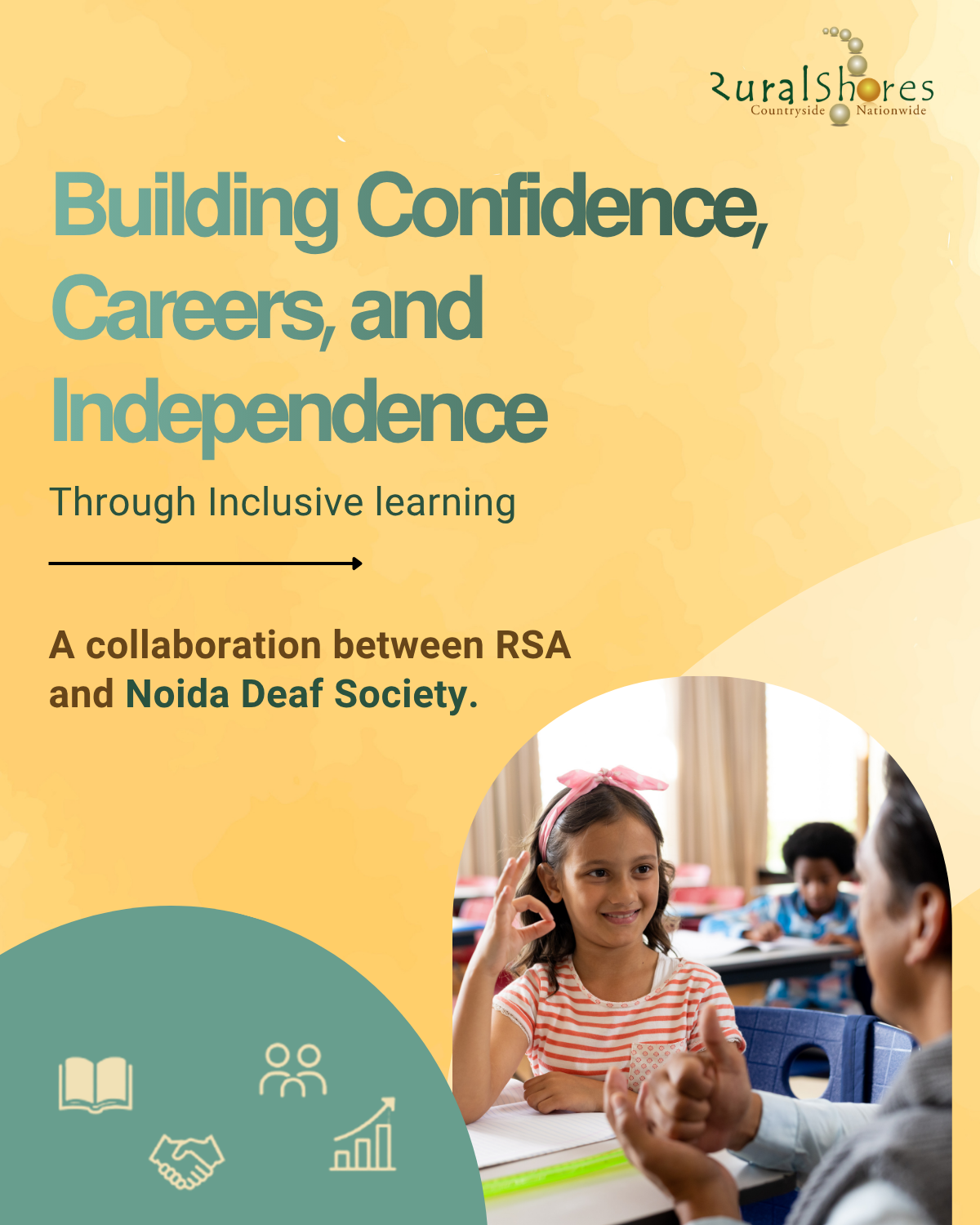
These learners were never asking, “Can we do this?”
They were already proving, “Yes, we can.”
A classroom was filled with activity.
One group was solving NCERT Maths questions.
Another was practicing English communication through visual interactions.
A few learners were working on vocational tasks and digital activities with complete focus.
There was no loud discussion.
No constant chatter.
But there was learning everywhere.
People assume deaf learners need lower expectations.
What they actually need is a classroom designed for them to succeed.
These were dedicated sessions for deaf and hard-of-hearing learners conducted through the collaboration between RuralShores Skills Academy and Noida Deaf Society.
And the energy inside the classroom was impossible to ignore.
One learner shared something during an interaction that stayed with the trainers:
“People think we cannot do much.
But we also want careers, confidence, and independence.”
This is what inclusion looks like when it’s not about sympathy – but about real opportunity.”
That is why the learning approach focused on both academics and employability.
Learners were being trained in:
- NCERT Maths, English, and Science
- Vocational and digital skills
- Workplace communication
- Practical assignments
- Application-based learning
- Confidence-building activities
And slowly, something powerful became visible.
Learners who initially hesitated during sessions started participating actively.
Some developed strong problem-solving abilities.
Some became highly confident in practical tasks.
Some started expressing ideas more independently through visual and activity-based learning.
Because when learning becomes accessible, practical, and outcome-oriented, confidence grows naturally.
And confidence changes everything.
It changes how learners see themselves.
How families see their potential.
And how society sees employability.
One of the most powerful realizations from these sessions was this:
Deaf learners do not need lower expectations.
They need learning environments designed to help them succeed.
They need opportunities.
Exposure.
Practical learning.
And people who believe in their abilities before judging their limitations.
Because inclusion is not about making learners fit into traditional systems.
It is about building systems where every learner gets the opportunity to grow with dignity, confidence, and independence.
And perhaps the most inspiring part?
They were never asking: “Can we do this?”
They were already showing: “Watch us.”
Let’s create more accessible and outcome-driven learning opportunities together.
Authored by: Neha Babbar