

Most CEOs believe culture is shaped by strategy.
Employees experience it through behaviour.
A company can spend months defining its values, refining policies, and discussing culture in leadership meetings.
Yet a single interaction between a manager and an employee can reinforce those values or completely undermine them.
That’s because workplace culture isn’t built during annual offsites, leadership retreats, or town halls.
It’s built in everyday moments.
How leaders respond to mistakes.
Whether effort is recognized.
Whether employees feel heard.
Whether people are treated with respect when no one is watching.
For CEOs and founders, culture is not an HR initiative.
It is a business advantage.
It influences retention, engagement, innovation, customer experience, and ultimately business performance.
Because employees don’t experience culture through policies.
They experience it through everyday leadership behaviours.
The good news?
Some of the most meaningful culture shifts do not require large budgets or complex initiatives.
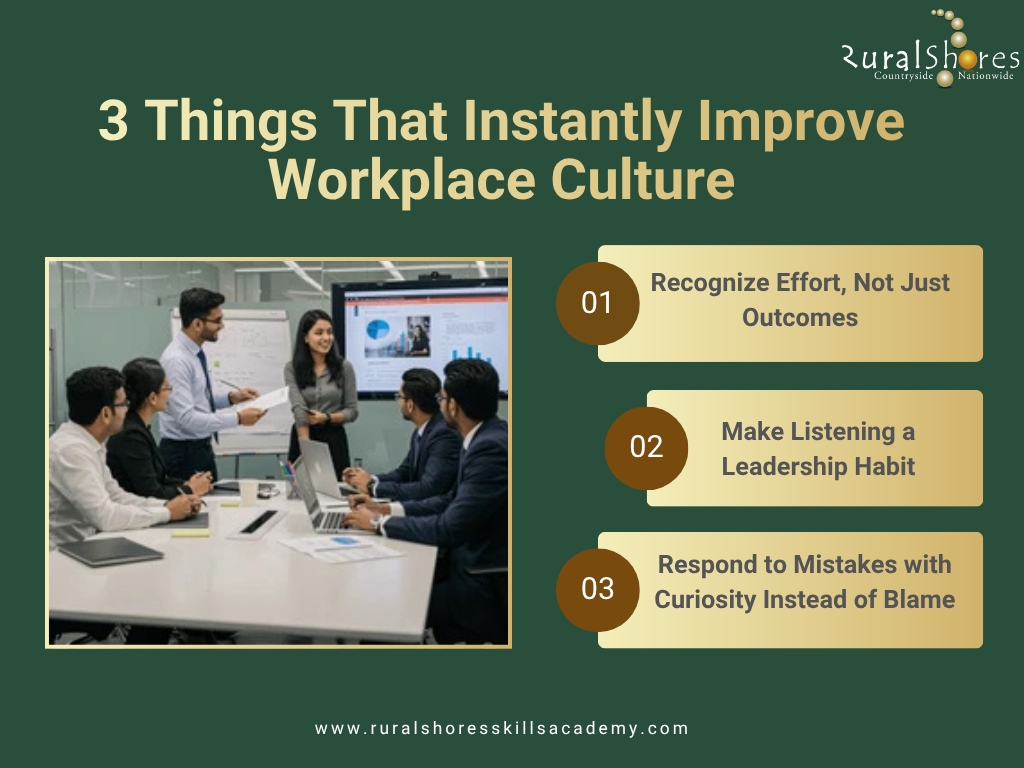
They begin with three simple leadership behaviours.
1. Recognize Effort, Not Just Outcomes
Most organizations celebrate results.
Targets achieved.
Projects completed.
Revenue generated.
These achievements deserve recognition.
However, strong cultures also recognize the behaviours that create those outcomes.
Effort.
Initiative.
Learning.
Collaboration.
Ownership.
When recognition is reserved only for results, employees often become more focused on avoiding failure than pursuing improvement.
Over time, this discourages experimentation and innovation.
Leaders who acknowledge effort and growth send a different message.
Progress matters.
Learning matters.
People matter.
And when people feel valued, they are more likely to contribute their best work.
Consider two managers.
One only recognizes employees when targets are achieved.
The other regularly appreciates initiative, collaboration, and continuous improvement, even before results become visible.
Over time, the second manager doesn’t just build motivation.
They build a team that is more willing to take ownership, support one another, and contribute new ideas.
That’s how strong workplace cultures are built.
One conversation at a time.
2. Make Listening a Leadership Habit
Many leaders believe they are approachable.
Far fewer employees feel heard.
One of the fastest ways to strengthen workplace culture is to improve the quality of listening.
Employees do not expect leaders to have every answer.
They do expect their perspectives to be considered.
Simple questions such as:
“What do you think?”
“What are we missing?”
“How would you approach this?”
can completely change the quality of workplace conversations.
When people feel heard, they become more engaged.
When they become more engaged, they take greater ownership.
And ownership is one of the strongest drivers of performance.
The most trusted leaders are not always the most charismatic.
They are often the ones who listen best.
In our experience working with learners, trainers, and organizations, we’ve observed that people rarely expect every idea to be accepted.
They simply want to know their voice was heard.
That distinction often determines whether people disengage or become deeply invested in the organization’s success.
3. Respond to Mistakes with Curiosity Instead of Blame
Culture reveals itself most clearly when things go wrong.
When a mistake occurs, leaders typically respond in one of two ways.
“Who is responsible?”
Or:
“What can we learn from this?”
The difference is profound.
The first creates fear.
The second creates growth.
Employees who fear blame tend to hide problems, avoid difficult conversations, and become less willing to take initiative.
Employees who feel safe discussing mistakes help organizations learn faster, solve problems sooner, and improve continuously.
Accountability remains essential.
But accountability and blame are not the same thing.
High-performing cultures maintain standards while creating opportunities for learning.
Why These Behaviours Matter
Culture is often treated as something abstract.
In reality, culture is the sum of daily experiences.
Employees decide every day whether they feel trusted, respected, and valued.
Those experiences influence whether they stay, contribute ideas, collaborate effectively, recommend the organization to others, and go the extra mile when it matters most.
Many leaders search for large-scale solutions to culture challenges.
Yet culture is often shaped by seemingly ordinary moments.
A manager recognizing effort.
A leader listening carefully.
A team learning from mistakes rather than hiding them.
These moments may seem small.
Collectively, they define the employee experience.
Looking Ahead
As AI continues to transform the workplace, human leadership will become even more valuable.
Technology can automate tasks.
AI can generate information in seconds.
But it cannot build trust.
It cannot create psychological safety.
It cannot make an employee feel genuinely heard, respected, or valued.
Those remain leadership responsibilities.
Organizations that create environments where people feel respected, empowered, and encouraged to contribute will continue to attract, retain, and inspire great talent.
The future belongs not only to organizations with the best technology, but also to those with cultures that bring out the best in people.
Final Thought
The strongest workplace cultures rarely emerge from grand initiatives.
They emerge from consistent leadership behaviours repeated every day.
A leader who listens.
A manager who recognizes effort.
A team that learns from mistakes instead of hiding them.
These moments may seem small.
Yet they shape how people think, collaborate, perform, and grow.
In a world where technology, products, and processes can be replicated, culture remains one of the few competitive advantages that is difficult to copy.
At RuralShores Skills Academy, we’ve seen that meaningful workplace cultures aren’t transformed by a single workshop or policy.
They evolve through small, consistent behaviours practiced every day by leaders, managers, and teams.
Every conversation.
Every piece of feedback.
Every response to a challenge.
Together, they define the culture people experience.
If you could change just one leadership behaviour in your organization tomorrow, what would it be?
Share your thoughts in the comments. We’d love to hear your perspective.
Authored by: Sonal Arora