

In many organizations, teams are constantly busy.
Calendars are full. Meetings continue throughout the day. Tasks are moving across dashboards. Updates are shared regularly.
From the outside, it looks productive.
But being busy and being productive are not always the same thing.
Real productivity happens when teams are clear about priorities, aligned towards outcomes, and confident in execution. And that shift often depends on leadership.
Over time, some leadership practices consistently help teams perform better — not by increasing pressure, but by creating clarity and focus.
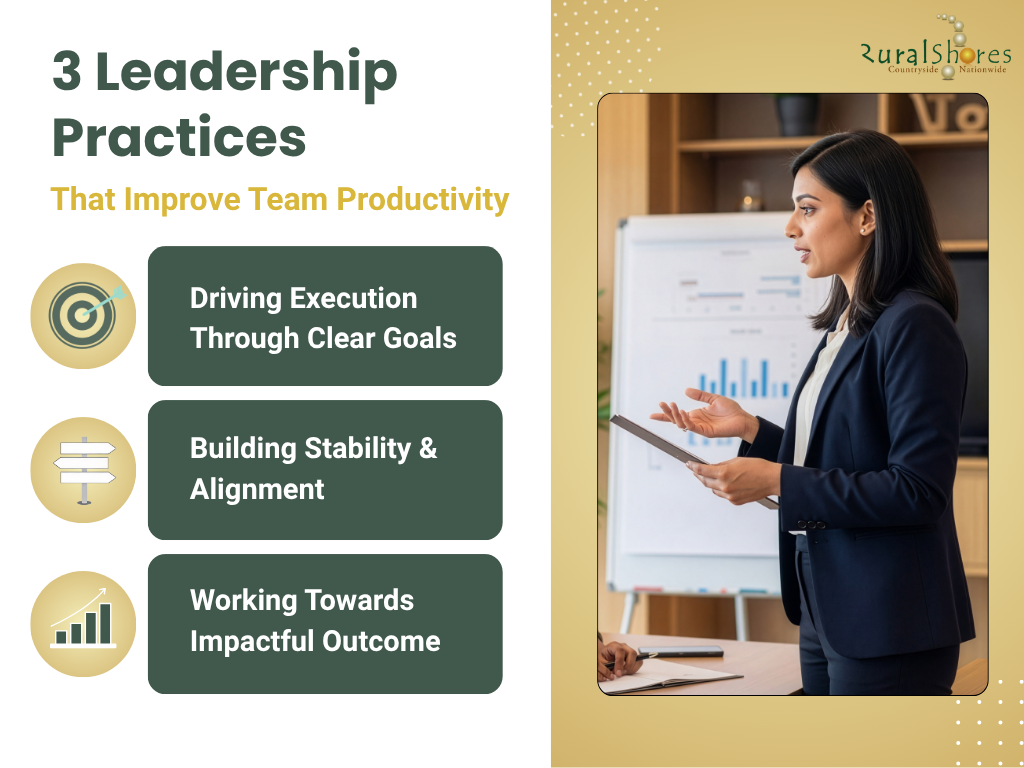
1. Defining Clear Outcomes Instead of Just Assigning Tasks
Many leaders assign work efficiently, but high-performing leaders go one step further: they define the outcome clearly.
Instead of saying:
“Finish this report.”
They explain:
“What decision will this report help us make?”
That small shift changes how teams approach work.
Gallup research has consistently shown that employees perform better when expectations are clear. When people understand the goal behind the task, they make better decisions independently and work with greater ownership.
Clarity reduces confusion, unnecessary revisions, and duplicated effort. It also improves confidence because teams know what success actually looks like.
The strongest teams are rarely the ones doing the most work.
They are usually the ones working towards the clearest outcomes.
2. Creating Stability and Consistent Direction
Fast-moving organizations often face changing priorities. That is natural.
However, when priorities shift too frequently, teams struggle to build momentum. They spend more time adjusting than executing.
Strong leaders create consistency even in fast-paced environments. They help teams understand:
- What matters most right now
- What can wait
- What success will look like this quarter or this month
For example, imagine a team beginning the week focused on improving customer delivery timelines. Midweek, attention suddenly shifts towards presentations and internal reporting. By the end of the week, neither goal gets completed properly.
This is not a capability issue. It is usually a prioritization issue.
Teams perform better when leaders protect focus.
Consistency builds trust in execution. It helps employees spend more time solving problems and less time second-guessing direction.
3. Working Towards Impactful Outcomes
Modern workplaces often reward visible activity:
- Long working hours
- Constant meetings
- Fast replies
- Busy schedules
But activity alone does not create business impact.
Some of the most effective teams are not the busiest teams. They are the most intentional teams.
McKinsey studies have highlighted that organizations improve operational productivity when they focus on continuous improvement, meaningful performance systems, and measurable outcomes rather than superficial activity tracking.
This means leaders should focus more on questions like:
- Did the work improve customer experience?
- Did it solve a business problem?
- Did it move the team closer to a measurable goal?
When teams are evaluated based on impact rather than busyness, work becomes more thoughtful, collaborative, and efficient.
The Leadership Shift That Changes Productivity
Productive teams are not built through pressure alone.
They are built through clarity, consistency, and meaningful direction.
The best leaders create environments where people understand priorities, take ownership, and know how their work contributes to larger goals.
Because productivity improves when leaders stop asking:
“Is everyone busy?”
and start asking:
“Are we moving towards meaningful results?”
That is the shift that turns activity into progress.
Call To Action :
If this resonated with you, share it with a leader or manager who is working on building a more focused and outcome-driven team.
For more insights on leadership, productivity, and workplace learning, follow along and stay connected.
Authored by: Neha Babbar