

In a business environment characterized by automation, regulatory scrutiny, and rapid pace, the maker-checker framework emerges as a distinctive approach.
Originally rooted in banking and finance, this system ensures that no single person controls a process end-to-end - one individual creates (maker), and another independently reviews (checker). It was built to prevent fraud and enforce compliance.
Originally developed in the banking and finance sector, the maker-checker principle was built to uphold accuracy, integrity, and accountability in decision-making. It’s true essence lies not in control, but in ensuring every process achieves its intended purpose — delivering the right outcome, the right way. By embedding structured review and validation at key stages, organizations move beyond mere task completion to true process excellence — where every action contributes to the larger strategic goal. In today’s complex, fast-paced business environment, this principle extends far beyond compliance — it’s about building systems that think, verify, and improve continuously.
But in today’s dynamic business environment, the principle extends far beyond governance.
Review, accountability, and continuous improvement – the core maker-checker values – must now be embedded across industries, not just compliance-heavy sectors.
Whether you run a manufacturing unit, a shared services center, or a digital-first operation, these principles are essential to scale with quality, minimize errors, and build organizational resilience.
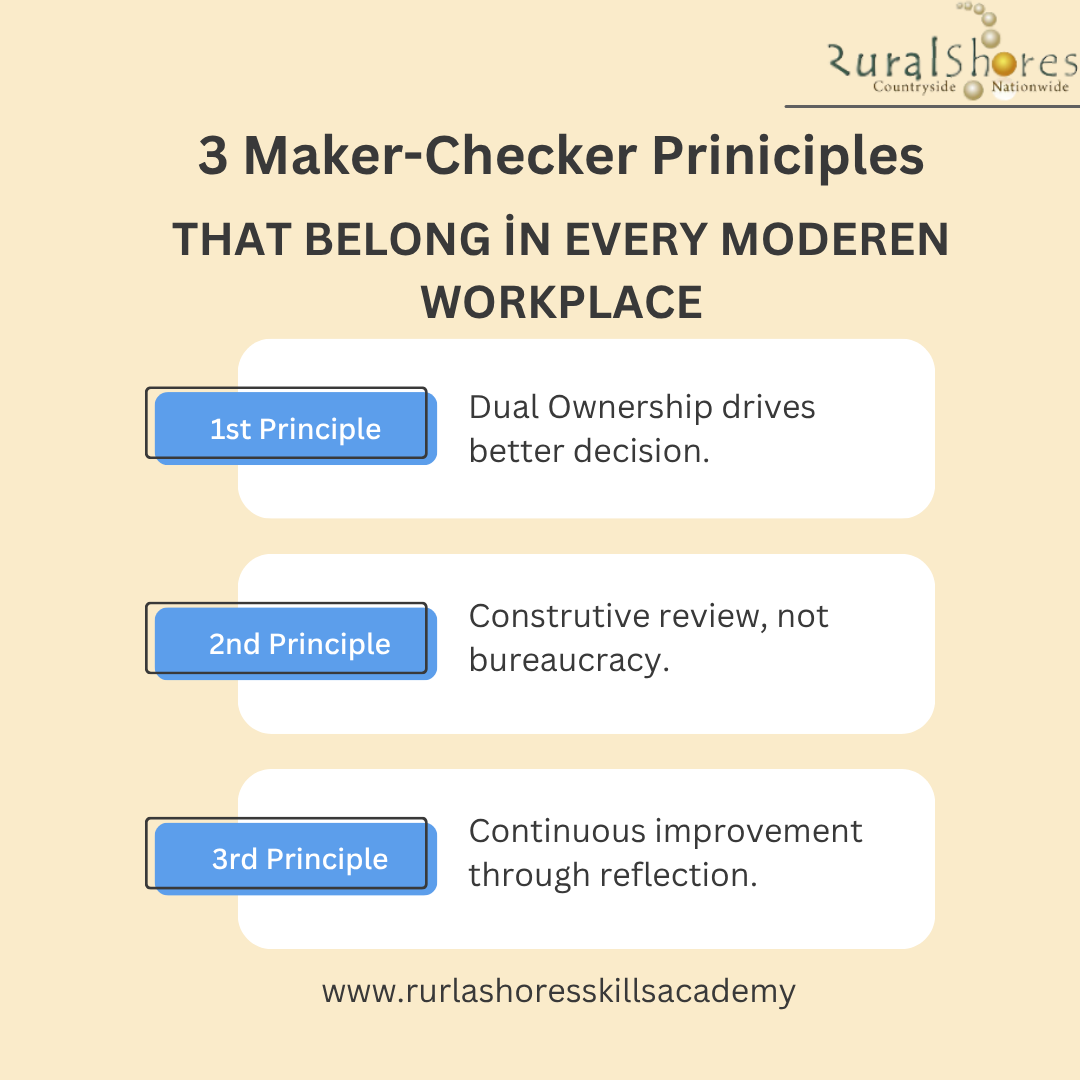
1️. Dual Ownership Creates Scalable Accountability
In high-performing organizations, ownership isn’t about doing everything yourself – it’s about building systems that hold everyone accountable.
The maker-checker principle formalizes this by introducing dual ownership of quality.
The maker-checker principle brings dual ownership of quality, raising the likelihood of outcomes coming out right – every time.”
When one team executes and another independently reviews, blind spots reduce dramatically. According to a 2024 PwC report, companies with structured peer-review or maker-checker mechanisms experience 37% fewer process errors and 28% higher compliance accuracy than those relying solely on self-verification.
Example: Operational Excellence in Logistics
A large Indian logistics company handling 25,000 daily shipments implemented a maker-checker validation in its dispatch operations.
Previously, the same person created shipment manifests and verified route entries – leading to frequent mismatches. After assigning a checker role:
- Data accuracy improved from 91% to 99.3% in three months.
- Rework time dropped by 42%, saving nearly ₹18 lakh annually.
- Client complaints on wrong deliveries fell by 60%.
Dual ownership doesn’t slow the process – it builds trust in every transaction.
It ensures decisions are validated, data is verified, and accountability is shared.
This principle is equally valuable in:
- Finance teams: Preventing payment duplication.
- Procurement: Ensuring vendor selection integrity.
- HR: Cross-verifying payroll or offer rollouts.
Wherever data meets decision-making, dual ownership strengthens the system.
2️. Constructive Review Is a Leadership Discipline, Not Bureaucracy
Many organizations fear that maker-checker systems create unnecessary red tape.
The truth? It’s not bureaucracy – it’s a culture of excellence.
When done right, review isn’t about catching errors; it’s about enhancing outcomes. A mature maker-checker setup treats the review process as a learning exchange - where the checker adds perspective, not punishment.
Mindset Shift: From Policing to Partnership
A report by McKinsey (2023) found that organizations where feedback is “development-oriented” rather than “defensive” have 30–50% higher process improvement rates.
In these workplaces, the maker-checker interaction becomes a micro-learning moment.
Instead of “Who made the mistake?”, leaders ask, “What did we learn here?”
Example: BPO Process Optimization
A major BPO handling insurance claims faced recurring rejections from the client due to missing fields in forms.
Initially, the checkers merely flagged the errors. The process remained stagnant.
Then, leadership changed the review design – checkers were trained to identify why errors occurred and to suggest process-level fixes.
Within two quarters:
- Error rate dropped by 48%.
- Average processing time per claim reduced by 18%.
- Employee satisfaction score rose by 23% because feedback became developmental, not disciplinary.
For CXOs, This Principle Means:
- Making review loops two-way - where makers can also give feedback on the process.
- Embedding structured checkpoints in workflows using digital tools (like Power Automate, Jira, or SAP Workflow).
- Measuring the value of review not by the number of errors found, but by how many were prevented or learned from.
Leaders must remember: a checker’s role isn’t to slow execution, but to elevate the standard.
When this mindset is institutionalized, review becomes a leadership discipline – not a procedural burden.
3️. Continuous Improvement: Turning Review Data into Business Intelligence
The third – and most strategic – maker-checker principle is continuous improvement.
A good review system doesn’t just approve work; it produces data.
And when analyzed, that data becomes a goldmine for process innovation.
Most organizations stop at the “check” stage. Great ones go a step further: they reflect, redesign, and retrain. This transforms maker-checker from a compliance tool into a strategic intelligence loop.
Example: Manufacturing Process Reinvention
A mid-sized automotive supplier in Pune applied maker-checker tracking to its assembly quality process.
They logged every review and reason for rework over six months – 14,000 entries.
Analysis revealed that 72% of recurring errors stemmed from unclear SOPs and inconsistent training, not operator negligence.
By redesigning documentation and introducing refresher training:
- Rework dropped by 36%.
- Machine downtime reduced by 22%.
- Client quality rating improved from 89% to 97%.
The takeaway?
Every maker-checker record is a feedback signal. Leaders who analyze those signals build systems that get smarter with every cycle.
How CxOs Can Embed Continuous Improvement:
- Digitize the Maker-Checker Trail:
Implement workflow tools that track review comments, approval timestamps, and rework reasons. These logs become powerful datasets for pattern recognition.
- Establish a Monthly “Process Intelligence Review”:
Instead of traditional audits, host cross-functional sessions to discuss what recurring maker-checker insights reveal.
- Link Reviews to Capability Building:
If 60% of review flags point to training gaps, it’s not a performance issue – it’s a learning opportunity. Redirect L&D focus accordingly.
The Data Advantage
According to Deloitte’s Global Human Capital Trends 2024 report, companies that integrate “feedback analytics” from operational review systems report:
- 41% faster process optimization cycles,
- 25% higher employee confidence in internal governance, and
- 2.2x better decision accuracy at the management level.
That’s not compliance. That’s strategy.
From Control Mechanism to Competitive Advantage
Traditionally, maker-checker was viewed as a control mechanism - a necessity in finance, audit, and compliance functions. But in 2025, it’s fast becoming a competitive advantage across industries.
Because when every process is validated, every outcome reviewed, and every insight looped back – you create an organization that learns faster than it fails.
And in volatile markets, learning speed is survival.
Industry Applications Beyond Compliance:
- Retail & E-commerce: Maker-checker in pricing approvals and SKU launches reduces pricing discrepancies and protects brand integrity.
- Healthcare: Dual review in patient data entry improves accuracy rates by up to 35%, reducing claim rejections and malpractice risks.
- IT & SaaS: Code reviews function as maker-checker equivalents, reducing post-release bugs by 50–60% in agile environments.
- Education & Training: Peer review of assessments ensures fairness and consistency, especially in scalable digital learning models.
The lesson:
Maker-checker is no longer a regulatory checkbox. It’s an operational mindset for sustainable growth.
Conclusion
The maker-checker principle may have been born in compliance, but its destiny lies in culture.
In a world where automation accelerates execution, human review and accountability remain the ultimate differentiators.
Review keeps your operations sharp.
Accountability keeps your teams aligned.
Continuous improvement keeps your business future-ready.
These three principles don’t just prevent errors – they build resilience, transparency, and trust, the currencies of modern leadership.
So, whether you’re leading manufacturing lines or digital operations – it’s time to stop seeing maker-checker as a “checklist.”
Start seeing it as your organizational operating system.
Written By: Abhinav Bajaj