

As organizations grow, leaders face a challenge that no amount of personal effort can solve: the inability to scale themselves.
In the early stages of a business, founders and leaders often stay close to every decision, approval, and problem. Teams move quickly because leaders are directly involved in execution. However, as the organization expands, this model becomes unsustainable. Decisions slow down, bottlenecks emerge, and teams become dependent on management for even routine actions.
Many leaders respond by increasing reviews, adding more reporting layers, or becoming more involved in day-to-day operations. While these actions may create short-term control, they rarely create long-term ownership.
The organizations that scale successfully operate differently. They build teams that make decisions, solve problems, and drive results without waiting for constant instructions.
This does not happen by accident.
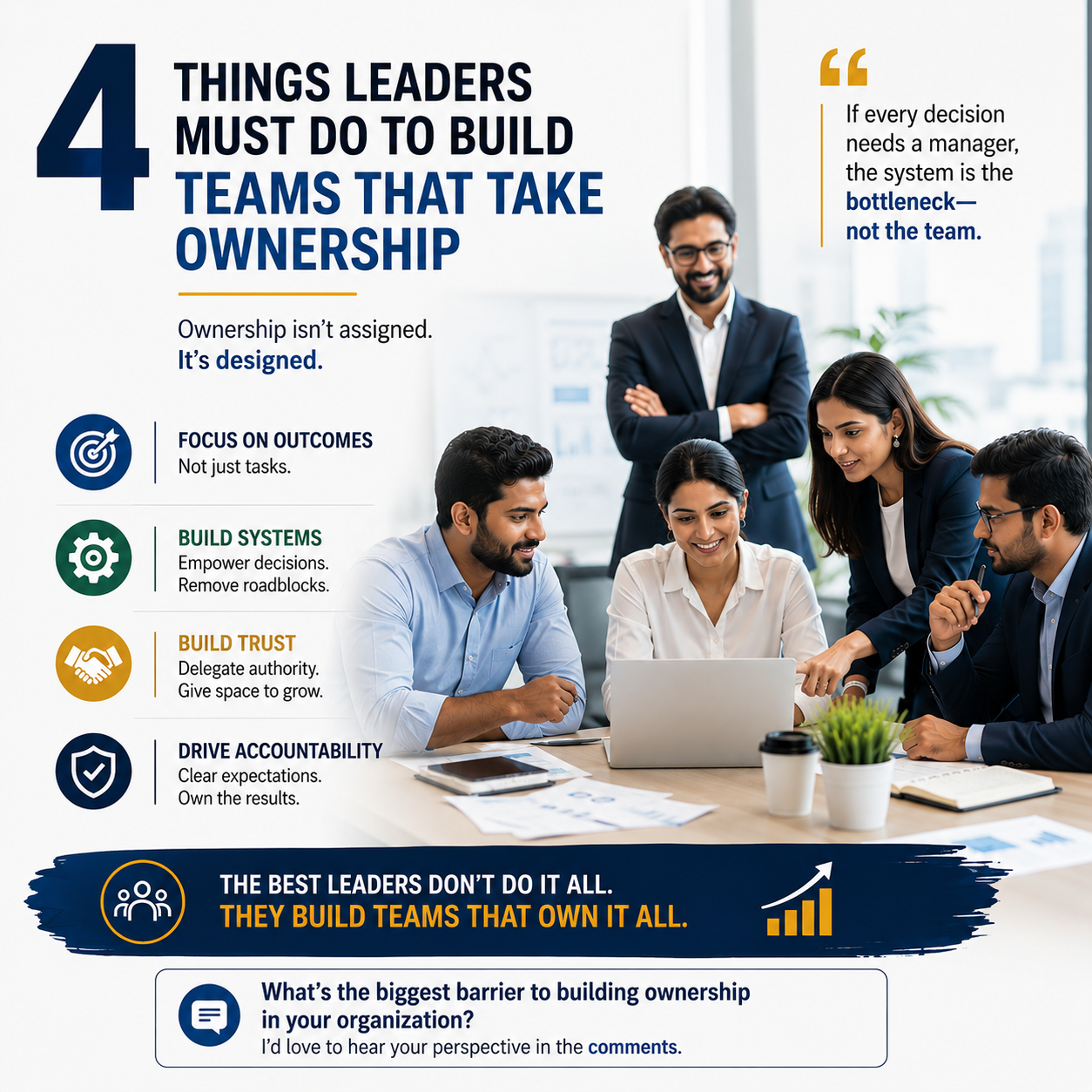
True scale happens when responsibility shifts from leaders to teams. Ownership is not assigned-it is designed through systems, trust, and accountability structures.
For CEOs, Business Heads, HR Leaders, and Delivery Heads, the question is no longer how to supervise more effectively, but how to create an environment where teams take responsibility naturally.
Here are four things leaders must do to make that happen.
1. Define Outcomes, Not Just Tasks
Many teams struggle with ownership because they are trained to execute instructions rather than achieve outcomes.
When leaders assign tasks such as “prepare the report,” “visit the client,” or “launch the campaign,” employees focus on completing activities rather than delivering results. The responsibility remains with the leader because the team only owns execution, not success.
Ownership begins when people understand the outcome they are responsible for creating.
A sales manager should not simply be asked to conduct customer meetings; they should own revenue targets and customer growth. A delivery manager should not only track timelines; they should own customer satisfaction and delivery quality.
When teams understand the “why” behind their work, they begin making decisions independently because they are guided by objectives rather than instructions.
Leaders who consistently define outcomes create teams that think, prioritize, and solve problems without requiring continuous intervention.
Leadership Actions:
- Clearly define success metrics for every role and project.
- Focus conversations on outcomes rather than activities.
- Measure impact, not effort alone.
- Ensure every employee understands how their work contributes to business goals.
Teams cannot own what they do not clearly understand.
2. Build Systems That Support Independent Decision-Making
Ownership often fails not because people lack capability but because organizations lack clarity.
Employees hesitate to make decisions when approval processes are unclear, escalation paths are confusing, or decision-making authority is poorly defined. In such environments, asking the manager becomes the safest option.
Over time, leaders unintentionally become operational bottlenecks.
High-ownership organizations solve this problem through systems rather than supervision.
They define who owns decisions, where decisions can be made independently, and when escalation is necessary. Employees know the boundaries within which they can operate confidently.
This creates speed without sacrificing accountability.
Strong systems do not reduce empowerment; they enable it.
The goal is not complete autonomy without oversight. The goal is decision-making within clearly defined frameworks.
Leadership Actions:
- Establish decision rights across teams and functions.
- Create clear escalation and approval guidelines.
- Document processes that remove ambiguity.
- Reduce unnecessary approval layers that slow execution.
If every decision needs leadership approval, ownership has not yet moved to the team.
3. Build Trust Before Demanding Ownership
One of the most common leadership mistakes is expecting ownership while continuing to micromanage execution.
Ownership and micromanagement cannot coexist.
Employees are unlikely to take responsibility if they believe every decision will be questioned or reversed. In such environments, people naturally shift into compliance mode. They do what is asked, avoid risks, and wait for instructions.
Trust changes that behavior.
When leaders demonstrate confidence in their teams, employees become more willing to take initiative and accept responsibility for outcomes.
Trust does not mean the absence of reviews or accountability. It means allowing teams the space to make decisions, experiment, and learn from mistakes within reasonable limits.
Leaders often say they trust their teams, but their actions communicate otherwise through constant follow-ups, excessive approvals, and unnecessary involvement in execution details.
Teams notice the difference immediately.
Trust is built when leaders delegate authority alongside responsibility.
Leadership Actions:
- Delegate decisions, not just tasks.
- Encourage initiative even when approaches differ from your own.
- Support learning from mistakes instead of punishing every failure.
- Resist the urge to step in unless intervention is truly necessary.
People take ownership when they feel ownership has genuinely been given to them.
4. Create Strong Accountability Structures
Trust without accountability creates confusion.
Accountability without trust creates fear.
High-performing organizations combine both.
Ownership becomes sustainable when expectations, measurements, and review mechanisms are clearly defined. Employees should know exactly what they own, how success will be measured, and how progress will be reviewed.
Importantly, accountability should focus on outcomes rather than blame.
The purpose of accountability is not to identify mistakes after they occur. It is to create visibility, encourage ownership, and enable course correction before problems become larger.
Regular business reviews, performance dashboards, and transparent metrics help teams monitor themselves instead of depending entirely on leadership oversight.
When accountability structures are strong, supervision naturally decreases because teams have visibility into their own performance.
The most scalable organizations are often those where employees hold themselves accountable before leaders need to intervene.
Leadership Actions:
- Define ownership for every deliverable and decision.
- Establish transparent performance metrics.
- Conduct regular review discussions focused on learning and improvement.
- Encourage peer accountability within teams.
People perform differently when ownership is visible and measurable.
The Shift Leaders Must Make
Leadership in growing organizations requires a fundamental shift in mindset.
Early-stage leadership is often about solving problems personally.
Scaled leadership is about building systems that allow others to solve problems consistently.
The transition is difficult because direct involvement creates a sense of control. However, organizations that depend heavily on a few leaders eventually hit growth limits. Decisions slow down, leaders become overwhelmed, and teams stop taking initiative.
The organizations that continue to grow successfully are those where ownership exists at every level.
In these organizations:
- Teams make decisions confidently.
- Managers focus on coaching rather than controlling.
- Leaders spend more time on strategy and less time on approvals.
- Accountability becomes part of the culture rather than a management process.
This is where true organizational scale begins.
Final Thoughts
Building teams that take ownership without constant supervision is not about finding exceptional employees who naturally behave like owners.
It is about creating an environment where ownership becomes the easiest and most logical way to work.
Leaders who want scalable organizations must move beyond supervision and focus on designing the conditions that encourage responsibility.
That means:
- Defining outcomes instead of tasks.
- Building systems that support decisions.
- Creating trust through delegation.
- Establishing strong accountability structures.
Organizations do not scale because leaders work harder.
They scale because teams become capable of carrying responsibility independently.
True scale happens when responsibility shifts from leaders to teams. Ownership is not assigned-it is designed through systems, trust, and accountability structures.
Authored by: Abhinav Bajaj