

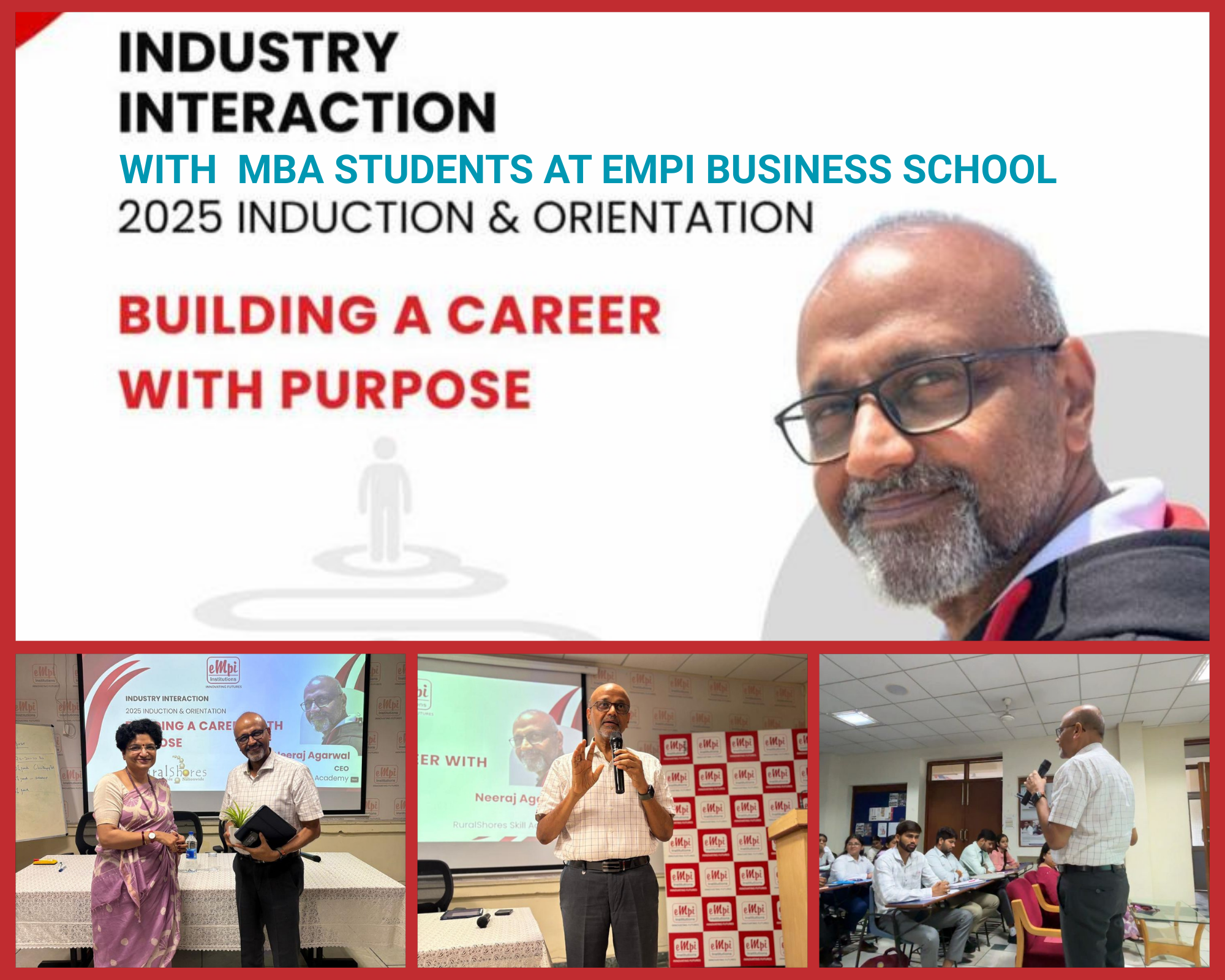
Reflections from a session with MBA freshers at EMPI Business School – 6th August 2025
By Neeraj Agarwal
Earlier this month, I had the privilege of addressing the fresh MBA cohort at EMPI Business School. Stepping into that hall, I was instantly reminded of my own journey—four decades of experimenting, stumbling, discovering, and building. From IIT Delhi to leading mission-driven ventures, it’s been a ride shaped not by one grand plan, but by moments of learning, people who inspired me, and purposeful action.
With only an hour to share insights that took me 40 years to earn, I distilled my thoughts into five key principles that could help these students build not just careers—but careers with purpose.
1. Purpose Is Not Found. It’s Built.
Many of us wait for that mythical “aha!” moment when purpose strikes like lightning. But in real life, purpose is built step by step—through actions, mistakes, reflection, and growth.
I started my journey as a Mechanical Engineer, working in factories and sales. Then moved into corporate training. None of these roles were labelled “purpose-driven.” But each taught me something. Eventually, I discovered that my true fulfilment came from enabling others to learn and grow. That led me to launch an NGO within a multinational company, and later, drive RuralShores Skills Academy.
Message to students: Don’t wait to “find” your purpose. Get moving. Reflect daily on what energizes you, what drains you, and where you can make a difference.
2. Know Thyself First: Unpack Your Unique ‘Why’ and Strengths
Too often, students enter MBA with career goals like “becoming a CXO” or “getting into consulting.” But without clarity on your own values, motivators, and strengths, these goals are hollow.
What helped me was asking: What legacy do I want to leave behind?
Once I reframed success from titles to impact, I started focusing on solving problems I cared about—like employability for underserved youth.
Tip: Take time during your MBA to explore your personal “why.” Tools like CliftonStrengths, VIA Survey, or even regular journaling can help uncover your real drivers. *(read more at end)
3. Purpose-Driven Careers = Strengths × Passion × Opportunity
This is the formula I shared with the students:
Career Purpose = What You’re Good At × What You Love × Where the World Needs It
For me:
- My strengths: understanding people, designing learning systems, building trust
- My passion: solving skilling problems at scale
- The world’s need: youth employability and field force capability
The magic lies in the overlap.
4. Follow the 70-20-10 Rule for Career Growth
In my experience, the most valuable learning didn’t come from books. It came from:
- 70%: Challenging, stretch assignments (like cracking a new tech product no one else wanted to touch)
- 20%: Learning from mentors, colleagues, and feedback
- 10%: Formal training
Lesson: Don’t shy away from difficult roles. They may not be glamorous, but they grow you fast.
5. Contribution > Designation
Real career success is not the title on your LinkedIn profile. It’s the value you create and the lives you impact.
I’ve seen people chase promotions only to feel empty at the top. Meanwhile, others in modest roles who drive change—whether for customers, communities, or teams—feel deeply fulfilled.
Success = Contribution + Growth + Joy
Further Insight: Opportunity is Everywhere (But Not Always Obvious)
Whether you’re in a large corporation, startup, non-profit, or government—opportunities to build purpose are all around you. But they aren’t obvious. You need what I call an “Opportunity Radar.”
- Stay alert.
- Talk to people outside your field.
- Notice problems that keep showing up—and that frustrate you.
I started a rural employability project while working in a corporate L&D role. A friend in logistics created a green supply chain initiative within his startup. Impact can be found anywhere.
Final Word to Students
Your MBA is not just a step up in your career. It’s a chance to pause, reflect, and redesign your life.
Don’t just chase what looks good on paper. Build something that feels good in your heart, uses your true strengths, and solves real-world problems.
Your purpose is waiting—not out there, but within you.
*Background notes:
1. Clifton Strengths (formerly StrengthsFinder)
What it does:
- Identifies your top 5 (or all 34) natural talent themes out of 34 possible.
- These themes are grouped into four domains: Executing, Influencing, Relationship Building, and Strategic Thinking.
Why it’s useful for MBA students:
- Helps you understand how you naturally think, feel, and behave—so you can build your career around those.
- Often used in leadership development, career planning, and team building.
Example:
If your top strengths include “Strategic,” “Learner,” and “Relator,” you might thrive in roles that involve solving complex problems while collaborating with people you trust, and constantly improving.
Where to take it:
- Paid tool offered by Gallup: https://www.gallup.com/cliftonstrengths
2. VIA Character Strengths Survey
What it does:
- Measures 24 universal character strengths, like Curiosity, Honesty, Leadership, Gratitude, and Perseverance.
- Tells you which values and behaviors are most core to your identity.
Why it’s useful for MBA students:
- It connects your career not just to your skills, but to your values and motivations—which are central to purpose.
- Often used in positive psychology, personal growth, and coaching.
Example:
If your top strengths are Creativity, Social Intelligence, and Fairness, you might be fulfilled in roles where you innovate and influence ethically in a team setting—like social entrepreneurship or HR strategy.
Where to take it:
- Free version available at: https://www.viacharacter.org
How to Use These Tools in Your Career Planning-
| Tool | Helps You Discover | Use For |
| Clifton Strengths | Natural talents & behaviours | Career fit, team roles, leadership style |
| VIA Survey | Core values & inner motivators | Purpose alignment, meaningful work, culture fit |