

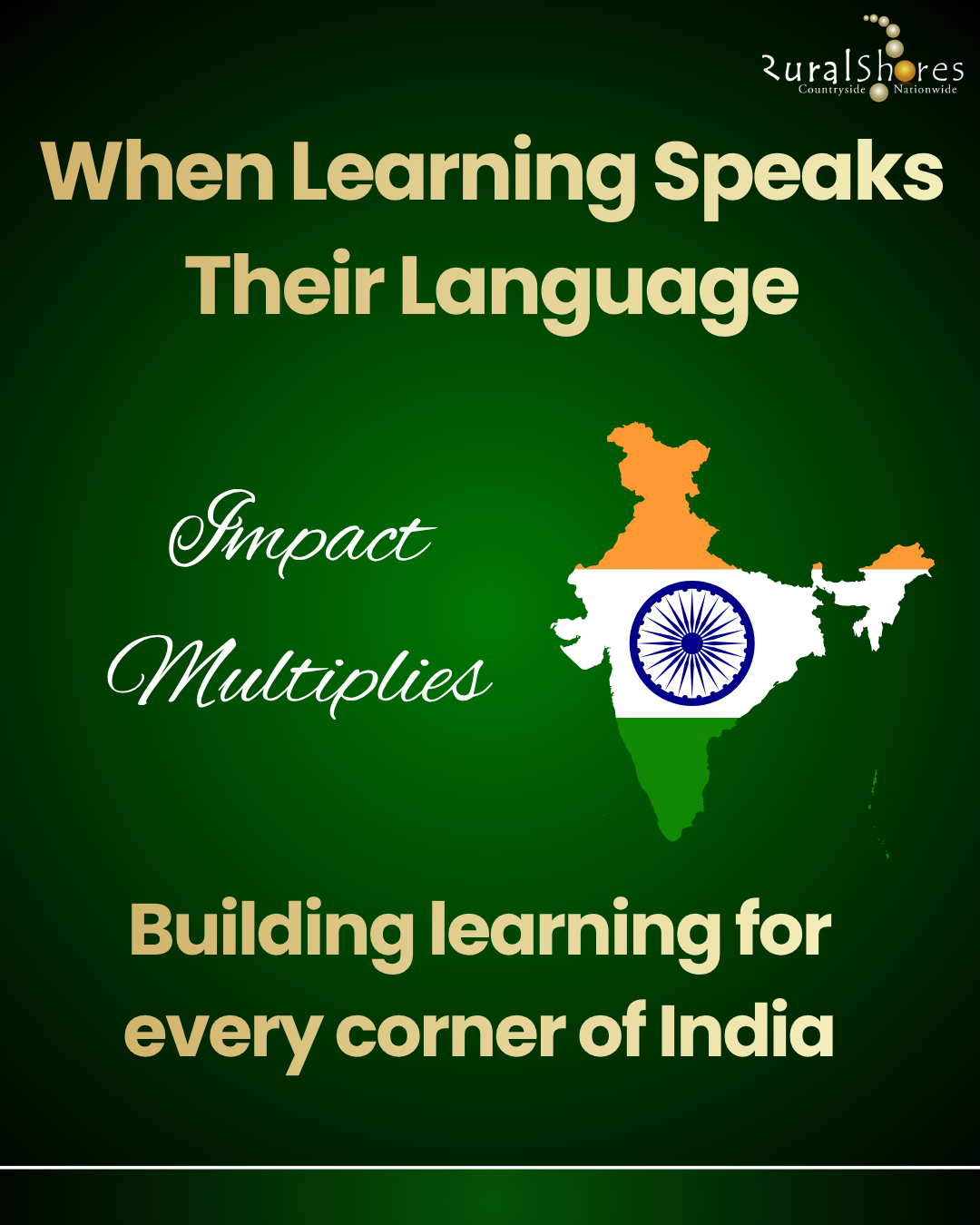
Can digital learning truly scale in India without losing local relevance?
That question has shaped our journey more than any technology choice or content strategy.
Because in India, scale is not the challenge.
Relevance at scale is.
At RuralShores Skills Academy, our e-learning journey began as a pilot in 2023. What started as an experiment has now grown into 13 e-learning projects across 8 Indian languages, with a potential reach of over 30 million learners.
But the real story is not the scale.
It is the shifts in thinking that got us here.
Shift 1: From Translation to Contextual Design
One of our early beliefs was simple:
If we translate content into local languages, learning will improve.
That assumption did not hold.
We realized that translation ensures access, not understanding.
What actually drives learning is:
- Local examples
- Familiar situations
- Cultural alignment
- Real-world relevance
This changed our approach completely—from building multilingual content to designing context-first learning experiences.
Shift 2: From Tool-Centric to Design-Led Thinking
In the beginning, we invested heavily in platforms and digital tools.
But engagement did not improve the way we expected.
The turning point came when we simplified our process:
Listen first. Design second. Develop third.
Every course started being shaped by:
- Root cause analysis of learner challenges
- SME-driven insights
- Audience realities in rural and semi-urban India
- Application-based design thinking
We also structured learning into three levels:
- Level 1: Guided interaction and basic understanding
- Level 2: Scenario-based decision-making
- Level 3: Simulation and real-world problem solving
What we realized was clear:
Technology delivers learning. Design determines impact.
Shift 3: From Individual Effort to System-Driven Collaboration
As scale increased, complexity increased faster.
We discovered that quality does not break in content—it breaks in coordination.
This led us to build a structured ecosystem:
- 50+ translators
- 20+ voice artists
- SMEs across domains
- Designers, reviewers, and project managers working in sync
And a structured three-layer review model:
- Peer review for clarity and structure
- Manager review for learning alignment
- SME review for accuracy and relevance
This brought one critical realization:
Scale in e-learning is not a production challenge. It is a systems challenge.
Shift 4: From AI Hype to Human–AI Balance
AI quickly became part of our workflow:
- Faster content creation
- Voice AI for multilingual scalability
- Automation of repetitive tasks
- Faster iteration cycles
But we also saw its limits very clearly.
AI cannot:
- Understand learner realities in depth
- Design meaningful learning experiences
- Replace SME judgment
- Capture cultural nuance
So our approach became balanced:
AI improves speed. Humans define meaning.
The strongest learning experiences still depend on instructional intent and contextual understanding.
Shift 5: From Delivery Metrics to Demand Signals
Some of our most impactful programs include:
- Financial Literacy
- BYOB (Build Your Own Business)
- Employability programs
- Corporate learning such as “Gen AI Essentials for Working Professionals”
But the most meaningful validation was not internal metrics.
It was external demand:
- Courses being requested in multiple languages
- Schools recommending programs organically
- Communities sharing learning experiences
- Repeat institutional partnerships
This led to a simple realization:
When learners ask for the same course in another language, impact is already proven.
From Pilot to 10 Million Learners
We did not start with scale as the goal.
We started with a problem:
How do we make digital learning meaningful in diverse Indian contexts?
Scale followed—but only after relevance was solved.
And along the way, one idea became clear:
India does not need more digital content.
It needs:
- Context-aware design
- Strong instructional thinking
- Deep multilingual integration
- Learning that reflects real life
The Road Ahead
The future of e-learning in India will not be defined by platforms or tools.
It will be defined by a simple question:
Does learning still feel local when it becomes digital?
Because when learning loses context, it loses impact.
But when learning speaks the learner’s language—culturally and practically—it becomes transformation.
LinkedIn Version (Rewritten)
From Pilot to 10 Million reach: What We Learned About Building E-Learning That Actually Works in India
Can digital learning truly scale in India without losing local relevance?
That question shaped our journey from a pilot in 2023 to 30 million learners today.
What began as an experiment has grown into:
✔ 13 e-learning projects
✔ 8 Indian languages
✔ 50+ translators
✔ 20+ voice artists
✔ Large-scale adoption across institutions
But the real story is not scale.
It is the shifts in thinking that made it possible.
Shift 1: From Translation to Context
Learning impact comes from relevance, not just language.
Shift 2: From Tools to Design
Technology enables learning. Instructional design drives outcomes.
Shift 3: From Individual Work to Systems
Scale depends on structured collaboration across teams.
Shift 4: From AI Adoption to AI Balance
AI increases speed, but human expertise defines learning quality.
Shift 5: From Metrics to Demand
The strongest validation is when learners request the same course in multiple languages.
Our programs include:
• Financial Literacy
• BYOB (Build Your Own Business)
• Employability training
• Corporate learning programs like “Gen AI Essentials for Working Professionals”
The journey from a pilot to 30 million learners has reinforced one belief:
E-learning in India succeeds only when it stays locally meaningful at scale.
Not just translated.
Not just digitized.
But truly contextual.
Authored by: Neha Babbar