

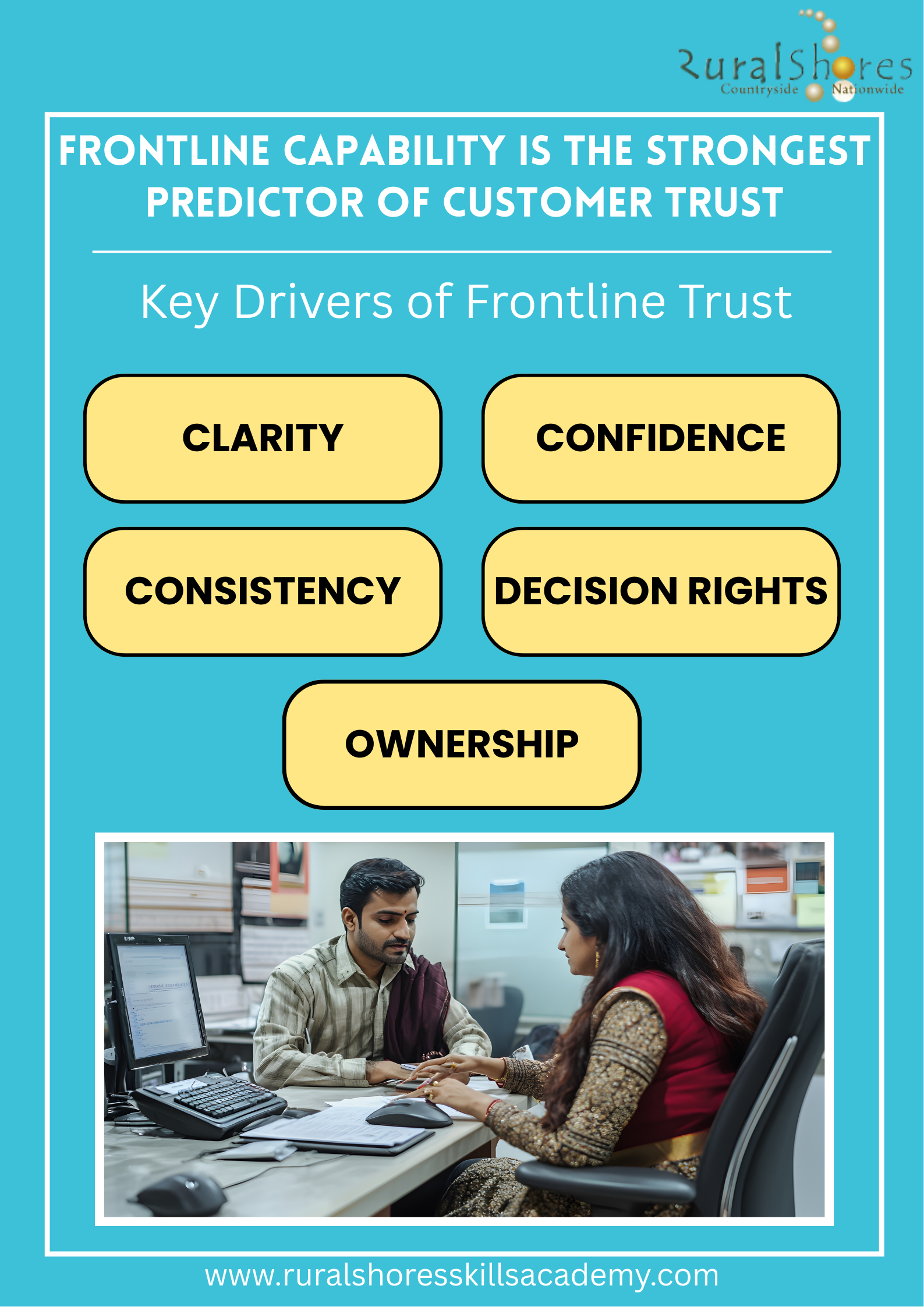
A customer walks into a bank branch at 4:57 PM on a Friday.
His salary was debited. The merchant wasn’t paid. His rent is due in two hours.
He says quietly,
“I can’t afford this to be stuck. I’ve never missed a payment before.”
The relationship manager checks the system.
Status: Processing – pending reversal.
No SLA. No clear timeline. No easy answer.
This is the moment where trust is decided.
She could deflect.
She could escalate blindly.
She could blame the system.
Instead, she says:
“This is on us. Here’s what happened, what I can do in the next 10 minutes, and what I will personally track for you.”
She explains the failure in plain language, raises a priority ticket, calls the backend team while he stands there, and writes down a follow-up timeline with her name on it.
The transaction resolves the next morning.
But the trust decision was made in three minutes.
As one frontline manager later put it:
“We’re not afraid of angry customers. We’re afraid of not knowing what we’re allowed to do when the system fails.”
Customers Don’t Experience Organizations. They Experience People.
For most customers, an organization is not its leadership team, strategy deck, or brand promise.
It is the person they interact with when something matters.
In services, retail, and BFSI, trust is built – or destroyed – at the frontline.
Trust is formed in high-stakes moments:
- A billing discrepancy
- A delayed delivery
- A rejected transaction
- A service breakdown
In these moments, customers subconsciously ask one question:
“Does this organization know what it’s doing?”
The answer depends almost entirely on frontline capability.
Research from McKinsey & Company consistently shows that the majority of customer perception is shaped by frontline interactions and service experiences rather than product features or pricing alone. One poor interaction can undo years of brand investment.
The 3 Drivers of Frontline Trust
Trust at the frontline is not abstract. It is operational.
It is built on three repeatable drivers:
1) Clarity
Can the frontline explain what happened and what will happen next?
Confusion signals incompetence – even when systems fail.
2) Confidence
Does the frontline project control over the situation?
Hesitation erodes trust faster than bad news.
3) Consistency
Does the customer get the same quality of response across branches, agents, and channels?
Variance feels like unreliability.
When clarity, confidence, and consistency show up under pressure, trust is created even in failure.
The Hidden Cost of Weak Frontline Capability
When frontline capability is thin, organizations see predictable outcomes:
- Inconsistent service across locations and channels
- Longer handling times and repeat contacts
- Escalations that pull leaders into avoidable issues
- Compliance breaches in regulated environments
- Silent churn, where customers leave without complaining
Acquiring a new customer costs 5-7× more than retaining one.
Yet most trust erosion happens quietly – one interaction at a time.
Industry Reality Checks
BFSI: Where One Sentence Can Trigger a Regulator
In BFSI, trust is not a brand attribute.
It is a risk control mechanism.
Nearly 1 in 3 complaints stem from miscommunication, not product flaws.
When charges, exclusions, or eligibility are poorly explained, customers assume intent long before they assume incompetence.
One frontline compliance lapse can trigger audits, penalties, and reputational damage far beyond the transaction value.
Organizations that invest in scenario-based compliance and communication capability report:
- 20-30% fewer escalations
- 15-25% improvement in renewals
- Lower audit observations
In BFSI, frontline capability protects both trust and the balance sheet.
Retail: The Brand Isn’t Your Logo – It’s Your Variance
A customer gets confident guidance in one store and confusion in another.
The product is the same.
The price is the same.
Trust is not.
73% of customers switch brands after just two poor experiences.
In large retail chains, inconsistency across stores is one of the biggest drivers of negative brand perception.
Retailers that standardize frontline behaviors see:
- 10-15% uplift in repeat purchases
- Higher basket sizes
- Fewer complaints and refunds
In retail, every frontline interaction either compounds brand investment – or quietly cancels it.
Services: The Hidden Margin Leak Is Decision Quality
In services, the frontline is the product.
Up to 40% of escalations are preventable with better first-contact handling.
Frontline teams often oscillate between escalating too early and overcommitting – both destroy trust and margin.
Each unnecessary escalation costs 3-5× more than a standard resolution.
Organizations that build decision frameworks and role-readiness see:
- 25-35% improvement in First Contact Resolution
- Lower handling times without sacrificing quality
- Faster CSAT and NPS uplift
In services, frontline capability is a structural margin lever.
Capability, Not Motivation, Is the Real Gap
Frontline employees are rarely disengaged by choice.
They are disengaged by uncertainty.
They silently ask:
- What do I say when this goes wrong?
- How far can I go without escalation?
- How do I stay compliant and human at the same time?
Without structured capability, people improvise.
Improvisation creates inconsistency.
Inconsistency erodes trust.
Structured Capability Makes Trust Predictable
Organizations that treat frontline capability as a system – not a one-time training – see:
- Confident, consistent customer handling
- Fewer escalations and complaints
- Stronger compliance
- Higher repeat business and lifetime value
- Brand credibility built through experience, not advertising
Trust becomes operational, not aspirational.
The Leadership Imperative
The real leadership question is not:
“Have we trained our people?”
It is:
“Have we built frontline capability that holds up under real customer pressure?”
In an AI-enabled, product-parity world, products will converge, pricing advantages will compress, and digital experiences will homogenize.
What will not commoditize is human judgment in moments of failure.
That is where trust is won.
That is where brands are truly differentiated.
That is where value is either protected – or silently destroyed.
The organizations that scale frontline capability with the same rigor they apply to technology, risk, and operations will win – quietly, consistently, and durably.
Because customers don’t trust organizations.
They trust the people who represent them.
In the end, trust is not built in strategy rooms.
It is built in three-minute conversations at 4:57 PM.
Authored by: Abhinav Bajaj