

Most organizations don’t have a training problem.
They have a leadership behavior problem.
Every year, companies invest heavily in learning and development. On paper, everything works. Programs are delivered. Completion rates are high. Feedback is positive.
In reality, very little changes.
Sales teams revert to old habits.
Managers continue to micromanage.
Customer experience remains inconsistent.
This is not a content issue.
It is a leadership issue.
Training doesn’t fail. The system rejects it.
The Real Problem Isn’t Capability. It’s Context.
Most CEOs assume that better learning leads to better performance.
It doesn’t.
Performance is shaped less by what people know, and more by the environment they operate in.
And that environment is defined by leadership.
Consider a typical sales training initiative.
A company invests in a strong program on consultative selling. Teams learn how to ask better questions, understand customer needs, and sell value instead of products.
During training, performance looks promising.
But back at work, managers continue to review:
- Call volumes
- Meeting counts
- Short-term targets
No one evaluates conversation quality.
No one reinforces the new behavior.
Within weeks, the team reverts.
Not because they didn’t learn.
Because the system didn’t allow them to apply it.
Organizations Are Optimizing Delivery. Not Adoption.
This is where most companies go wrong.
They invest in:
- Better content
- Better trainers
- Better platforms
But ignore the one thing that determines impact.
Adoption.
Research consistently shows that behavior change fails without reinforcement. Managers drive the majority of team engagement and performance, yet are rarely aligned or equipped to sustain change.
So training becomes an event. Not a lever for transformation.
How Leadership Quietly Kills Training Impact
Not intentionally. But consistently.
1. Misaligned Metrics
Leaders talk about quality, but measure quantity.
Teams follow metrics, not messaging.
2. No Reinforcement System
Training ends where it should begin.
No coaching. No structured follow-up.
3. Lack of Role Modeling
Leaders don’t demonstrate the behaviors they expect.
So teams don’t take them seriously.
4. Short-Term Pressure
Quarterly targets override long-term capability building.
Execution wins over evolution.
Same Training. Different Outcome.
Two organizations invest in identical customer service training.
One treats it as a workshop.
The other treats it as a system change.
The second organization:
- Trains managers to coach
- Redefines KPIs
- Reviews real interactions regularly
Within months, outcomes improve.
The difference is not learning.
It is leadership involvement.
The Shift CEOs Need to Make
If training is expected to deliver results, it cannot remain an L&D initiative.
It must become a leadership-owned system.
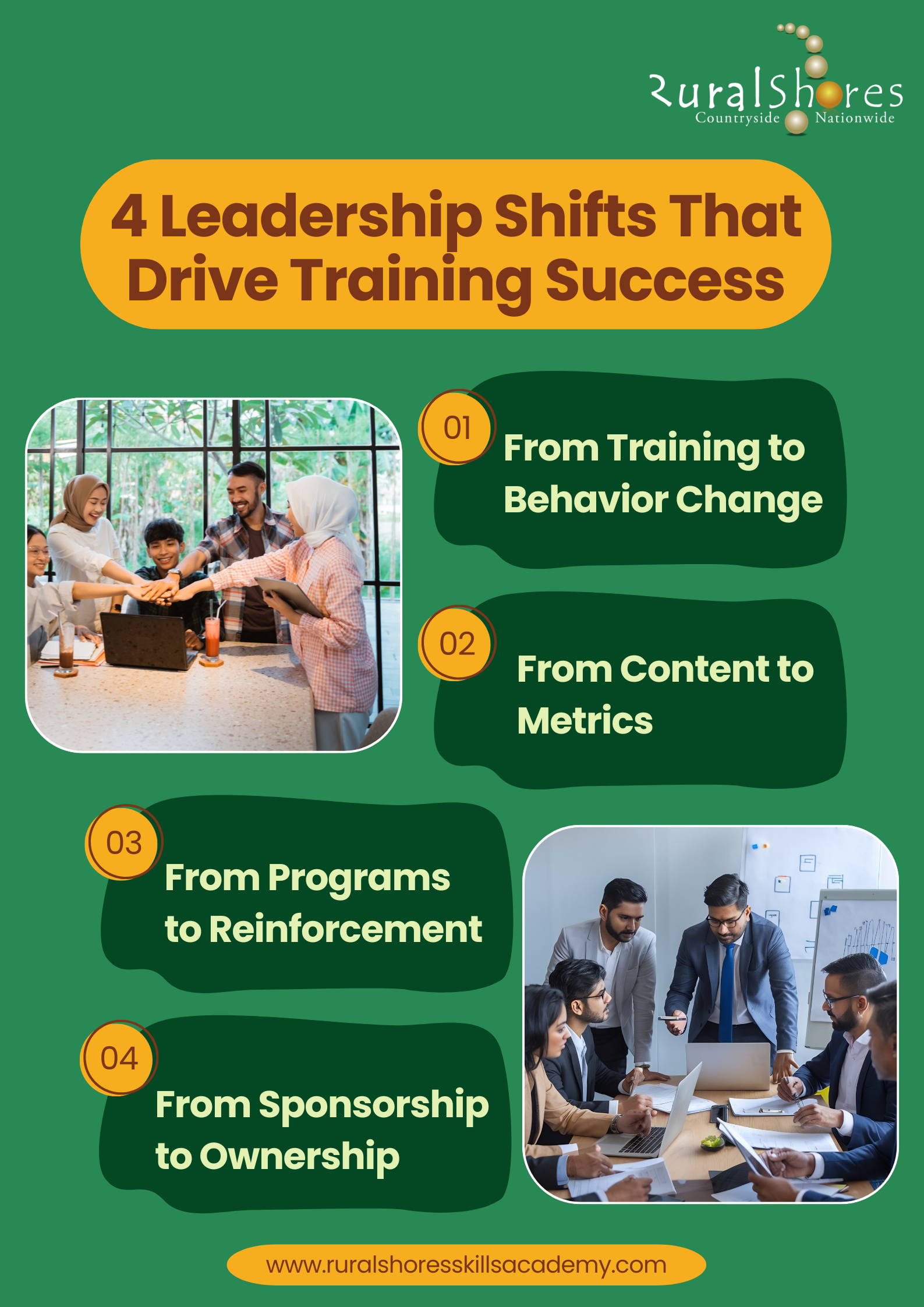
That requires four shifts:
1. From Training to Behavior Change
Define what must change on the ground. Not just what must be taught.
2. From Content to Metrics
Align performance systems with desired behaviors.
3. From Programs to Reinforcement
Build ongoing coaching and review mechanisms.
4. From Sponsorship to Ownership
Leaders must drive the change. Not delegate it.
The Real Role of a CEO
In most organizations, training is sponsored by leadership.
It is rarely driven by them.
That is the gap.
Because employees don’t follow training modules.
They follow leadership signals.
What leaders measure, review, tolerate, and reward ultimately defines behavior.
Final Thought
Organizations don’t change when people learn something new.
They change when leaders behave differently.
Until that happens, even the best training programs will continue to produce average results.
A Better Question to Ask
Instead of asking:
“Was the training effective?”
Ask:
“What did leadership do differently after the training?”
The answer to that question determines whether training was an expense.
Or an investment.
Authored by: Neha Babbar