

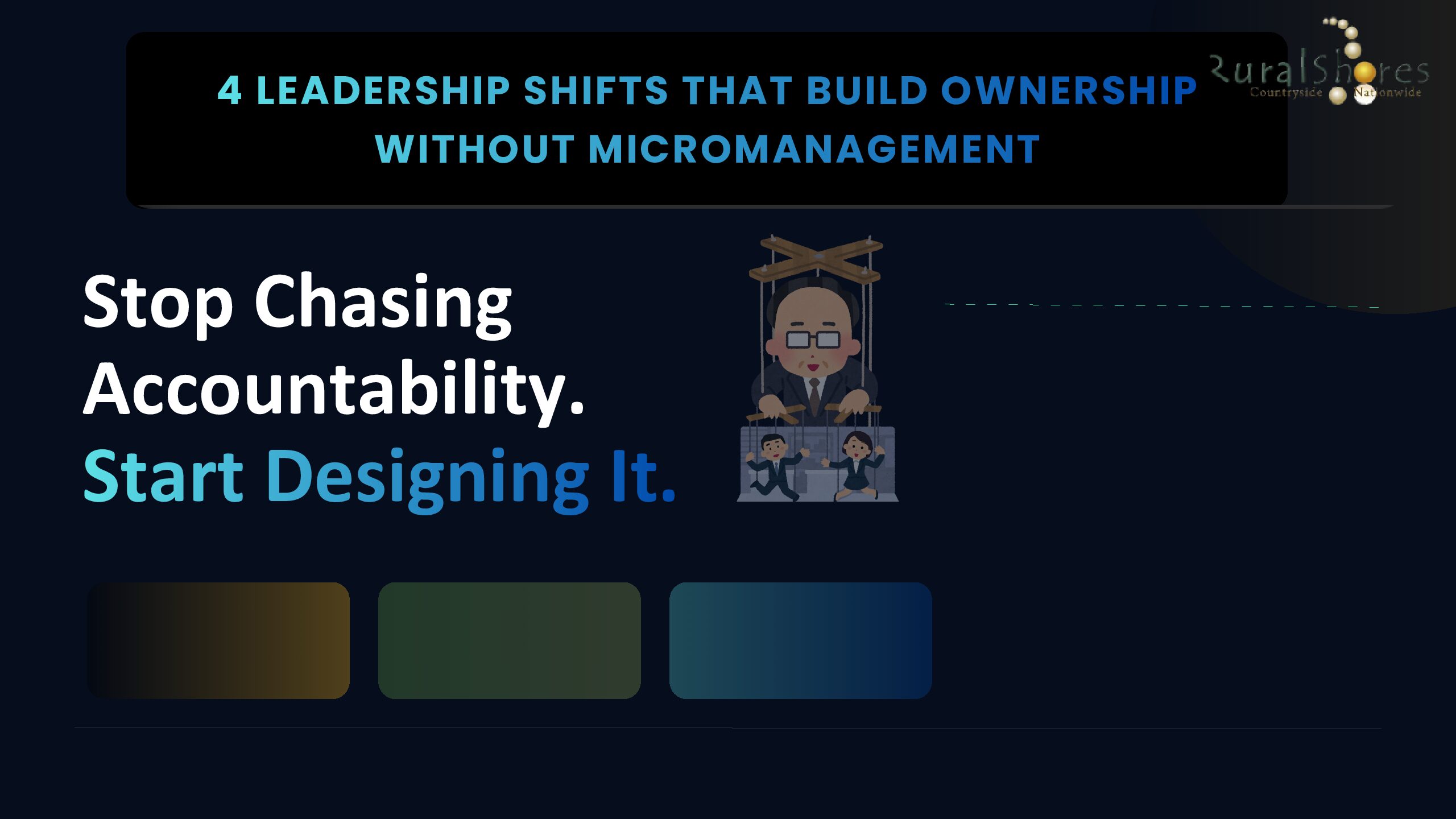
Why the Best Leaders Build Accountability Without Micromanagement
Every leader wants accountable teams.
Yet many unknowingly create the exact opposite.
More review meetings.
More approvals.
More status updates.
More follow-ups.
It feels like stronger leadership. In reality, it often creates dependence instead of accountability.
Over time, people stop making decisions. They wait for instructions, seek approvals for routine tasks, and hesitate to solve problems independently.
Not because they lack capability.
Because the system has taught them that accountability means checking with the manager first.
This is one of the biggest leadership paradoxes.
Accountability isn’t created through supervision. It is designed through clarity, ownership, and continuous feedback.
As organizations grow, this distinction becomes even more important. Leaders simply cannot scale themselves by becoming involved in every decision. Sustainable growth depends on building teams that know what they own, understand how success is measured, and feel empowered to act without waiting for permission.
So how do great leaders build accountability without resorting to micromanagement?
1. Replace Activity Monitoring with Outcome Ownership
One of the most common leadership mistakes is measuring effort instead of impact.
Managers often ask:
“Did you complete the report?”
“How many client calls did you make?”
“Did you finish the presentation?”
These questions focus on activity.
High-performing organizations ask different questions.
“Did the report help improve decision-making?”
“Did customer engagement increase?”
“Did the presentation achieve its objective?”
People naturally optimize for what leaders measure.
If you measure activity, teams become experts at staying busy.
If you measure outcomes, they begin making better decisions independently because they understand the result they are responsible for creating.
The shift from tasks to outcomes is where accountability begins.
2. Give Authority Alongside Responsibility
Nothing weakens accountability faster than assigning responsibility without decision-making authority.
Many employees hear:
“You’re responsible for this project.”
Followed immediately by:
“But check with me before making any major decisions.”
That isn’t accountability.
It’s dependency.
People cannot be expected to own results if they don’t have the authority to influence those results.
Clear decision boundaries allow employees to act confidently while still knowing when escalation is appropriate.
The goal isn’t unrestricted autonomy.
It’s empowered decision-making within clearly defined guardrails.
Responsibility without authority creates frustration.
Authority without accountability creates chaos.
Strong organizations design both together.
3. Replace Inspection Loops with Feedback Loops
Many organizations mistake accountability for constant monitoring.
Daily status updates.
Frequent follow-ups.
Lengthy review meetings.
These practices often create reporting cultures rather than learning cultures.
The best leaders spend less time asking,
“What’s the status?”
and more time asking,
“What’s getting in your way?”
That single shift changes the quality of every conversation.
Regular coaching, retrospectives, peer reviews, and constructive feedback encourage people to identify risks early, learn continuously, and solve problems before they become larger issues.
People improve faster through meaningful feedback than through constant inspection.
4. Make Accountability Part of the Culture, Not Just the Manager’s Job
Many organizations believe managers create accountability.
The strongest organizations build systems where teams hold themselves accountable.
Ownership is visible.
Success measures are transparent.
Responsibilities are clearly defined.
Progress is reviewed regularly.
When expectations are clear, accountability becomes a shared responsibility rather than something enforced from above.
The highest-performing teams don’t wait for managers to ask difficult questions.
They ask those questions themselves.
That’s when accountability becomes part of the culture.
The Leadership Shift
Leadership changes as organizations grow.
In the early stages, leaders solve problems personally.
As organizations scale, leaders must build systems that allow others to solve problems consistently.
This requires a fundamental shift in mindset.
Stop measuring presence.
Start measuring outcomes.
Stop approving every decision.
Start defining decision boundaries.
Stop relying on supervision.
Start designing accountability.
One of the biggest misconceptions in leadership is that accountability is a people problem.
More often, it is a systems problem.
When people lack clarity, authority, or timely feedback, accountability naturally weakens.
When those elements are intentionally designed, accountability becomes the easiest way to work.
Looking Ahead
As AI automates reporting, workflows, and routine management tasks, leadership will become less about checking activity and more about enabling better decisions.
Future-ready organizations won’t succeed because they have more dashboards.
They will succeed because they have stronger ownership, clearer expectations, and cultures where accountability is embedded into everyday work.
Technology can improve visibility.
Only leadership can create accountability.
Final Thoughts
The best leaders don’t spend their time chasing updates or following up on every task.
They build teams that know what success looks like, understand what they own, and have the confidence to act.
Because accountability isn’t something leaders demand.
It’s something they design.
When expectations are clear, decision rights are defined, and feedback flows continuously, accountability stops being a management process and becomes part of the culture.
That’s when organizations truly become scalable.
How has your organization built accountability without increasing supervision? What leadership practices have made the biggest difference?
Authored by: Sonal Arora