

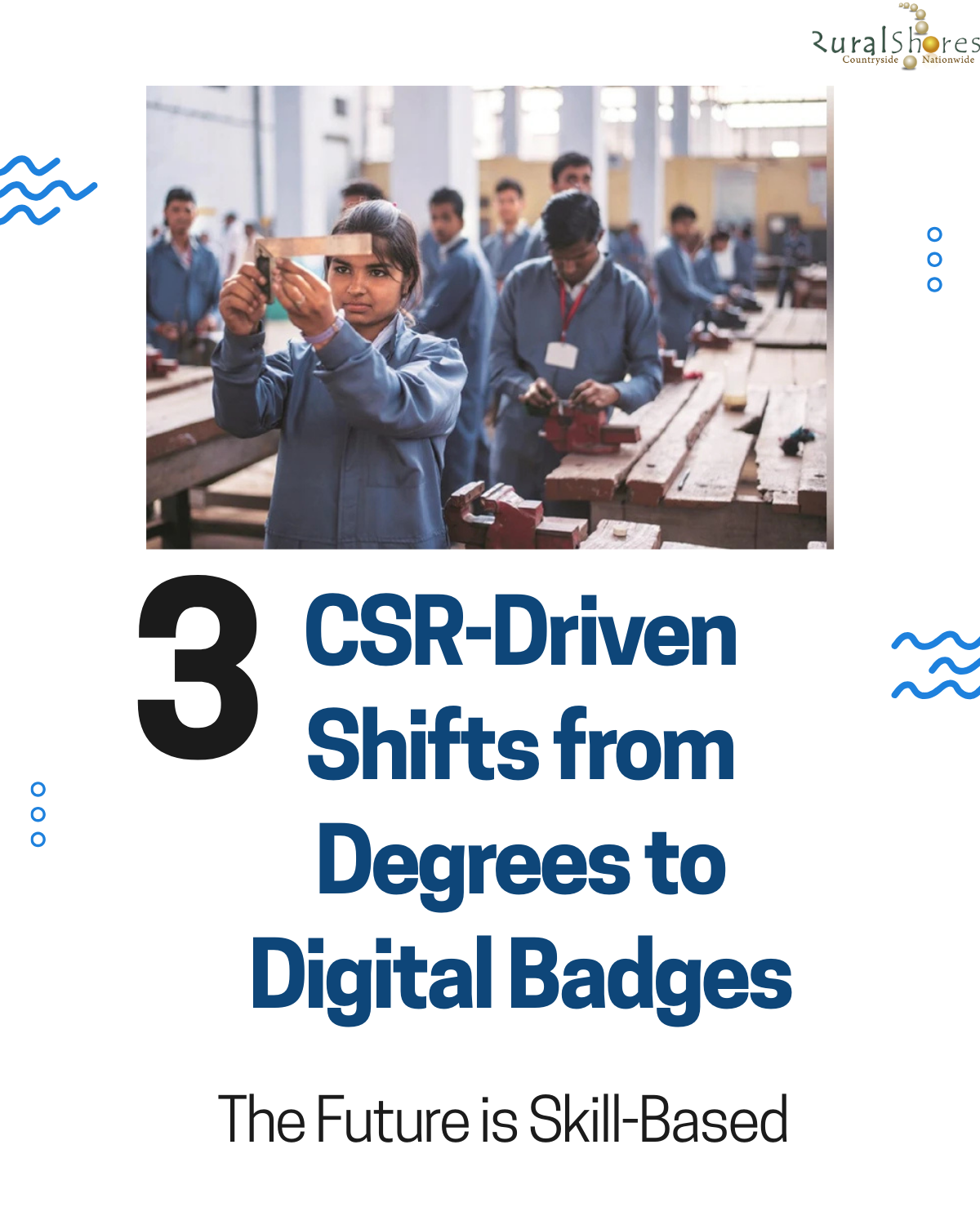
The traditional four-year degree, once the undisputed gold standard of employability, is experiencing a profound transformation. In an era demanding agility, specialized skills, and continuous learning, a new currency is emerging digital badges, micro-credentials, and skill-based signals. Interestingly, Corporate Social Responsibility (CSR) initiatives are accelerating this shift, connecting talent ecosystems with business transformation agendas.
Here are three CSR-driven shifts reshaping how we view skills and employability:
1. Broadening Access: The Equity Imperative
Traditional degrees often exclude talented individuals who lack access to formal education. Digital badges lower these barriers by focusing on specific, in-demand skills with less cost and time commitment. This opens doors to a broader, more diverse workforce.
The CSR Impact: RuralShores Skills Academy (RSA) is training underserved youth from rural India in digital courses, communication, and employability skills. Many of these young people cannot access formal college education, but through RSA’s CSR-backed programs, they now earn micro-credentials that signal job readiness. Importantly, these micro-credentials are not just gateways to entry-level roles; they also form building blocks for career progression, enabling learners to keep stacking skills, qualify for higher-responsibility roles, and move up the ladder over time. This means CSR is not just creating jobs but fostering long-term employability and growth pathways.
2. Investing in Lifelong Learning: The Sustainability Imperative
In a rapidly changing economy, the shelf-life of skills is shrinking. CSR demands a resilient, adaptable workforce. Digital badges support continuous upskilling and reskilling, keeping employees relevant.
The CSR Impact: RSA partners with corporate clients to align training with actual job roles like data entry, logistics or customer support, so learners graduate with skills that directly map to employability.
3. Enhancing Transparency: The Governance Imperative
Hiring based on degrees can lead to bias. Strong governance requires fair, transparent practices. Digital badges offer granular, verified proof of specific skills, reducing ambiguity and bias in recruitment.
The CSR Impact: Through RSA’s partnerships, a learner’s digital badge becomes more than a certificate, it’s a verified, industry-backed signal of employability. Importantly, RSA also facilitates direct placements, with more than 70% of participants placed in meaningful jobs. This closes the loop between training, validation, and workforce entry—delivering real impact for both youth and industry.
The Call to Action for Business Leaders:
The shift from degrees to digital badges isn’t a fad; it’s a fundamental recalibration of our talent ecosystem, powered by CSR. Leaders who embrace this change will:
- Access a broader, more diverse talent pool.
- Cultivate a resilient, continuously learning workforce.
- Build a more transparent and equitable organization.
At the same time, this transition is not without challenges; standardizing credentials, ensuring employer adoption, and validating badge quality are critical hurdles. Addressing this requires strong collaboration between corporates, CSR-driven institutions, and training partners like RSA.
It’s time to move beyond traditional gatekeepers and recognize the power of demonstrated skill. The future of work is not just educated—it is skilled, inclusive, and continuously evolving.
Collaborate with RuralShores Skills Academy (RSA) to co-create CSR-driven skilling and placement programs. Together, we can build pathways from training to jobs, empower rural youth with industry-ready credentials, and create measurable business and social impact.
Authored By Kavita Mawari