

I have spent the better part of three decades in the business of building human capability – first at one of India’s most respected education and training organisations, and for the last twelve years at RSA, where we work with youth who are trying to find their first real foothold in the economy. In that time, I have sat through hundreds of training program reviews, signed off on curricula that looked impressive on paper, and watched too many of them disappear without a trace into the daily noise of organisational life.
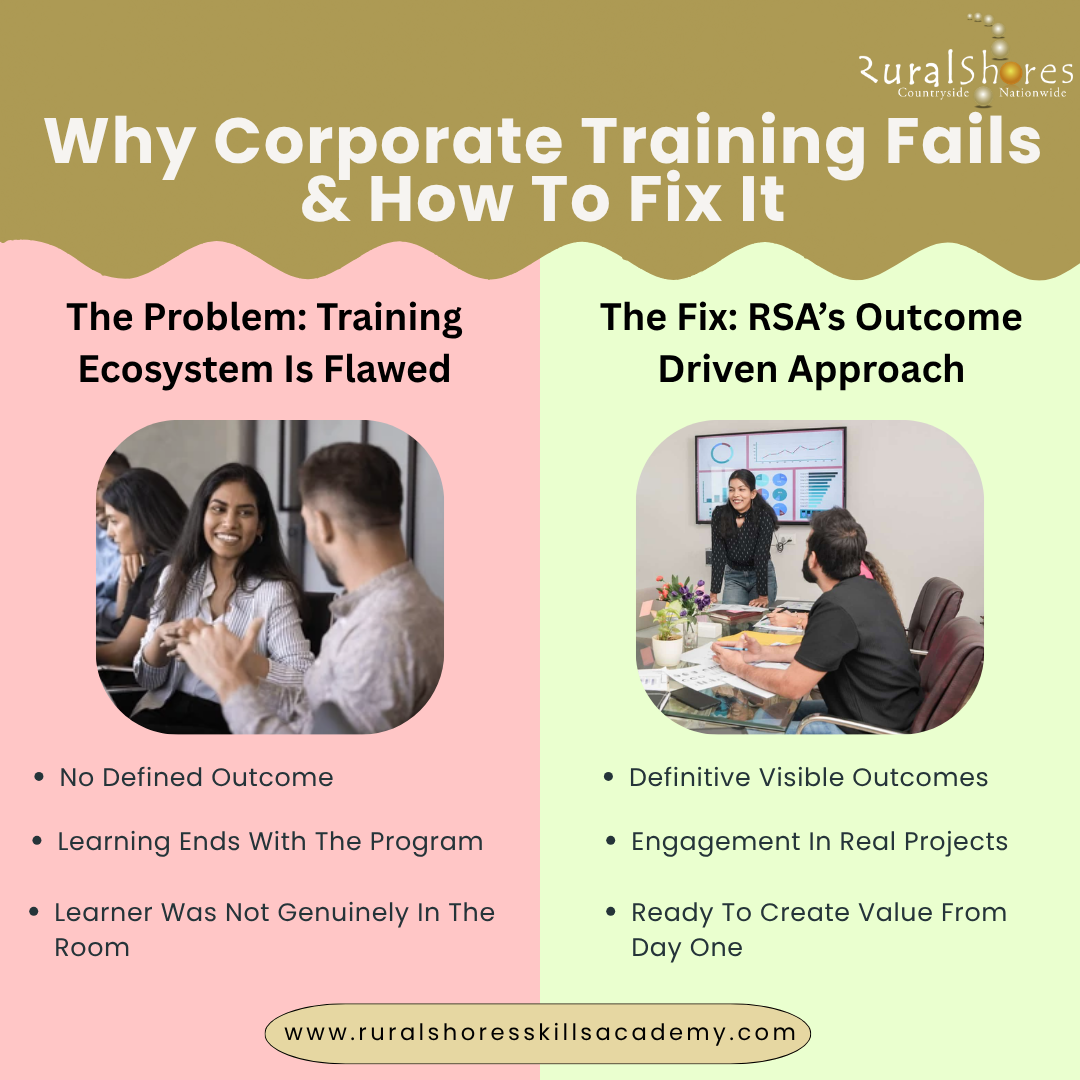
Let me be direct about what I have learned: most corporate training programs in India – whether run internally or by external agencies – are not failing because of bad content or incompetent facilitators. They are failing because of how they are designed, commissioned, and governed. And the organisations paying for them have largely stopped asking the right questions.
This is not a criticism from the outside. I have been on both sides of this table. I know what it looks like when a program is built to satisfy an annual training calendar rather than a business problem. I know what it feels like to present a ‘training impact report’ that is really just a collection of attendance numbers and participant satisfaction scores. And I know, with some discomfort, that for a portion of my earlier career, I contributed to that system.
What follows is what I now know to be true – and what the best organisations I have observed have quietly figured out.
THE FIRST FAILURE
Nobody defined what the training was supposed to change.
Every training program I have ever seen begins with good intentions. Leadership wants the sales team to sell better. HR wants managers to lead more effectively. Operations wants fresher hires to become productive faster. These are legitimate goals. But somewhere between the goal and the program design, something critical gets lost: the specific, measurable business outcome that the training is supposed to move.
Instead, what gets designed is a program. A number of days. A set of modules. A list of topics. A facilitator. A venue. And eventually, a certificate.
A program without a measurable destination is not a learning intervention. It is an event.
I remember reviewing a leadership development initiative – a well-funded, twelve-module program rolled out across an organisation’s middle management layer. When I asked the HR head what success would look like in six months, she said: ‘We want our managers to be more empowered.’ When I asked how we would know if that had happened, there was a pause. The honest answer was: we would not know. There was no metric. No baseline. No follow-up plan.
The program ran. The feedback forms were positive. The certificates were distributed. And eighteen months later, the same organisation was running the same program again, because – as the new HR head put it – ‘the previous one didn’t seem to stick.’
This is not an isolated story. It is the default. In most Indian organisations, training budgets are managed by HR, measured by hours delivered and attendance rates, and evaluated by something called a ‘participant satisfaction score’ – a form filled out at the end of a program by people who are relieved it is over. The business unit that would actually benefit from a behaviour change rarely owns the program. And without that ownership, there is no accountability for the outcome.
The fix is uncomfortable in its simplicity: before commissioning any training program, define one business number it is meant to move. Measure that number before the program starts. Measure it again ninety days after. Share the result with the business – not just HR. Make the learning team accountable to that number. Everything else follows from that.
THE SECOND FAILURE
The learning ends the moment the program does.
There is a well-established body of research on how adults retain and apply new skills. It is not flattering to the training industry. Within a week of a typical training program, participants retain perhaps half of what they were exposed to. Within a month, without reinforcement, that figure drops to below twenty percent. The forgetting curve is not a metaphor. It is a documented, predictable pattern that the training industry has known about for decades – and largely ignored, because the business model is built around delivery, not retention.
I have walked into organisations six months after a training intervention and asked frontline managers what they remember from the program their team attended. The honest ones tell me: very little. The polite ones say it was ‘useful at the time.’ Almost none of them can tell me how it changed the way their team works.
The real question is not what was taught. It is what changed in the workplace the Monday after.
The reason is structural. Most programs end at the closing slide. The participant returns to their desk. Their manager – who was not briefed on what the team learned and has no accountability for the on-job application – asks nothing. The performance management system continues rewarding the old behaviour. And the training, however well-designed, has no mechanism to survive contact with the real work environment.
The organisations that solve this do not buy better training. They redesign the conditions around the training. They build in a structured on-the-job phase – typically sixty to ninety days – with a specific task the participant must complete using what they learned. They brief the manager before the program, not after. They create a simple accountability loop: what did you try, what worked, what did not, what do you need next. None of this is expensive. All of it requires intentional design.
At RSA, this is not a principle we borrowed from a textbook. It is something we learned by watching what happened when we did not do it. Early in our work with youth entering their first jobs, we ran well-designed classroom programs and then handed participants over to employers. The results were inconsistent. When we redesigned the experience to include a structured on-job phase – with real projects, manager check-ins, and a defined outcome – retention and performance improved substantially. The learning needed a place to land.
THE THIRD FAILURE
The learner was never genuinely in the room.
Of the three failures, this one is the most human – and the most overlooked. You can design a program with a clear business metric and a robust transfer plan, and it will still fail if the person sitting in the room does not actually want to be there.
Forced attendance is the original sin of corporate training. When a participant is pulled off real work – work they are accountable for, work that has deadlines – to attend a program that was commissioned without their input and delivered by a facilitator they have never heard of, on topics that may or may not be relevant to their actual role, the best you can hope for is polite compliance. They will attend. They will fill in the form. They will give you a four out of five because they are professional people. And they will learn nothing that changes how they work.
Engagement that is performed is not engagement. It is endurance.
There is also the facilitator credibility problem, which in India is particularly acute. I have been in rooms where a thirty-five-year-old trainer with a coaching certification was explaining ‘effective leadership’ to a group of senior managers with fifteen years of battle-hardened experience. The managers were too polite to say what they were thinking. But they were thinking it.
The organisations that crack engagement do two things differently. First, they involve learners in the design – even minimally. When a participant knows that their real challenges shaped the program content, they show up differently. Second, they put credible people in the room. At RSA, one of the most powerful things we do is place our learners in live projects with real clients and real consequences. The stakes are genuine. The learning is not about a hypothetical manager in a case study – it is about their own work, their own team, their own mistakes and recoveries. That is when people learn.
Senior leaders being visible in learning – not as occasional guest speakers, but as genuine participants in the process – changes the signal the organisation sends about what growth is worth. When people see their most respected leaders taking learning seriously, the permission to invest in their own growth becomes real.
THE COMMON THREAD
Every failure is a design failure – not a content failure.
The three problems I have described – no business metric, no transfer mechanism, no genuine engagement – look different on the surface. But they share a single root cause: training is designed around the convenience of delivery, not around the needs of the learner or the priorities of the business.
The content is almost never the problem. India has extraordinary facilitators, deeply knowledgeable subject matter experts, and organisations that have invested seriously in curriculum quality. What we have not invested in is the ecosystem around the learning – the accountability structures, the on-job reinforcement, the manager involvement, the business metrics that make the outcome visible and therefore improvable.
Fix the ecosystem. The content will take care of itself.
The good news is that the fix does not require a larger budget. It requires different decisions at the design stage – decisions that most organisations are not currently making, not because they lack the resources, but because nobody is asking the right questions before the program begins.
WHAT GOOD LOOKS LIKE – THREE INDIAN EXAMPLES
These are not theoretical models. These are organisations that changed one or two structural things and saw measurable results. The fixes were simple. None of them required a bigger training budget.
| Infosys – making training accountable to a business numberIT Services · Problem fixed: No measurement, compliance optics | |
| THE PROBLEM | Freshers completed onboarding and were deployed, but time-to-productivity varied widely across batches and the training team had no visibility into why. The program was evaluated on hours delivered and participant satisfaction – neither of which predicted on-the-job performance. |
| WHAT CHANGED | Curriculum redesigned around role-readiness, not subject coverage. Pre and post assessments introduced for each cohort. Managers briefed on what each batch had learned before deployment. Ninety-day on-job check-ins built into the cycle. The L&D team was made accountable to time-to-productivity – a number the business already tracked – not to training hours delivered. |
| Result: Infosys maintained below-industry attrition through periods of sector-wide churn and was recognised by ASTD as a global benchmark for employee training for three consecutive years. Role-readiness scores improved cohort over cohort. The model scaled to hundreds of thousands of employees without losing its structural integrity. | |
| HDFC Bank – building practice into the program architectureBFSI · Problem fixed: Single-event mindset, no transfer | |
| THE PROBLEM | Branch staff were trained in classroom settings and returned to branches with no reinforcement structure. Skills faded within weeks. Complaints about inconsistent customer experience across branches persisted despite repeated training investments. Managers were not briefed and had no accountability for post-training application. |
| WHAT CHANGED | Training redesigned as a blended twelve-month arc: structured classroom learning followed by an eight-month paid, supervised on-the-job phase at a live branch. Curriculum co-created with business teams to reflect real branch scenarios – not generic banking theory. Managers given a follow-up accountability structure, not just a training completion report. |
| Result: Branch-ready professionals joining through this model showed faster ramp-up to full productivity and measurably higher product cross-sell performance compared to traditionally trained peers. The model scaled to thousands of hires annually and became a structural competitive advantage in talent development – not just an HR initiative. | |
| Asian Paints – putting the right people in front of learnersFMCG / Manufacturing · Problem fixed: Facilitator credibility gap, leadership absence | |
| THE PROBLEM | Management trainees were trained by external facilitators with no Asian Paints context. Trainees understood theories but felt disconnected from real business priorities and the organisation’s way of operating. Early attrition among management graduates was high relative to investment in the program. |
| WHAT CHANGED | Induction redesigned so that senior leadership – including the MD – directly engaged every incoming batch. Factory immersion, live dealer market visits, and R&D plant exposure replaced generic modules. External partners retained only for specific skill-building sessions. The ‘why we do things here’ was delivered by the people who had built the business over decades. |
| Result: Asian Paints built a reputation as one of India’s most sought-after employers for management graduates. Post-program retention significantly exceeded sector average. Completers of the redesigned program formed a disproportionate share of the organisation’s mid-management leadership pipeline within five years. | |
WHY RSA EXISTS
Transforming Youthful Minds for Lifelong Growth
RSA was not built on a theory. It was built on the accumulation of evidence – gathered over years of watching what works and what does not – that training programs fail not because of what they teach, but because of how they are structured, who they are designed for, and whether anyone is accountable for the outcome.
Our learners are young people – often from backgrounds where a first professional opportunity is genuinely life-changing. We cannot afford the luxury of running programs that feel good on paper but produce nothing measurable. For our learners, a program that does not result in real capability is not a missed business opportunity. It is a missed life opportunity.
So we design differently. We engage learners in real projects – not simulations, not case studies, not hypotheticals – that they genuinely want to work on. Domain skills and behavioural capabilities are not separated into different tracks delivered on different days. Leadership, communication, critical problem-solving, teamwork, and the discipline of continuous learning are developed in the act of doing real work, with real stakes, for real outcomes.
The result is not a certificate. It is a professional who is ready to create value from day one – and equipped to keep growing long after the program ends.
Twelve years into this work, the thing I am most certain of is this: the question that should open every training conversation is not ‘what will we teach?’ It is ‘what will be different in the workplace, and how will we know?’
Until that question is asked – and answered honestly – the investment will continue to disappear. And the people who deserved better from the program will simply move on and find another way.
That is the problem RSA was built to solve.
Authored by: Neeraj Agarwal