

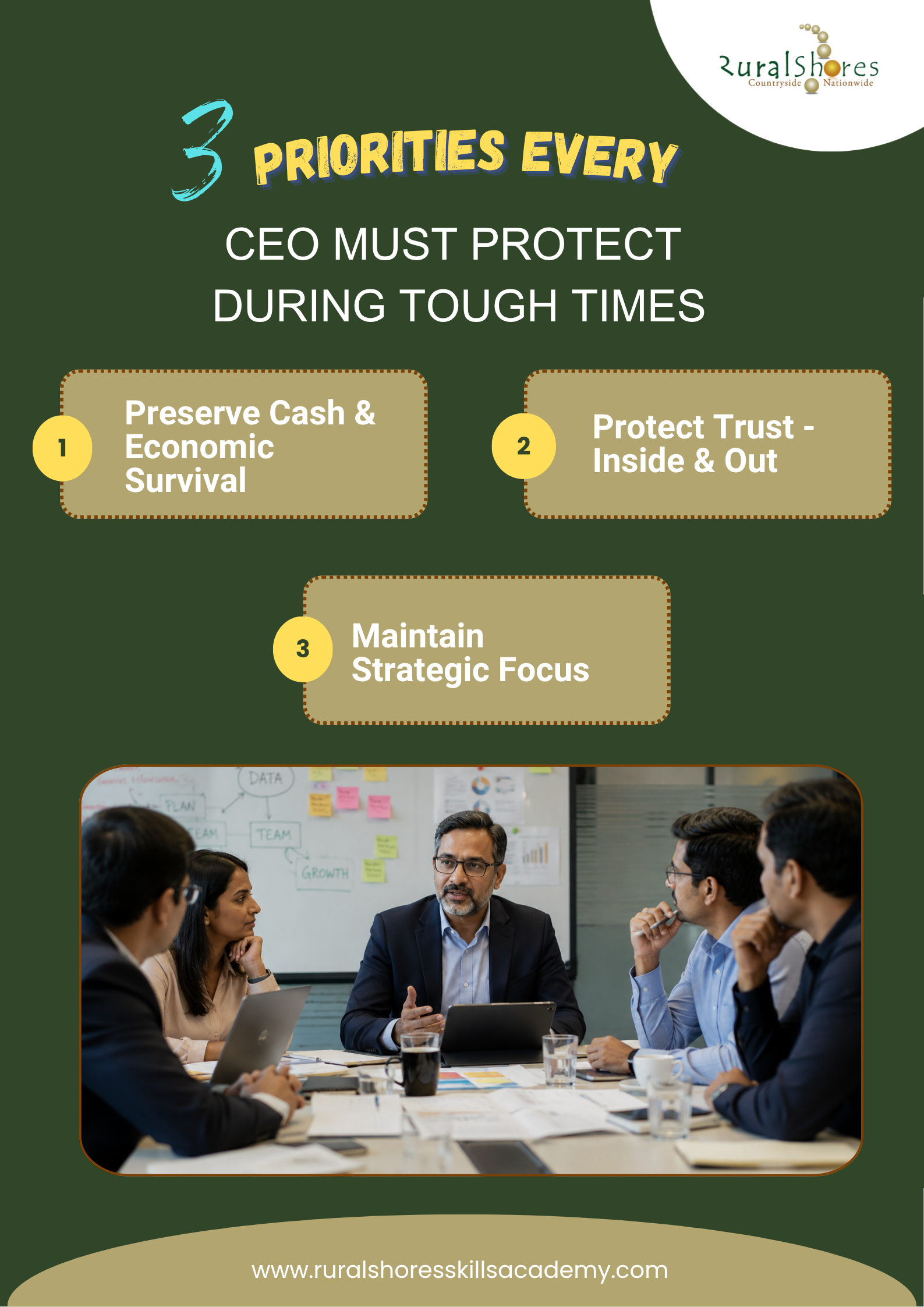
When profits drop, growth slows, attrition rises, and pressure mounts simultaneously — most leaders reach for more frameworks, more priorities, more plans. The best ones do the opposite.
01
Preserve Cash & Economic Survival
Financial stability first
02
Protect Trust — Inside & Out
The real currency of crisis
03
Maintain Strategic Focus
Where organizations fragment
Not twenty priorities. Not endless frameworks. Just three anchors — and the discipline to hold them when everything else is pulling you in every direction.
1ANCHOR ONE
Preserve Cash and Economic Survival
This is the first responsibility — and it sounds obvious until you watch companies ignore it. Without financial stability, strategy becomes theory. Morale collapses. Customers lose confidence. Investors panic. Teams become distracted fighting fires that didn’t need to start.
“What keeps this company financially alive and operationally strong for the next 12–24 months?”
Great CEOs become intensely clear about cash runway, profitability drivers, collections discipline, cost structure, productivity, and revenue predictability. They ask that question repeatedly — not as a fear exercise, but as a focusing tool.
INDUSTRY EXAMPLE — APPLE, 1997
When Steve Jobs returned to Apple, the company had roughly 90 days of cash left. His first move wasn’t a product launch — it was a $150M investment secured from Microsoft and a brutal culling of the product line from dozens of SKUs to four. He protected the economic engine first, then rebuilt from there. Eighteen months later, Apple was profitable again.
INDUSTRY EXAMPLE — SATYA NADELLA, MICROSOFT (2014)
When Nadella took over, Microsoft was losing relevance and burning money on underperforming units. His early moves were deliberately economic: kill Windows Phone, shrink the Nokia hardware bet, refocus cloud investment where returns were demonstrably highest. He stopped leakage before accelerating growth. Microsoft’s market cap has since grown more than 10×.
This is not fear-based cost cutting. It is protecting the economic engine — focusing resources where returns are highest, stopping leakage, improving execution efficiency. A company can survive a temporary lack of growth. It cannot survive sustained financial instability.
2ANCHOR TWO
Protect Trust — Internally and Externally
During difficult periods, trust becomes the real currency of an organization. Once it breaks, attrition accelerates, execution slows, internal politics rise, customers hesitate, and fear spreads faster than facts.
Employees in tough times are watching specific things — not your vision slides or all-hands presentations. They are watching the emotional stability of the CEO. The consistency of decisions. The fairness of how burdens are shared. The transparency of communication. And whether leadership is still genuinely committed.
People can tolerate difficulty. They struggle to tolerate uncertainty without leadership.
INDUSTRY EXAMPLE — ED BASTIAN, DELTA AIR LINES (2020)
When COVID-19 grounded the airline industry, Delta’s CEO communicated weekly — sometimes daily — with employees. He took a 100% pay cut before announcing any workforce changes. He was visible, specific, and honest about the depth of the crisis. Delta emerged from the pandemic with notably higher employee trust scores than competitors who went silent or communicated through press releases. Delta has consistently ranked among the best-run U.S. airlines since.
INDUSTRY EXAMPLE — HOWARD SCHULTZ, STARBUCKS (2008)
Returning to Starbucks during the financial crisis, Schultz flew 10,000 store managers to New Orleans for a leadership summit — a costly move that many questioned. His message: we are recommitting to who we are, together. The investment in visible leadership during crisis helped stabilize a workforce that had begun to fragment. Starbucks recovered faster than most retail brands in the downturn.
The communication great CEOs offer in tough times is not motivational speeches or fake positivity. It is clarity, honesty, direction, steadiness, and presence. Those five things, delivered consistently, build more trust in a crisis than years of smooth sailing ever could.
3ANCHOR THREE
Maintain Strategic Focus
This is where most organizations quietly break. When pressure rises, the instinct is to move. To try more things. To chase adjacent opportunities, diversify randomly, overload teams with disconnected initiatives, or react emotionally to every competitor move. The result is energy dispersed precisely when concentration is needed most.
In difficult periods, focus creates power.
Great CEOs do the opposite of the instinct. They simplify. They decide — with clarity and courage — what matters most, which offerings truly work, where the company actually wins, which customers matter most, and what must stop.
INDUSTRY EXAMPLE — REED HASTINGS, NETFLIX (2011)
After the disastrous Qwikster split and a 77% stock price drop, Hastings faced enormous pressure to diversify and hedge. He did the opposite — he doubled down on streaming, let the DVD business decline naturally, and focused relentlessly on original content as the differentiator. Netflix’s clarity of focus through that crisis is now studied as a case study in strategic discipline under pressure.
INDUSTRY EXAMPLE — JENSEN HUANG, NVIDIA (2018–2019)
During the crypto mining bust, NVIDIA’s GPU revenues collapsed and analysts questioned its direction. Huang refused to scatter the strategy. He stayed focused on AI compute and data center — a bet that appeared risky at the time but was grounded in where the company genuinely won. That focus, maintained through significant external pressure, positioned NVIDIA for what became one of the most dramatic revenue expansions in tech history.
Then comes the harder part: aligning the organization repeatedly around those few priorities. Not once, not in a strategy offsite. Repeatedly — in every decision, every resource call, every conversation about what gets funded and what gets stopped.
Why These Three — and Not Twenty Others
Cash & Economics protects
Survival — the right to keep playing
Trust protects
Organizational stability — the ability to execute
Strategic Focus protects
Future recovery — the direction of effort
When all three remain strong, the organization retains the capacity to recover. Morale can lift. Growth can return. Teams can stabilize. Innovation can restart — on a solid foundation, not wishful thinking.
When all three weaken simultaneously, organizations start fragmenting internally — and the fragmentation is rarely visible until it has already done serious damage. The talent leaves quietly. The customers hesitate silently. The strategy drifts without anyone calling it a drift.
WHAT GREAT CEOS COME TO UNDERSTAND
During tough periods, the CEO’s job is not to appear invincible. Not to have all the answers. Not to control everything that is happening outside the building.
Their real role becomes something quieter and harder: creating clarity amid confusion. Creating stability amid anxiety. Creating disciplined movement amid pressure.
That steadiness — held consistently, across the three anchors above — becomes the emotional and strategic center of the organization when everything else is moving.
Just want to share briefly about RSA, that we have gone through tough times and have steadily brought it to growth over the last 12 years from the start point. We not only survived COVID turbulence of a big customer reducing the business to one-fifth, and many other customers going off. With focus on the three anchors primarily, maintained low attrition, and came out of debts, and are now getting more deals from the customers.
If this resonated, share it with a leader navigating a difficult season. And drop a comment: which of these three is hardest to hold under pressure?
Authored by: Neha Babbar