

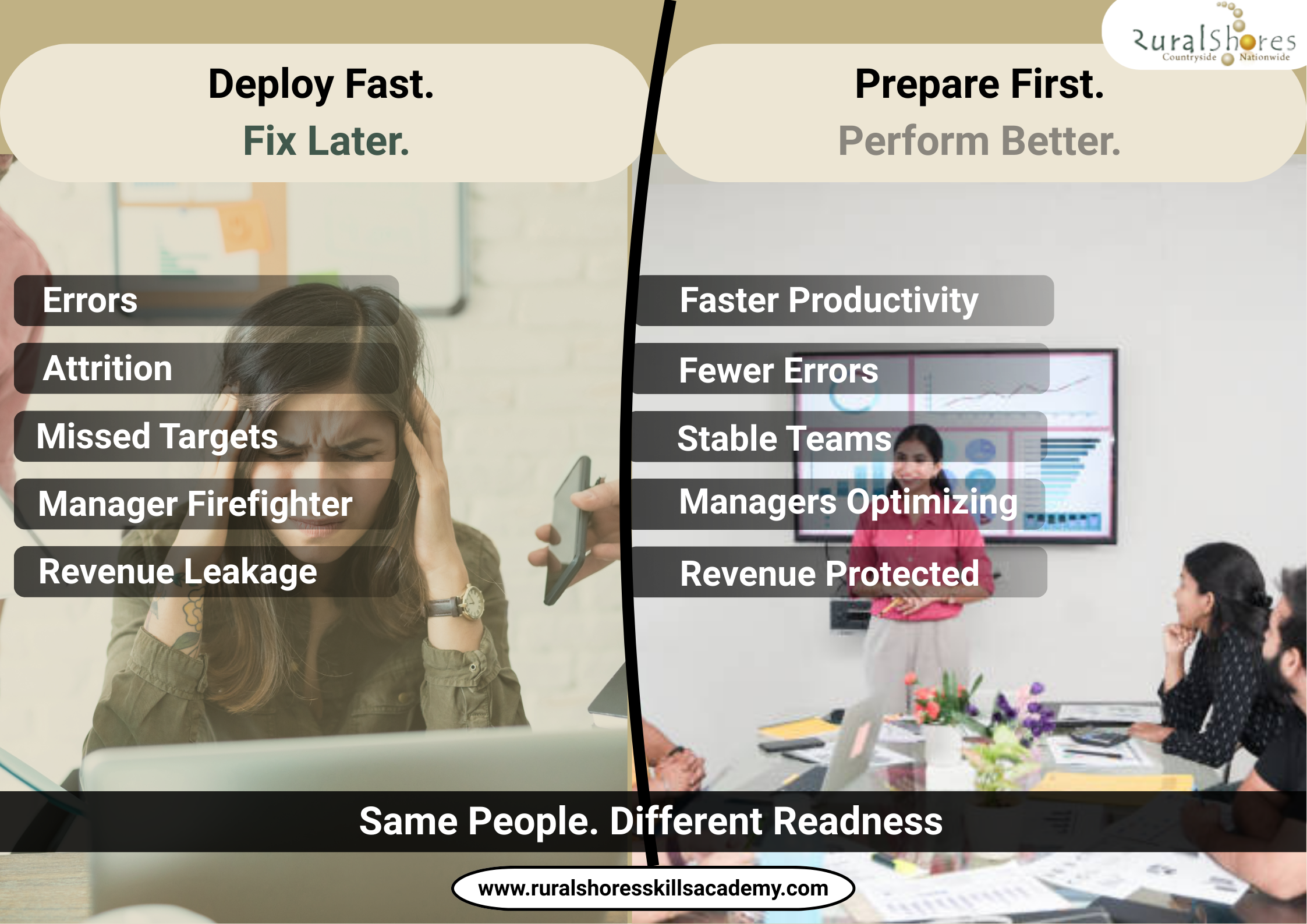
Pre-deployment training is a different paradigm entirely. It operates on a simple principle: prepare the workforce before exposure to live operations.
At RuralShores Skills Academy, we don’t just teach job tasks. We build operational readiness across multiple dimensions:
Foundational Context: Why does this organization exist? What value does it create? How does your role contribute to that value? What makes this work meaningful – both for the organization and for your own life and career?
When employees understand context and purpose, research from the NeuroLeadership Institute shows they make better decisions under uncertainty, demonstrate 30% higher engagement, and are significantly more resilient during challenging periods.
Essential Skills and Decision-Making Frameworks: What are the 15-20 critical micro-skills this role requires? What decisions will you face daily, and what frameworks help you make them correctly? How do you prioritize when multiple demands compete? What constitutes quality in this role, and how do you self-assess?
We don’t teach people to follow scripts mindlessly. We build judgment and adaptive capability.
Tools and Technology Proficiency: What systems will you use? What digital tools enable your productivity? How do you use AI assistants to enhance your work? How do you troubleshoot common technical issues independently?
Basic digital fluency is no longer optional for any role. We ensure employees arrive on day one already comfortable with the technology ecosystem they’ll navigate.
Continuous Learning Capability: How do you learn from experience? How do you seek help effectively? How do you give and receive feedback? How do you improve incrementally?
The goal isn’t just preparing people for their first day—it’s preparing them to continue developing long after formal training ends.
Real-World Application and Simulation: We create realistic simulations of the actual work environment—difficult customer interactions, complex problem scenarios, high-pressure situations. Employees practice, make mistakes, receive coaching, and improve before those mistakes impact live operations.
Research from the Industrial and Organizational Psychology journal demonstrates that simulation-based training reduces time-to-competency by 30-40% compared to on-the-job learning.
The Third-Party Advantage: Five Critical Benefits for Large-Scale Deployment
When organizations deploy large workforces—hundreds or thousands of employees across multiple locations—the question arises: build internal pre-deployment training or partner with a specialized third party?
Our experience, validated by operational data from companies we’ve supported, demonstrates five decisive advantages of the third-party model for large-scale deployments:
1. Focused, Specialized Delivery at Scale
The Challenge: Internal teams are optimized for running operations, not training hundreds of new hires simultaneously. When deployment needs surge, operational teams face impossible choices: do I maintain operations or train new people? The answer is usually “both poorly.”
The Third-Party Advantage: Specialized training partners maintain dedicated infrastructure, experienced trainers, and proven curricula purpose-built for rapid deployment. At RuralShores, we can deploy comprehensive pre-deployment training for 500+ employees simultaneously across multiple locations without disrupting your operations.
Real Impact: A logistics company needed to deploy 800 warehouse associates across 12 fulfillment centers in preparation for peak season. Their internal training capacity could handle perhaps 50 people per month. Partnering with us, they completed comprehensive pre-deployment training for all 800 associates in 6 weeks, allowing operational teams to maintain focus on preparing facilities and processes. The alternative—trying to train internally while ramping operations—would have compromised both training quality and operational readiness.
2. Rigorous Skills Validation and Quality Assurance
The Challenge: Internal training often lacks robust validation mechanisms. There’s pressure to pass everyone because the business needs bodies. Supervisors hesitate to fail candidates they’ll later manage. The result: people certified as “trained” who aren’t actually competent.
The Third-Party Advantage: Independent validation removes these pressures. Third-party trainers can objectively assess competency against defined standards and flag candidates who don’t meet requirements—without the political complications of internal dynamics.
Our Approach at RuralShores: Every trainee undergoes structured competency assessments across knowledge, skills, and behavioral dimensions. We use:
- Written assessments testing decision-making frameworks and conceptual understanding
- Practical demonstrations of critical job tasks evaluated against scoring rubrics
- Simulated scenarios assessing judgment under realistic pressure
- Behavioral interviews gauging work readiness, professionalism, and cultural fit
Candidates must achieve defined proficiency thresholds. Those who don’t are marked for additional training or, if they can’t reach standards, recommended for non-deployment. This sounds harsh, but it protects operational efficiency.
Real Impact: For a customer service deployment, we trained 350 candidates but certified only 312 as deployment-ready. The 38 who didn’t meet standards received additional focused training—16 subsequently passed, while 22 were counseled into different roles better suited to their capabilities.
The client deployed 328 agents who met objective competency standards. Their operational data told the story: first-month error rates were 60% lower, average handle time met targets immediately, and quality scores exceeded industry benchmarks. Critically, 90-day attrition was only 8% compared to 28% in their previous cohort trained internally without rigorous validation.
The “failure rate” in training saved the company from deploying unprepared people who would have failed in operations—a far more costly outcome.
3. Consistent Quality Across Large, Distributed Deployments
The Challenge: When deploying hundreds of people across multiple locations, maintaining consistent training quality is extraordinarily difficult with internal resources. Different trainers teach differently. Regional variations creep in. Standards drift.
The Third-Party Advantage: Specialized training partners industrialize quality control. Standardized curricula, certified trainers, common assessment tools, centralized quality monitoring, and data-driven continuous improvement ensure that someone trained in Location A receives equivalent preparation to someone trained in Location Z.
Our Quality Framework: We maintain trainer certification programs, conduct regular training audits, use technology platforms that standardize content delivery, implement cross-location calibration sessions, and analyze performance data across all cohorts to identify quality variations and correct them.
Real Impact: A retail chain needed to staff 80 new stores across 6 states with 2,400 associates within 3 months for a simultaneous launch. Training internally across this geography with consistent quality would have been nearly impossible.
We deployed standardized pre-deployment training across 15 regional centers using certified trainers, digital learning platforms, and centralized quality monitoring. Post-deployment audits conducted by the client across all locations showed statistically insignificant variance in competency levels—whether the associate was trained in Kerala or Rajasthan, they demonstrated equivalent capability.
This consistency enabled the chain to execute a smooth multi-location launch. Store productivity ramped at similar rates regardless of location, and the company avoided the operational chaos of having some locations staffed with well-prepared teams while others struggled with inadequately trained personnel.
4. Independent Validation of Post-Deployment Performance
The Challenge: Internal teams often lack the capacity, tools, or objectivity to conduct rigorous post-deployment validation. Is training actually translating into operational performance? Which aspects of preparation are working? Which need improvement? These questions often go unanswered.
The Third-Party Advantage: Third-party partners can provide independent validation mechanisms that track post-deployment performance, correlate it with training interventions, and provide data-driven insights for continuous improvement—without the biases of internal stakeholders invested in defending their training approach.
Our Validation Approach: For clients who engage us for this, we implement:
- Post-deployment performance tracking (error rates, productivity metrics, quality scores) for cohorts we trained
- Comparison analysis against baseline data or control groups
- Correlation studies identifying which training elements most strongly predict performance
- Regular performance audits and mystery shopping to assess real-world competency
- Closed-loop feedback to continuously refine pre-deployment curricula based on operational data
Real Impact: For a financial services BPO, we tracked post-deployment performance of 400 agents we trained over 6 months. Our analysis revealed that agents scoring above 85% on our simulation assessments during training achieved first-call resolution rates 22% higher than those scoring 70-84%, and 35% higher than those scoring below 70%.
This insight drove two changes: First, the client raised the deployment threshold to 80% simulation performance, with additional training for those between 70-80% before deployment. Second, we redesigned the training to provide more intensive simulation practice, particularly on the scenarios correlating most strongly with post-deployment success.
Within two quarters, the average first-call resolution rate improved by 18%, and the variance across agents decreased significantly—more consistent, higher-quality performance delivered by a workforce whose pre-deployment preparation had been optimized based on independent validation data.
5. Operational Leadership Remains Focused on Operations, Not Training
The Challenge: Perhaps the most insidious cost of inadequate pre-deployment training is the opportunity cost. When managers and supervisors spend their time on remedial training and constant error correction, they’re not doing what creates business value: optimizing processes, driving innovation, developing strategy, serving customers, or pursuing growth initiatives.
The Third-Party Advantage: Comprehensive pre-deployment training dramatically reduces the supervision burden. Employees arrive operationally ready, not operationally incompetent. Managers can focus on leadership, optimization, and growth rather than constant correction and firefighting.
Real Impact: A logistics company tracked supervisor time allocation before and after implementing comprehensive third-party pre-deployment training for warehouse associates:
Before (learning on the job):
- Error correction and rework supervision: 42% of time
- Basic skills coaching: 28% of time
- Process execution and management: 22% of time
- Process improvement and optimization: 8% of time
After (comprehensive pre-deployment training):
- Error correction and rework supervision: 15% of time
- Skills coaching and development: 18% of time
- Process execution and management: 35% of time
- Process improvement and optimization: 32% of time
The shift is profound. Supervisors reclaimed approximately 35% of their time previously consumed by remedial work. They redirected this toward process improvement initiatives that increased warehouse throughput by 23% over the following year, reduced damage rates by 31%, and improved on-time fulfillment from 94.2% to 98.7%.
The cost of pre-deployment training was significant—approximately ₹12,000 per associate. But the operational efficiency gains, measured in reduced supervision burden, faster ramp-to-productivity, higher quality, and freed leadership capacity for growth initiatives, generated ROI of approximately 340% within the first year.
Implementation Framework: Making Pre-Deployment Training Operational
For COOs and Operations Heads considering this approach, implementation requires systematic planning:
1. Define Operational Readiness Standards What does “deployment-ready” mean for each critical role? Define this rigorously in terms of knowledge, skills, and behaviors. Avoid vague aspirations; create objective, assessable standards.
2. Calculate the True Cost of Inadequate Preparation Measure your current state: What are error rates in the first 90 days? How much supervisor time goes to remedial coaching? What’s your early attrition rate? What quality issues arise from inadequate preparation? Convert these to financial impact. This becomes your baseline and business case.
3. Design Comprehensive Pre-Deployment Curricula Work with training partners to build preparation programs covering context, essential skills, tools, decision-making frameworks, and realistic simulation. Resist the temptation to shorten training to accelerate deployment—comprehensive preparation pays for itself rapidly.
4. Implement Rigorous Validation Mechanisms Define competency thresholds and assessment methods. Be willing to delay deployment of individuals who don’t meet standards. Short-term deployment pressure should never override long-term operational efficiency.
5. Track Post-Deployment Performance Rigorously Measure whether pre-deployment training translates into operational performance. Track error rates, productivity, quality, attrition, and supervision burden for trained cohorts. Use this data to continuously improve preparation.
6. Choose Partners Who Understand Operations, Not Just Training If engaging third parties, select partners who think like operators, not just trainers. They should understand your operational metrics, speak your language, and measure success in operational outcomes, not training activity.
Conclusion: Pre-Deployment Training as Strategic Advantage
In an era of persistent talent challenges and operational pressure, pre-deployment training represents a significant competitive advantage. Organizations that deploy workforce readiness as systematically as they deploy capital equipment or technology infrastructure achieve:
- Faster time-to-productivity: 30-40% reduction in ramp time
- Higher quality: 40-60% reduction in early-stage error rates
- Better retention: 25-35% improvement in first-year retention
- Lower supervision burden: 35-50% reduction in remedial coaching time
- Stronger operational stability: Faster achievement of steady-state performance
- Enhanced leadership capacity: Managers freed to focus on optimization and growth
The question for operations leaders isn’t whether pre-deployment training delivers value – the data is unequivocal. The question is: how long will you continue accepting the hidden costs of deploying unprepared workforces?
Every day you deploy someone who isn’t truly ready is a day of operational inefficiency, customer experience compromise, supervision burden, and missed growth opportunity.
Pre-deployment training isn’t an HR initiative. It’s an operational efficiency lever that stabilizes operations faster, improves throughput, and allows your leadership to focus on growth rather than constant correction.
The companies winning operationally aren’t those with the lowest training costs. They’re those with the highest workforce readiness.
Authored By: Neeraj Agarwal