

Your organization invested heavily in training last year.
Can you quantify the performance improvement that followed?
For most leaders, that question is uncomfortable. Not because training didn’t happen, but because its business impact was never clearly measured.
According to Deloitte India Human Capital Trends reports, mid-to-large Indian organizations spend ₹15,000–25,000 per employee annually on training. Yet McKinsey Global Institute and Brandon Hall Group research suggests that only 12–15% of this investment translates into measurable on-the-job performance improvement.
The gap between training spends and execution impact costs Indian companies an estimated ₹12,000–15,000 crore annually in lost productivity and opportunity cost (Brandon Hall, Deloitte synthesis).
The problem is not intent. It is approach.
Why This Matters More Now Than Ever
Three shifts have changed the economics of capability building in Indian enterprises.
1. Skills Expire Faster Than Training Cycles
According to the World Economic Forum – Future of Jobs Report, the effective shelf-life of many professional skills has dropped from five years to 18–24 months due to digitization and automation.
Generic training content cannot keep pace with this rate of change.
2. Attrition Has Made Replacement Hiring Unsustainable
As per Mercer India Workforce Turnover Studies and Michael Page India Talent Trends, attrition in IT, BPO, and GCC environments ranges between 25–30% annually.
LinkedIn Workplace Learning and Deloitte Human Capital Trends show that upskilling existing employees is nearly three times more cost-effective than replacement hiring but only when training improves real performance.
3. Execution Is the Last Defensible Advantage
According to Harvard Business Review and BCG strategy research, in markets where products and pricing are easily replicated, execution capability not ideasdetermine sustained advantage.
Training that does not improve execution speed, accuracy, and consistency is operational noise.
The Hidden Cost of Generic Training
Most organizations underestimate the true cost of ineffective training.
Direct Costs
- Training fees: ₹20,000–30,000 per employee annually
(as reported in Deloitte India Human Capital Trends)
- Lost productivity during training: 24–40 hours per employee per year, depending on role and delivery format
(Deloitte India L&D benchmarking)
- Travel and logistics: Especially significant for offsite or centralized programs
Hidden Costs (Often 3–5x Higher)
- Low skill adoption: According to the Brandon Hall Group, 70–80% of generic training is never applied on the job
- Delayed ramp-up: Employees take longer to reach full productivity after role transitions or onboarding
- Operational errors: Increased rework, compliance lapses, quality failures, and customer dissatisfaction
- Employee disengagement: Irrelevant training contributes to frustration and higher attrition risk
(LinkedIn Workplace Learning Report)
Illustrative Business Impact
- Consider a 500-person organization spending ₹25,000 per employee annually on standard training.
- Total annual training spend: ₹1.25 crore
- If only 20–25% of learning is applied, the remaining investment delivers little operational value
- When lost productivity, delayed ramp-up, and rework are included, the effective waste can reach ₹3–5 crore per year
- This is why the real question is not “Is custom training expensive?”
It is “How much does ineffective training already cost us?”
This reframes the debate:
Custom training is not expensive. Generic training is wasteful.
Where Performance Actually Breaks Down
Standard training programs teach principles.
Your employees need practice.
Generic frameworks cover competencies.
Your business requires execution in specific contexts – your CRM, your compliance steps, and your customer profiles.
According to McKinsey’s Capability Building for the Digital Age, performance gaps emerge after training. When employees return to work, open proprietary systems, face scenarios not covered in generic content and improvise.
Multiply this by hundreds of employees and thousands of daily decisions.
That is where training ROI evaporates.
Custom vs. Standard Training: The CXO Decision Matrix
| Factor | Custom Training | Standard Programs |
| Best for | High-volume, high-impact workflows | Foundational / generic skills |
| Time to impact | Days to weeks | Months |
| Cost per learner | Higher upfront, lower long-term | Lower upfront, higher long-term waste |
| Skill adoption rate | 70–90% (ATD benchmarks) | 20–40% |
| ROI timeline | 6–12 months | Often unmeasurable |
This matrix allows leaders to self-diagnose without sales pressure.
When Custom Training Makes Strategic Sense
According to BCG and McKinsey capability frameworks, customization delivers strong ROI when:
High-ROI Scenarios
- High-volume, repeatable tasks with high cost-per-error
- Rapid scaling where consistency across locations is critical
- Proprietary workflows that define competitive advantage
- Compliance-heavy environments with regulatory exposure
- Large employee populations where 5% productivity gains materially affect margins
Poor-Fit Scenarios
- Small teams (<20 employees)
- Processes still under experimentation
- Generic skills (Excel, PowerPoint, basic communication)
From Decision to Delivery: The Custom Training Journey
CXOs think in execution timelines. A typical rollout follows this structure:
Phase 1: Performance Diagnosis (Week 1–2)
- Map workflows
- Identify failure points
- Define measurable success metrics
Phase 2: Content Design (Week 3–5)
- Build real scenarios
- Replicate systems and tools
- Align assessments to KPIs
Phase 3: Pilot & Refine (Week 6–7)
- Deploy to 10–15% of target group
- Capture performance feedback
- Iterate content
Phase 4: Scale & Measure (Week 8+)
- Full rollout
- Track operational metrics in real time
This structure reduces risk and accelerates value realization.
ROI in Practice: A Technical Support Example
For a technical support team handling 12,000 calls per month, training focused on the top 20 recurring issues and actual resolution workflows.
Before Training
- First-call resolution: 58%
- Repeat call rate: 42%
- Average handle time: 8.2 minutes
- Monthly agent hours: 1,640
After Training (30 Days)
- First-call resolution: 81%
- Repeat calls reduced by 40%
- Time saved: 280 agent hours/month
- Cost savings: ₹4.2 lakhs per quarter (₹500/hour loaded cost)
Training investment: ₹1.2 lakhs
ROI: 350% in Q1; ~1,400% annualized
CSAT improved from 3.8 to 4.4, while agents handled 15% higher volume without new hiring.
The Strategic Shift CXOs Are Making
For leaders facing margin pressure and talent constraints, every investment requires prioritization.
In discussions with 40+ Indian CXOs over the past year, a consistent pattern emerges:
- Training is approved because “we should”
- Results are assumed, not tracked
- Adoption is rarely measured
Organizations that shift to custom, workflow-aligned training report 3–4x higher skill adoption rates (ATD, Brandon Hall benchmarks).
The shift is simple but uncomfortable:
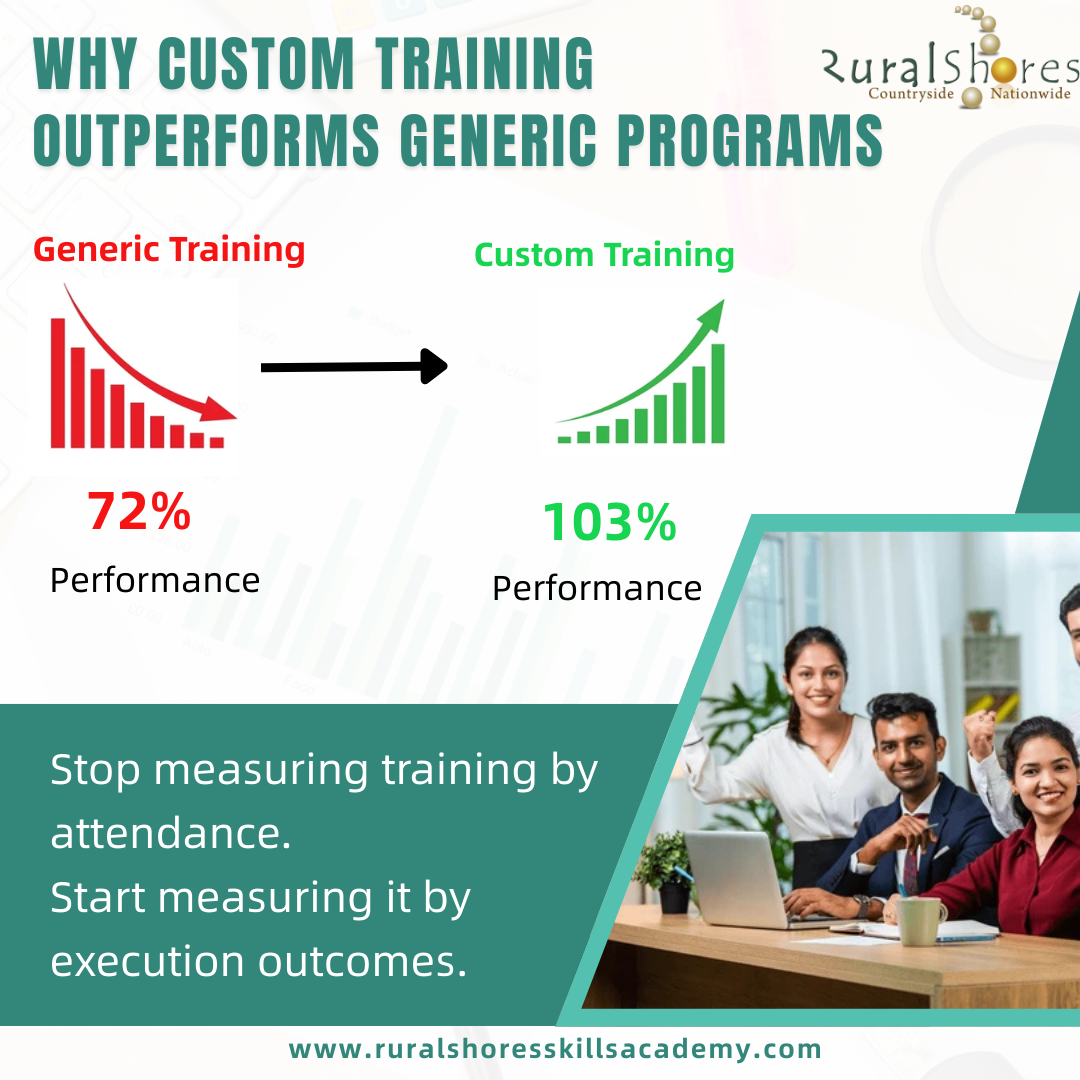
Stop measuring training by attendance. Start measuring it by execution outcomes.
Is Custom Training Right for Your Organization? A Self-Assessment
Ask yourself:
- Can you quantify the business cost of performance gaps?
- Do 50+ employees perform similar high-impact workflows?
- Are your processes stable but proprietary?
- Can you commit to measuring performance, not completion?
- Do current programs show <40% skill adoption?
If you answered “yes” to three or more, custom training likely offers significant ROI.
If not, improve foundational systems before customizing.
The Bottom Line
Generic training programs exist because they are convenient, not because they are effective.
Custom training demands higher upfront investment and greater discipline. But for organizations where execution defines competitive advantage, the ROI gap is no longer debatable.
The question is not whether custom training works.
The data is clear.
The question is whether your organization is ready to treat training not as an activity but as a performance lever.
Authored By: Kavita Mawari