

On my first year as CEO of RuralShores Skills Academy, I encountered a pattern that would define our approach to corporate training forever.
We had just completed an intensive marketing training program for 150 field representatives of an FMCG company. The curriculum was excellent, the trainers experienced, the participants enthusiastic. Completion rates: 98%. Assessment scores: averaging 84%. By traditional training metrics, it was a success.
Three months later, I joined our team on field audits. What I observed shook me. The representatives we’d trained weren’t implementing what they’d learned. They’d reverted to old habits—skipping crucial steps in the marketing process, ignoring the consultative approach we’d taught, making compliance violations we’d specifically addressed in training. When I asked why, the responses were telling: “It felt too slow under pressure,” “My supervisor wants speed, not process,” “I forgot the exact steps.”
Eighty percent of what we’d trained had degraded.
This wasn’t a training failure. It was a monitoring failure. We had assumed that learning would automatically translate into sustained performance. We were wrong.
That realization, emerging from my systems thinking background in mechanical engineering, changed everything. In manufacturing, you don’t design a process and hope it continues working correctly. You build in monitoring, feedback loops, and quality control. You measure, you inspect, you adjust.
Why would human capability be any different?
The Uncomfortable Truth About Skills Degradation
Research from Ebbinghaus on memory retention shows that without reinforcement, we forget 70% of new information within days. But skills degradation in workplace contexts is even more insidious because it’s not about forgetting—it’s about reverting, cutting corners, and drift.
From our work across BPO operations, retail environments, field sales forces, and manufacturing contexts, the pattern is consistent: approximately 80% of frontline employees demonstrate significant skill degradation within 90 days without monitoring and reinforcement. Middle management fares better but still shows concerning decline—perhaps 50-60% experiencing some degradation.
The degradation isn’t uniform. It follows predictable patterns:
High-frequency, low-stakes tasks degrade fastest. The daily activities that seem routine—data entry protocols, customer greeting standards, documentation processes—erode quickly because they feel unimportant. Until they’re not. Until incomplete documentation triggers a compliance issue, or poor customer greeting standards damage brand perception at scale.
Complex, multi-step processes degrade under pressure. When time constraints increase or supervision decreases, people unconsciously simplify. They skip steps. They take shortcuts. The 7-step sales process becomes 4 steps. The quality checklist becomes a cursory glance.
Skills requiring judgment degrade when purpose is unclear. If someone doesn’t understand why a particular approach matters—why we ask these questions, why we follow this sequence, why we document in this way—they’ll modify or abandon it the moment it feels inconvenient.
New skills compete with old habits. Under stress or cognitive load, people default to what’s familiar. Even after excellent training, the old way of doing things lurks beneath the surface, ready to reemerge.
The Cost of Unmonitored Skills: Real Consequences
Case 1: The FMCG Compliance Crisis That Wasn’t
During a routine physical audit at retail locations where we’d trained brand promoters for a major FMCG company, our monitor observed promoters making claims about product benefits that violated advertising standards—claims we had specifically trained them not to make.
The deviation was subtle. Instead of saying “this product supports digestive health when combined with a balanced diet,” they were saying “this product cures digestive problems.” The difference seems small. The legal and reputational risk was enormous.
When questioned, the promoters genuinely didn’t realize they’d drifted. “It’s basically the same thing,” one said. “Customers understand it better this way.”
Our immediate intervention involved on-the-spot coaching using Socratic questioning: “What did we discuss about medical claims? What’s the difference between ‘supports’ and ‘cures’? Why does that distinction matter legally? What could happen to the company—and to you—if a customer files a complaint based on this claim?”
Within the same conversation, understanding dawned. The promoter hadn’t forgotten the training; they’d rationalized around it because the compliant language felt less compelling. Once they reconnected with the purpose—the legal and ethical framework—behavior corrected immediately.
We caught this across 12 locations before it became a regulatory issue. Without monitoring, this would have scaled to hundreds of promoters making problematic claims across thousands of customer interactions. The potential cost: regulatory action, brand damage, and possible product recall or marketing ban.
The cost of monitoring: ₹2.5 lakhs for weekly audits across locations for three months.
The cost of what we prevented: Potentially ₹15-50 crores in regulatory penalties, legal costs, and brand damage, plus the operational disruption of halting a major campaign.
Case 2: The BTL Coverage Transformation
A consumer goods company engaged us to train field teams for below-the-line marketing activities with a target of reaching 5,000 households per week per team across 50 teams. After training, initial performance was strong—teams hit 92% of weekly targets in week one.
By week six, coverage had dropped to 64% of targets. Teams were completing their days earlier, reporting fatigue, and showing declining morale.
Our physical audits revealed the issue: teams had unconsciously optimized for completing tasks rather than achieving outcomes. They were rushing through interactions, reducing the quality and depth of engagement. They’d shortened the demonstration time, skipped the feedback collection process, and weren’t capturing complete household data.
The work felt completed to them—they’d visited households, delivered the message. But the quality had degraded to the point where impact was minimal.
Our monitoring approach wasn’t punitive. Our field auditor spent a day with one team, observing, then debriefing. The conversation focused on understanding:
“What did you notice about household responses today compared to your first week?”
“When you shortened the demonstration, how did that affect the questions they asked?”
“What was the purpose of collecting detailed feedback—why did we include that in the process?”
Through guided reflection, the team realized they’d drifted from the methodology. We didn’t tell them they were wrong—we helped them see the consequences of their modifications.
The intervention worked. Within two weeks, with continuous monitoring and coaching, coverage improved to 88% of targets, and critically, quality metrics (measured through callback surveys) improved by 31%. The teams weren’t just visiting more households—they were creating more impact per visit.
The business outcome: The campaign that was heading toward significant underperformance achieved 96% of its overall reach targets and exceeded engagement quality benchmarks.
Case 3: The Silent Failures Nobody Measures
Perhaps the most insidious cost of missing monitoring is what we never see—the accumulation of small degradations that never become visible crises but quietly erode performance.
A retail chain trained store associates on a customer service protocol designed to increase basket size through consultative engagement. Training was excellent. Initial compliance during the supervised period: 87%.
The company didn’t implement ongoing monitoring. Six months later, mystery shopping audits (conducted for a different purpose) revealed protocol compliance at 23%. Associates had reverted almost entirely to transactional service—take the order, process the payment, move to the next customer.
What was the cost? Nobody knew, because nobody measured it. But the company had designed the protocol because testing showed it increased basket size by an average of 18%. If we conservatively assume the degraded compliance cost even half that potential uplift across hundreds of stores and millions of transactions, the unmeasured cost likely ran into crores annually.
This is the silent killer: skills degradation that doesn’t create a crisis, just slowly bleeds performance.
Our Monitoring Framework: Building Quality Control for Human Capability
Drawing from my engineering background, I approached skill monitoring as a quality control system for human performance. Just as manufacturing monitors process adherence, output quality, and equipment performance, we needed to monitor skill application, behavioral consistency, and capability maintenance.
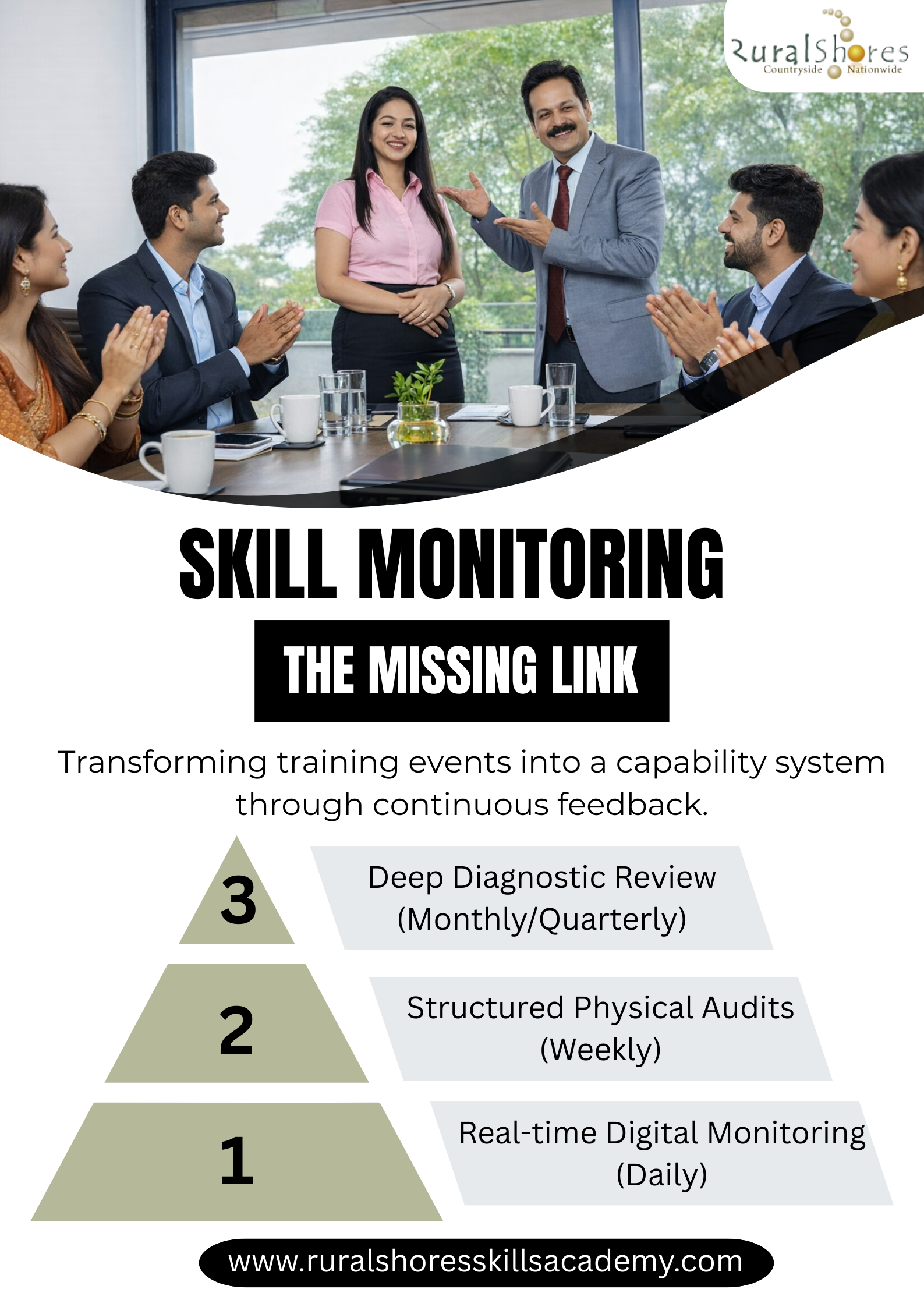
We built a three-layered approach:
Layer 1: Real-Time Digital Monitoring (Daily)
Through our online portal integrated with client operational systems, we capture real-time performance data linked directly to trained skills.
For a BPO operation, this means tracking: average handle time, first-call resolution rates, script adherence, escalation frequency, customer satisfaction scores—all correlated with specific trained behaviors.
The system is automatic, not manual. Data flows continuously. Algorithms identify deviations from expected performance patterns. When a trained employee’s metrics diverge significantly from their post-training baseline or peer benchmarks, the system flags it.
Critical insight: We’re not monitoring outcomes alone—we’re monitoring capability indicators. For example, if first-call resolution drops, we can correlate it with specific trained skills: Are they asking diagnostic questions? Are they using the knowledge base effectively? Are they following the resolution framework?
This allows us to identify not just that performance is declining, but which specific skills are degrading.
The system generates automated alerts, but more importantly, it generates developmental insights. When we review data with a performer, we’re not saying “your numbers are down.” We’re saying “the data suggests you may not be consistently applying the diagnostic questioning framework we trained—let’s explore what’s happening.”
This is monitoring as intelligence, not surveillance.
Layer 2: Structured Physical Audits (Weekly)
Data tells you what is happening. Observation tells you why.
Every week, our trained auditors conduct physical audits—we call them “capability checks”—at work locations. These aren’t announced. Not because we want to catch people doing things wrong, but because we want to observe authentic performance, not performance theater.
What we observe:
- SOP execution: Are the standard operating procedures being followed? Which steps are consistently executed, which are skipped or modified?
- Confidence and competence: Does the performer demonstrate confidence in applying the trained skills? Where do they hesitate or show uncertainty?
- Environmental factors: What workplace conditions are affecting performance? Is the supervisor reinforcing or undermining trained behaviors? Are tools and resources adequate?
- Unintended adaptations: How have performers modified what we taught? Sometimes adaptations are improvements—context-appropriate adjustments. Sometimes they’re degradations. We need to distinguish.
The approach is fundamentally developmental. Our auditors are trained to observe first, question second, and prescribe last.
A typical interaction:
Auditor: “I noticed you modified the customer greeting process—you’re skipping the brand introduction. Walk me through your thinking on that.”
Employee: “Customers seemed impatient. I felt like it was wasting their time.”
Auditor: “Interesting. What did we discuss in training about the purpose of the brand introduction?”
Employee: “Building trust and credibility.”
Auditor: “Right. So the question is: can we build that trust faster or differently without losing its purpose? What if we integrated it more naturally into the needs assessment phase? Let’s try that together.”
This is coaching disguised as monitoring. We’re not enforcing compliance—we’re developing capability.
Importantly, our auditors also identify and celebrate what’s being done excellently. Recognition reinforces correct application far more effectively than criticism corrects poor application.
Layer 3: Deep Diagnostic Reviews (Monthly/Quarterly)
Beyond daily data and weekly observation, we conduct deeper diagnostic reviews that analyze patterns across individuals, teams, locations, and time periods.
Questions we’re answering:
- Which trained skills show the most consistent application? Which degrade fastest?
- Are there specific environmental or managerial factors correlating with better skill retention?
- Which performers maintain high capability—and what can we learn from them?
- Where is training design itself contributing to degradation? (Perhaps something we taught isn’t practical in real conditions)
This level of analysis closes the loop between training design and operational reality. Monitoring isn’t just ensuring people apply what we taught—it’s validating whether what we taught is actually applicable.
When we identify systemic degradation of a particular skill, we don’t blame the performers. We redesign the training, improve the job aids, or work with the client to modify the environment.
The Galvanizer Mindset: Monitoring as Development, Not Policing
The difference between monitoring that improves performance and monitoring that crushes morale is entirely about mindset and methodology.
Monitoring as policing operates from suspicion: “Did you follow the rules? Where did you fail? What will we penalize?”
Monitoring as galvanizing operates from curiosity: “What’s actually happening in the work? Where are you struggling? How can we help you succeed?”
Our approach is rooted in what we call “multi-perspective Socratic coaching.” When we identify skill degradation or deviation, we don’t lecture. We provide inputs from multiple perspectives through questioning:
Perspective 1 – The Individual: “What’s your experience been applying this skill? What’s feeling difficult or unnatural?”
Perspective 2 – The Purpose: “What was the intended outcome of doing it this way? What are we trying to achieve for the customer/company/you?”
Perspective 3 – The Consequence: “What happens when we do it differently? What’s the impact on quality, risk, or results?”
Perspective 4 – The Alternative: “What would make this easier to apply consistently? What support or adjustment would help?”
This approach accomplishes three things simultaneously:
- It surfaces the real barriers to skill application—which are often environmental, not motivational
- It reconnects the performer with the purpose of the skill—restoring intrinsic motivation to apply it correctly
- It positions us as partners in their success, not judges of their compliance
One of our auditors shared a story that exemplifies this. He was observing a field sales representative who was consistently skipping the needs assessment phase of the consultative selling process we’d trained. Instead of immediately correcting, he asked:
“I’m curious—walk me through your typical customer interaction. What’s your thought process?”
The rep explained: “Most of my customers are small retailers with very limited time. They get annoyed if I ask too many questions. They just want to know what’s on offer and make a quick decision.”
The auditor responded: “That makes sense—respecting their time is important. Here’s a different perspective: what if the reason they seem impatient with questions is because the questions don’t feel relevant to them? What if we could ask two or three questions that actually demonstrate we understand their business—wouldn’t that build credibility rather than waste time?”
They practiced together—refining the needs assessment into three sharp, business-relevant questions that took 45 seconds but dramatically improved the quality of the subsequent recommendation.
The sales rep’s performance improved by 28% over the following month. But more importantly, his confidence and engagement increased. He didn’t feel monitored—he felt supported.
Implementation Framework: Five Principles for Effective Skill Monitoring
For COOs and Risk & Compliance leaders considering implementing systematic skill monitoring, these principles have proven essential:
1. Define Observable Capability Indicators, Not Just Outcome Metrics
Don’t just measure results—measure the behaviors and skills that produce results.
For compliance roles, don’t just track violations—track adherence to verification protocols, documentation completeness, and decision-making quality.
For sales roles, don’t just track revenue—track consultative questioning, objection handling, and relationship-building behaviors.
Why it matters: When performance declines, outcome metrics tell you there’s a problem. Capability indicators tell you which skills have degraded and need reinforcement.
2. Monitor in Real Context, Not Simulated Conditions
Skills that work in a training room may fail under operational pressure. The purpose of monitoring is to assess capability in real work conditions—with actual customers, real time pressure, authentic complexity.
This is why our physical audits are essential alongside digital monitoring. You cannot fully assess capability through data alone.
3. Make Monitoring Frequency Match Risk and Degradation Speed
Not all skills require the same monitoring intensity.
High-risk, non-negotiable skills (financial processes, health and safety protocols, compliance requirements) require intensive monitoring—daily data review, frequent physical audits, zero tolerance for deviation.
Complex skills with high degradation rates (consultative selling, coaching, quality assessment) require moderate frequency monitoring—weekly observation, continuous feedback.
Stable, high-frequency skills (basic operational procedures, system navigation) can be monitored less intensively—monthly sampling audits, quarterly deep reviews.
Match your monitoring investment to risk profile and degradation patterns.
4. Separate Monitoring from Performance Management
This is critical. If employees perceive monitoring as linked directly to punishment or rewards, they will perform for the audit, not for the work.
Our monitoring identifies capability gaps and triggers developmental interventions—additional coaching, refresher training, job aid improvements. It informs broader performance management, but it’s not a “gotcha” system.
The message must be clear: Monitoring exists to help you succeed, not to catch you failing.
5. Close the Loop: Use Monitoring Data to Improve Training Design
Monitoring isn’t just about ensuring people apply what we taught—it’s about validating whether what we taught actually works in operational reality.
When we identify consistent degradation of a particular skill across multiple performers, we don’t blame them. We investigate:
- Was the training design inadequate?
- Is the skill impractical given real work conditions?
- Do performers lack necessary tools or support?
- Is the work environment undermining trained behaviors?
Then we fix the root cause—redesigning training, improving job aids, or working with clients to modify the environment.
Monitoring completes the learning cycle: Train > Apply > Monitor > Learn > Improve Training.
The ROI Nobody Calculates: Prevention
The business case for skill monitoring is difficult to quantify precisely because the value is largely in what doesn’thappen.
Compliance violations that don’t occur. Quality failures that don’t reach customers. Operational inefficiencies that don’t compound. Employee attrition that doesn’t happen because people feel supported rather than set up to fail.
But we can estimate:
A single prevented compliance violation in financial processes: ₹10 lakhs to ₹5 crores (depending on severity, regulatory penalties, remediation costs)
Maintained quality standards in customer-facing roles: 15-25% improvement in customer satisfaction and retention metrics
Reduced supervision burden: When frontline employees consistently apply trained skills, supervisors spend 30-40% less time on error correction and remedial coaching
Training ROI protection: Without monitoring, approximately 80% of training investment degrades within 90 days. Monitoring preserves 60-70% of capability over 12+ months.
For a ₹1 crore training investment, monitoring that costs ₹15-20 lakhs annually protects ₹50-60 lakhs in capability value that would otherwise erode.
The math is clear: monitoring costs are a fraction of what degradation costs—you just never see the degradation expense line item because it’s hidden in poor performance, quality issues, compliance incidents, and missed opportunities.
Conclusion: From Training Events to Capability Systems
After 35 years of developing people and managing operations, I’ve come to this certainty: training without monitoring is waste.
It’s well-intentioned waste. It’s waste that looks productive—people attending workshops, completing modules, passing assessments. But if those trained capabilities degrade within months, what have we actually built?
My engineering background taught me that you don’t build a manufacturing process and hope it continues producing quality output. You design, implement, monitor, adjust, and continuously improve.
Human capability requires the same discipline.
The organizations winning operationally aren’t those investing most in training. They’re those ensuring trained capabilities persist, deviations are caught early, and skill application is continuously reinforced through systematic monitoring.
This isn’t about creating surveillance culture. It’s about creating developmental infrastructure—systems that help people succeed by ensuring they don’t drift, by catching degradation early, by providing ongoing coaching and support.
For COOs and Risk & Compliance leaders, the question is simple: Are you managing training as an event or capability as a system?
Events end. Systems endure.
Skill monitoring and audits are the missing link that transforms training events into capability systems—systems that reduce operational risk, maintain quality standards, protect compliance, and ensure your training investments continue delivering value long after the workshop ends.
The choice is yours. But know this: in the 80% of your workforce experiencing skills degradation right now, there’s either a crisis emerging or performance eroding.
Monitoring is what stands between training investment and wasted investment. Between capability and degradation. Between hoping people perform and ensuring they can.
Authored by: Neeraj Agarwal