

If everything is “AI-first,” nothing is. The edge is where you choose to stay deeply human.
Most CXOs fall into one of two AI traps:
They either chase prompt mastery to become “AI super-users,” or they hand it off completely to IT as “not my problem.”
Both miss what actually moves the needle.
The leaders winning with AI aren’t prompt engineers. They’re the ones who know:
- Which decisions stay human-only
- Which managers need upskilling to make AI work at the last mile
That’s the leadership edge in 2026.
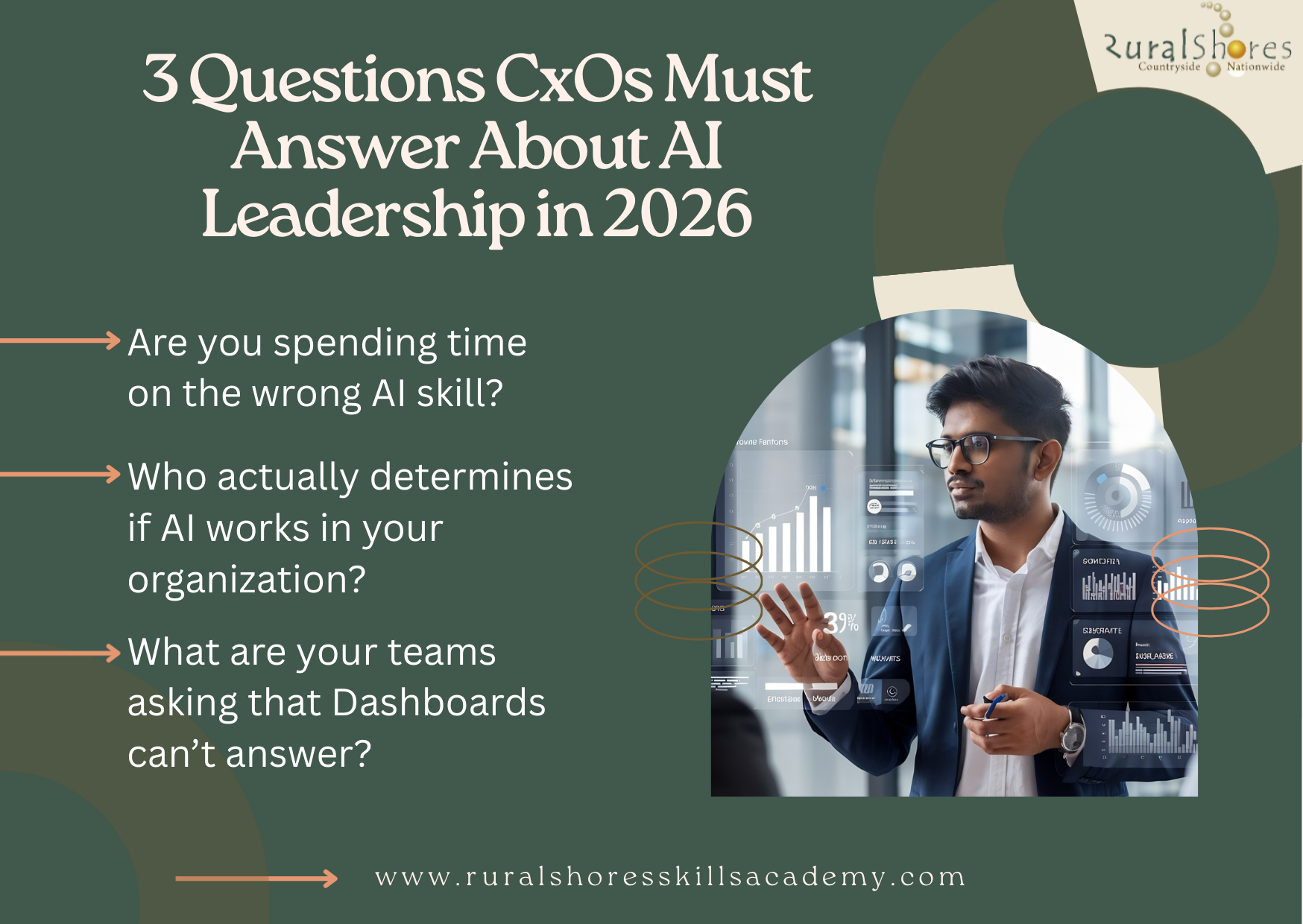
1. Are You Spending Time on the Wrong AI Skills?
Some leadership teams quietly believe, “If I personally learn every AI feature, I’ll future-proof myself.” Executives spending hours in prompt workshops, tinkering with agents, debating which LLM is better.
Useful? A bit. Strategic? Not really.
Where it actually matters is the ability to ask the right questions of AI, not to operate it like a power user. For example, a retail CEO doesn’t need to design the demand-forecasting model—but they must be the one asking:
- “What assumptions sit under this forecast?”
- “Where could this model be biased or blind?”
- “What decisions will we not automate, no matter how good the model gets?”
That line—between what AI can do and what it should do is not a technical line. It’s a leadership line.
2. Who Actually Determines If AI Works in Your Organization?
Most AI strategies stall at slideware because the “last mile” managers don’t know how to rewire daily work. Frontline leaders worry three times more than executives about how AI will actually change jobs, workloads, and expectations.
Imagine two scenarios in a customer operations team:
- Team A just adds a chatbot. Managers tell people, “Use it where you can.” Six months later, NPS is flat, agents feel threatened, and escalations are messy.
- Team B’s managers sit with RSA-trained facilitators and map the workflow: which 20% of repetitive tasks can move to AI, what new conversations humans will own, how success will be measured, and how to communicate this so people see growth, not replacement.
Same tool, opposite outcomes. Here’s what most boards miss: the quality of AI implementation is determined by your least-prepared manager, not your best-trained data scientist. That’s the bottleneck no one’s addressing.
This is where leadership + AI really matters: not in knowing every feature, but in training your managers to redesign roles, metrics, and rituals around AI so people feel safer, not smaller.
3. What Your Teams Are Asking That Dashboards Can’t Answer?
AI is brilliant at generating answers; it is terrible at holding anxiety.
Your high performers are quietly asking:
“Will my role shrink?”
“Will my manager only care about the dashboard now?”
“Is there still space for judgment, or is it all about what the model says?”
Human-centric leadership isn’t a “soft” counterpoint to AI; it’s the risk control. Organisations that invest in leaders who can communicate honestly about change, listen without defensiveness, and make fair calls with imperfect data are seeing higher engagement and better performance.
A simple example: one CHRO we worked with asked managers to use AI only for pre-work (drafting questions, summarising data before a 1:1), never as a substitute for the actual conversation. The message to employees was clear:
“AI helps me prepare for you. It doesn’t replace you.”
That single line increased manager trust scores by 34% in one quarter. Leadership communication isn’t soft. It’s the infrastructure AI strategy runs on.
Trust went up. So did the quality of coaching conversations.
Where RSA fits into a CxO’s AI agenda
If your AI roadmap has tools, pilots, and platforms but no leadership and manager track—you are building a faster car without teaching anyone to drive it well.
RSA’s corporate leadership programs focus on:
- Helping managers redesign workflows so AI removes friction, not jobs.
- Training leaders to balance AI insights with human judgment in decisions.
- Building the emotional skills to hold teams steady while roles and structures shift.
That’s where AI stops being a buzzword and starts compounding value.
If your AI roadmap has tools and pilots but no manager development track, we should talk.
RSA works with leadership teams to build the human capability that makes AI investments compound- not stall.
DM me if you’re scaling AI and need to scale leadership capability alongside it.
#AILeadership #HumanCentricAI #CsuiteROI
Created by: Sonal Arora