

Why concentrating expertise in a few people is one of the most overlooked business risks – and what high-performing Indian organizations are doing about it.
63% of employers cite skill gaps as barrier to transformation (WEF)
40× – cost of capability gap vs. cost of prevention (manufacturing case)
90 days to build your first functional capability pipeline
The Question Every Leader Should Ask
If your top performer was unavailable tomorrow, would the work stop?
For most organizations, the honest answer is yes. And that single reality exposes a deeper vulnerability than most leadership teams acknowledge – one that costs Indian businesses crores annually in lost productivity, client attrition, and missed growth.
Resilience is often discussed in terms of backups, buffers, and duplication. But redundancy alone does not keep a business moving. Capability does.
This is the distinction that separates organizations that absorb disruption smoothly from those that are destabilized by it – and it is a distinction that is increasingly visible in the results of high-growth Indian enterprises.
The Hidden Cost of Capability Concentration
In many organizations, expertise is concentrated in a few high-performing teams or individuals. This improves short-term efficiency. It also creates a structural vulnerability that remains invisible – until a key person leaves, a team is overstretched, or a disruption arrives.
The World Economic Forum reports that 63% of employers view skill gaps as a major barrier to business transformation. For Indian enterprises, this risk is amplified by structural attrition rates of 25-35% in IT and BPO sectors, accelerating Tier-2 and Tier-3 expansion, and the concentration of digital transformation expertise in small technical teams.
Three Sectors. Three Costly Lessons.
BFSI: A mid-sized NBFC lost ₹2.8 crore in delayed disbursements when three underwriting team members resigned within 60 days. Cross-training 18 analysts would have cost ₹6 lakhs and prevented the disruption entirely.
Manufacturing: A precision component manufacturer saw 35% production capacity drop for 11 weeks when their lead CNC operator went on medical leave. Cost: ₹18 crore. Prevention cost: ₹4.5 lakhs – 40 times less.
Technology Services: A Bengaluru IT firm lost 30% of a major client engagement (₹4.2 crore annual impact) when a single account manager resigned. A distributed relationship model would have made the transition invisible to the client.
Strategy without distributed execution capability is aspiration, not plan. The boardroom can be brilliant. If capability stops three levels down, results stop there too.
What Capability Distribution Looks Like in Practice
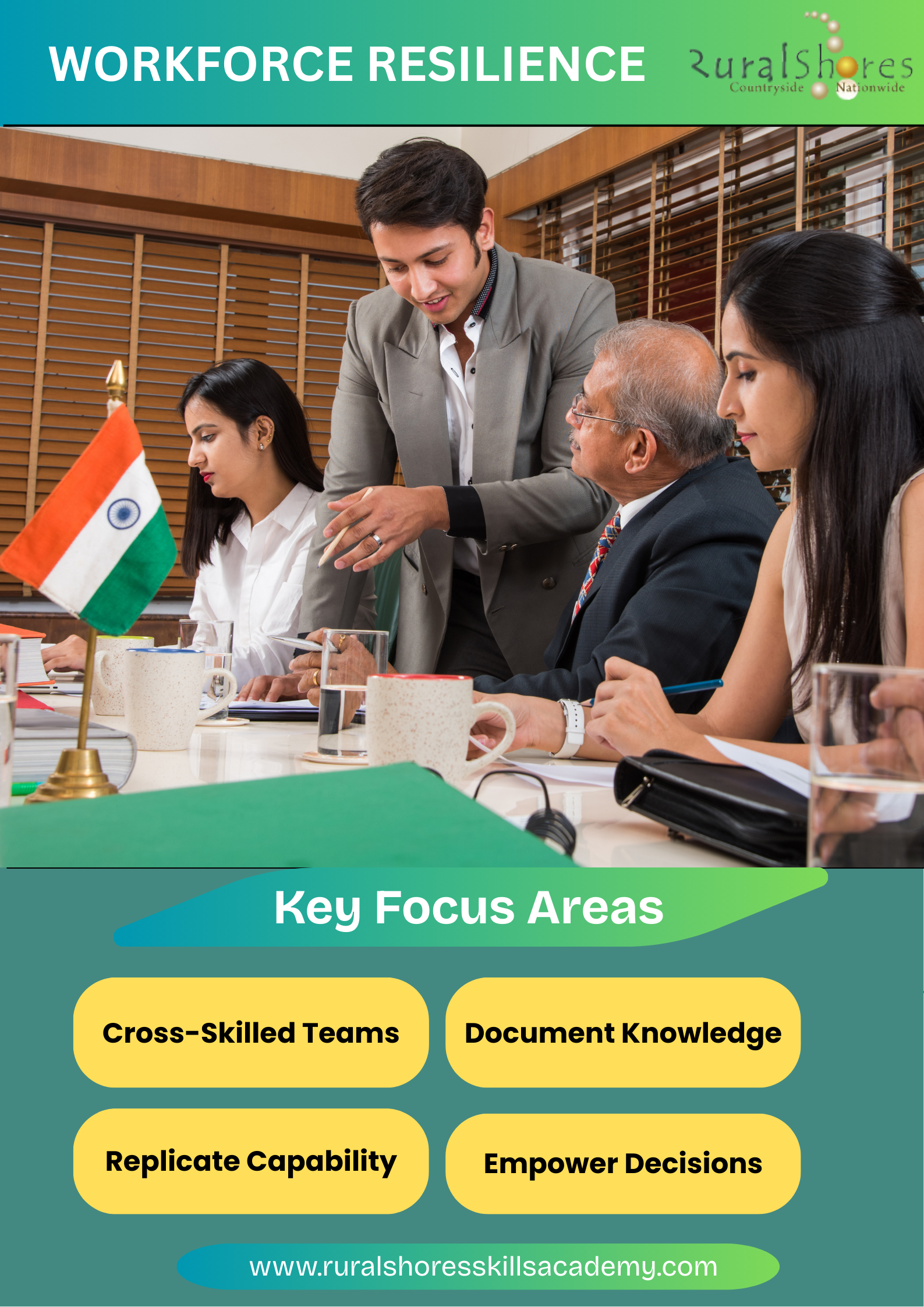
Capability distribution is intentional but not complicated. High-resilience organizations focus on four areas:
- Cross-skilling with depth: Ensure every critical function has at least two to three people capable of executing to standard – not theoretical coverage, but validated competency.
- Knowledge in systems, not heads: Build scenario-based guides, decision trees, and documented workflows that allow capable team members to handle 80% of situations independently within two weeks.
- Frontline empowerment with clear boundaries: Define which decisions frontline teams can make independently. Organizations that do this consistently see 30-40% faster client response times and measurably lower leadership bottlenecks.
- Multi-location capability replication: Ensure that a disruption at one site does not cascade system-wide. Strength concentrated at headquarters is not organizational strength.
Resilience Is Also a Growth Strategy
The case for capability distribution is not only defensive. Organizations with distributed capability enter new markets faster, scale more reliably, and respond to client demands more quickly. The same capability that absorbs a shock also powers a sprint.
A logistics company that cross-trained 60% of its operations team across three functions absorbed 28% festive season attrition without a single client SLA breach. Their competitors scrambled. They scaled. That is the offensive power of capability distribution.
Capability distribution is not risk mitigation spending. It is competitive infrastructure.
The 90-Day Starting Point
- Weeks 1-2: Map capability concentration risks – person, location, and knowledge dependencies. Rank by business impact.
- Weeks 3-4: Prioritise the top five to eight risks. Calculate the real cost of each failing.
- Weeks 5-10: Design distribution – cross-skilling programs, knowledge documentation, role redesign, or location replication as appropriate.
- Week 12+: Validate through simulation, rotation, and performance measurement.
Is Your Organization at Risk? Six Questions
- Can you name your top five capability concentration risks right now?
- If your top three performers left this month, would clients notice within 30 days?
- Are critical processes documented well enough for a capable new person to execute independently within two weeks?
- Do frontline teams resolve most issues independently, or do escalations routinely reach senior leaders?
- Is capability distribution reviewed at leadership level – with metrics and owners?
- Are managers rewarded for developing and distributing capability, not just individual output?
4+ Yes: Strong foundation. Focus on optimization. | 2-3 Yes: Prioritise your top gaps before next growth phase. | 0-1 Yes: Active risk requiring immediate attention.
The Bottom Line
Disruption is no longer rare – it is routine. The organizations that navigate it best are not the ones with the most backups. They are the ones with the most capable people, spread widest across the system.
Resilience follows capability. And capability drives growth.
Ready to assess your capability resilience? Connect with our workforce planning team to discuss a structured capability distribution strategy for your organization.
Workforce ResilienceCapability BuildingTalent Strategy IndiaOrganizational RiskL&D StrategyBusiness ContinuityReskillingWorkforce Planning
Authored by: Neha Babbar