

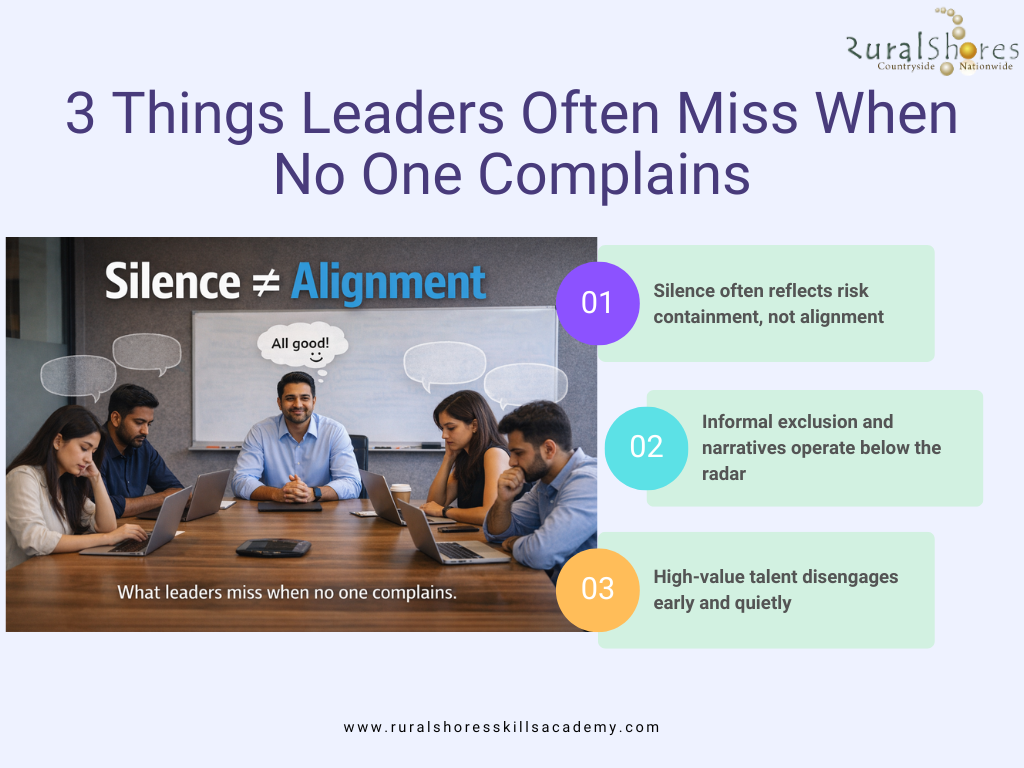
In many organizations, the absence of complaints is interpreted as stability. No escalations. No friction. No visible conflict. In reality, silence is often a lagging indicator.
Senior leaders understand that culture risk rarely announces itself loudly. It shows up quietly, long before performance or attrition metrics react.
1. Silence often reflects risk containment, not alignment
When employees stop voicing concerns, it’s not always because issues are resolved. More often, it indicates that people have calibrated their behavior to minimize exposure.
This results in reduced challenge, fewer upward insights, and a narrowing of decision inputs. On paper, execution continues. In practice, engagement and ownership decline.
What’s often missed: Middle management may be filtering concerns upward to protect their own standing. You’re not hearing complaints because three layers are intercepting them, not because they’ve stopped.
2. Informal exclusion and narratives operate below the radar
Cultural fragmentation rarely appears as open conflict. It develops through missed participation, side conversations, and informal interpretations across teams.
Because these dynamics don’t surface as formal issues, leadership visibility remains low. Over time, trust and cross-functional effectiveness weaken, even in high-performing environments.
What’s often missed: Employees may be speaking up on safe topics while avoiding real issues—performative engagement that mimics what leadership wants to hear. High survey scores can coexist with strategic concerns never surfacing.
3. High-value talent disengages early and quietly
Strong contributors typically don’t escalate repeatedly. They observe system responses and adjust.
Early signals include lower discretionary effort, reduced idea-sharing, and limited risk-taking. By the time attrition occurs, disengagement has already been normalized.
What’s often missed: Past leadership reactions—even subtle ones—teach people when to stay silent. Most silence isn’t organic; it’s learned behavior based on pattern recognition of how leaders actually respond.
What this means at the leadership level
Organizational health is not defined by the absence of complaints. It’s defined by the quality of challenge, inclusion, and psychological safety within the system.
Effective leaders actively assess what is not being said. They track participation, not just outcomes. They notice who has stopped contributing before metrics signal a problem.
Three diagnostic questions:
- When was the last time someone told me something I didn’t want to hear?
- Are my managers rewarded for surfacing problems or for appearing problem-free?
- Do we have genuinely safe channels for concerns—and do people trust them?
Because silence is rarely neutral. It’s often the earliest indicator that leadership attention is needed—and sometimes, that leadership behavior needs to change.
Created By: Sonal Arora