

Why people keep making the same mistakes and how leaders can design better systems
Why do well-designed training programs struggle with engagement, while optional initiatives are easily ignored? Why do employees postpone learning they agree is important? And why do incentives sometimes backfire instead of motivating better performance?
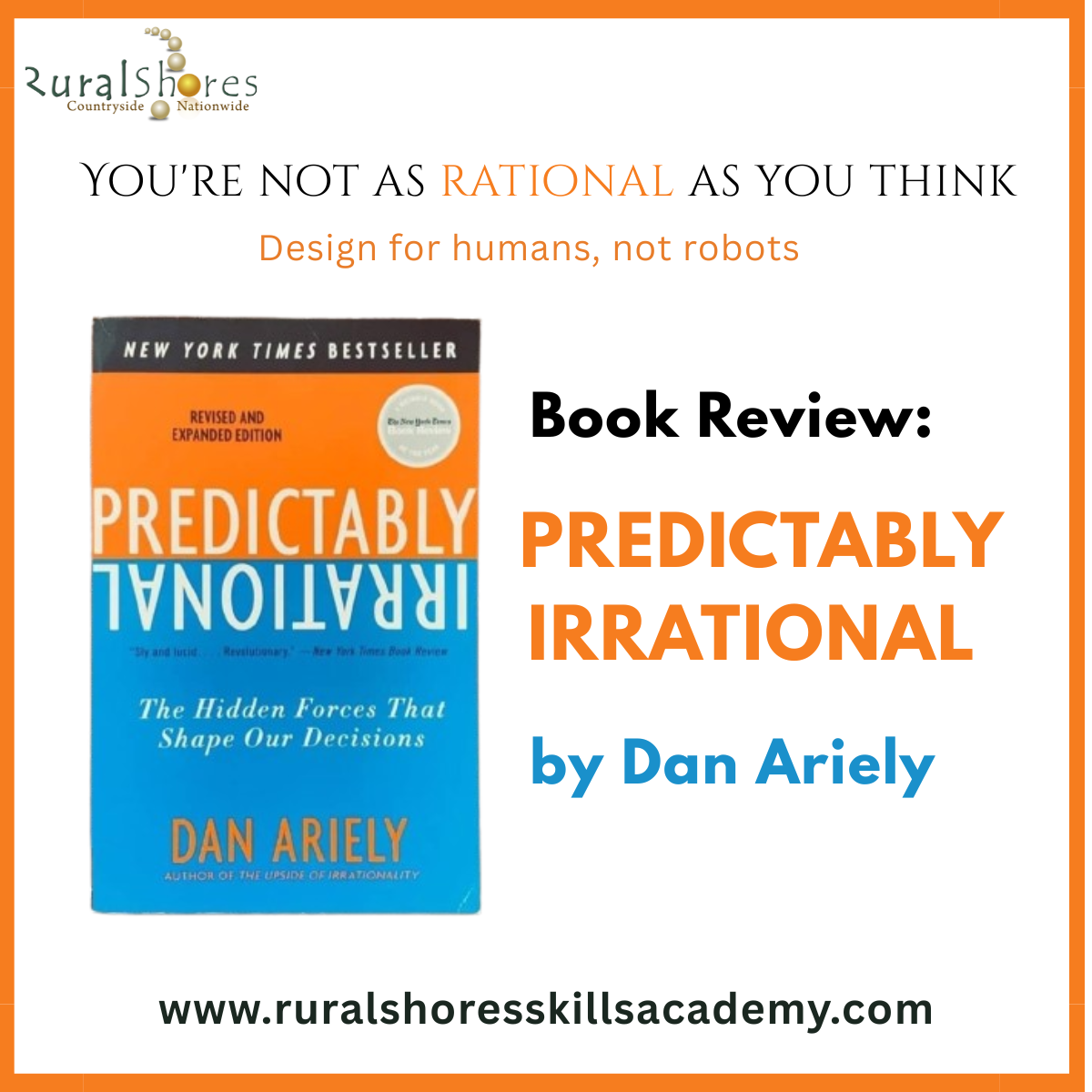
Published in 2008, Predictably Irrational challenges one of the most deeply held assumptions in business and organizational design that people are rational decision-makers. As Dan Ariely famously puts it, “We are not only irrational, but predictably irrational.” This predictability, Ariely argues, is not a flaw to be corrected but a pattern to be understood and designed for.
Rather than merely cataloging human biases, the book offers a blueprint for building systems that align with how people actually behave, not how we wish they would.
Key Takeaways from the Book
1. We Judge Everything Relatively, Never Absolutely
Ariely demonstrates through multiple pricing experiments that we rely heavily on comparisons and context. As he writes, “We humans tend to compare things relatively, not absolutely.” A $2,000 suit seems expensive, until it’s displayed next to a $5,000 suit, then it seems like a bargain. We don’t have an internal value calculator; we rely entirely on external reference points.
What I changed in my classroom: As a youth empowerment and soft skills trainer, I used to introduce communication skills by asking “How would you rate your current communication abilities?” This anchored students to their perceived weaknesses. Now I start by showing them video clips of poor versus excellent communicators, then ask “Which elements from the excellent example do you already use?” This reframes the comparison, they’re no longer measuring themselves against an abstract ideal but identifying strengths they already possess. Engagement and confidence in the first session increased noticeably.
The Implication: Whoever controls the comparison set controls the perceived value. Want employees to value a benefit more? Change what you’re comparing it to.
2. The Word “Free” Rewires Our Decision-Making
Ariely demonstrates that zero cost doesn’t just reduce price, it fundamentally alters decision-making. As he succinctly states, “Free is a very special price.”
When something becomes free, people stop evaluating trade-offs and risks. The emotional pull of “free” overrides rational calculation, often leading to worse choices.
What I Changed in My Classroom: I used to offer “optional practice exercises” for students who wanted to go deeper. Completion was less than 15%. After reading Ariely, I restructured these as “Advanced Modules.” Suddenly, completion jumped to 67%. The content was exactly the same only the framing changed. A small framing eliminated the “I’ll do it later” mentality and made students treat the material as valuable rather than disposable.
The Implication: Your “free” lunch-and-learns are accidentally signaling low value. Your “complimentary” wellness programs see worse engagement than nominal-cost programs. The price of zero carries a psychological cost you haven’t calculated.
3. Social Norms and Market Norms Cannot Coexist
We operate in two parallel worlds: the social world of favors, community, and relationships, and the market world of transactions, fairness, and payment. Introduce payment into a social exchange, and you permanently convert it to a market transaction. When the two collide, “the market norms usually win.”
Ariely illustrates this with a daycare center that started charging parents a fine for late pickups. Late pickups increased, parents now viewed the fine as a price for a service, not a violation of social trust. When the daycare removed the fine, pickups stayed late. Once you cross from social to market norms, there’s no going back.
The Implication: Every time you add a small cash incentive to “boost” a team-building activity or cultural initiative, you’re destroying the intrinsic motivation you’re trying to enhance. Stop mixing market language with social initiatives.
This has profound implications for how leaders drive cultural alignment. Consider the common practice of recognition programs: a manager wants to acknowledge an employee who went above and beyond, so they present a “Values Champion Award” along with a Rs. 500 gift voucher or Amazon coupon. The intention is good, to make the recognition more valuable. The effect is devastating. You’ve just converted heartfelt appreciation into a business transaction worth Rs. 500. The employee no longer thinks “My leader noticed my contribution and values me,” but rather “My extra effort was worth Rs. 500 to the company.” When market norms enter recognition, they don’t enhance the social motivation, they replace it entirely.
4. Anchoring Determines All Subsequent Judgments
In one of the book’s most striking experiments, Ariely asked MIT students to write the last two digits of their Social Security numbers, then bid on items like wine, chocolate, and computer equipment. Students with high numbers (80-99) bid up to 346% more than students with low numbers (00-19). An arbitrary number, one they generated themselves completely anchored their perception of value.
The Implication: That first salary offer in a negotiation? It anchors everything that follows. Your initial project budget estimate? It echoes through every subsequent discussion. Your competitor’s pricing? It may be anchored to an arbitrary number from a decade ago, yet it’s anchoring yours right now.
5. Expectations Literally Change Our Experience of Reality
Once we own something, we value it roughly twice as much as identical things we don’t own. Ariely’s Duke basketball ticket experiment proved this dramatically: students who won lottery tickets demanded an average of $2,400 to sell them. Students who didn’t win them would pay only $170 to buy them. Same ticket. Same game. 14x price difference.
The Implication: This explains why employees resist new systems even when they’re objectively superior. They “own” the current process and irrationally overvalue it. Stop fighting this bias—work with it by involving employees in co-creating the change.
6. We’re All a Little Dishonest When We Think We Won’t Get Caught
Given the opportunity to cheat without detection, most people cheat just a little enough to benefit but not enough to damage their self-image as honest people. This “fudge factor” explains creative expense reports, padded time sheets, and optimistic project estimates. But Ariely discovered that making ethics salient (signing honor codes before filling out forms, being reminded of the Ten Commandments) reduces cheating dramatically.
The Implication: Your ethics training fails not because people don’t know right from wrong, but because ethics isn’t salient at the moment of decision. Build ethical prompts into the point of action, not into annual training.
What “Cheating Just a Little” Looks Like in Practice:
- The timesheet: You worked 7.5 hours on a project but rounded it to 8 hours because “I thought about it during lunch” or “I’ll probably spend that extra 30 minutes next week anyway.”
- The project estimate: You know the project will take 3 weeks, but you say 4 weeks to build a buffer. Not a lie, exactly just “being realistic about potential delays.”
- The office supplies: You take home a pack of Post-its, some pens, a notebook because “the company won’t miss them” and “I use them for work sometimes anyway.”
None of these people think of themselves as dishonest. They’d be offended if accused of stealing. Yet they’re all cheating, just a little. Just enough to benefit without shattering their self-image as ethical people.
What Leaders and L&D Professionals Can Learn
Stop Designing for Rational Learners
Your learners won’t “choose” to complete training because it’s valuable. They’ll procrastinate, get distracted, and rationalize skipping it. Design programs with built-in commitment devices: cohort start dates, peer check-ins, manager touchpoints, and mandatory milestone meetings.
Example: A company rolled out a self-paced compliance course with a 3-month completion window. Despite multiple reminder emails, only 38% completed it. The following quarter, the same content was launched as a 4-week cohort program with fixed start dates, weekly check-ins, and a mandatory manager review at the end. Completion jumped to 92%.
Insight: Learners didn’t suddenly value compliance more, the structure removed procrastination.
Eliminate “Learner Choice” Paralysis
A library of 50 optional courses feels empowering but triggers decision paralysis and procrastination. Curated pathways with clear progression consistently outperform buffet-style catalogs. The paradox: reducing choice increases engagement.
Example: An LMS offered 60 leadership courses labeled “Choose what suits you.” Most employees bookmarked courses but never started. L&D later introduced three predefined tracks: First-Time Manager, People Leader, and Business Leader, each with 5 courses in sequence. Enrollments increased, but more importantly, course completion doubled.
Insight: Fewer choices reduced anxiety and created momentum.
Rethink “Free” Professional Development
Counter-intuitively, requiring nominal commitment mechanisms (even $5 deposits refunded upon completion) creates more psychological investment and higher completion than completely free programs. “Free” accidentally signals “disposable.”
Example: A company offered free certification prep workshops. Attendance dropped sharply after the first session. The next batch required employees to commit a refundable ₹500 deposit, returned upon attending all sessions. Attendance stabilized across weeks, and dropouts fell dramatically.
Insight: The money wasn’t the motivator, the commitment was.
Use Social Proof, Not Incentives
Small cash bonuses for training completion convert intrinsic motivation into a transaction and usually a poor one. Instead, leverage social norms: show completion rates by department, create peer cohorts, make learning visible and celebrated.
Example: Instead of offering ₹1,000 for completing a sales training, a regional sales head published a weekly dashboard showing completion rates by team and recognized the first team to hit 100% in the town hall. Teams began reminding each other to finish the course — no incentive required.
Insight: Visibility and peer norms outperformed cash rewards.
For Organizational Leaders
Audit Your Anchors
Every number you introduce – salary ranges, budget estimates, performance ratings becomes an anchor that shapes all future discussions. Set them strategically, not accidentally. Ask: “What arbitrary number from the past is still anchoring our decisions today?”
Example: A leadership team continued budgeting ₹15 lakh annually for a function because “that’s what we’ve always spent,” even though the team had doubled in size. When questioned, no one could explain the original number. Resetting the anchor based on current needs led to a more realistic ₹28 lakh budget.
Insight: Old numbers quietly control new decisions.
Design for the Endowment Effect
Change management fails when you ask people to abandon systems they “own.” Instead, involve employees early, let them co-create the solution, and frame changes as additions rather than replacements. Give them ownership in the new system before asking them to release the old.
Example: An HR team tried to replace a legacy appraisal system and faced resistance. In the next attempt, they invited managers to co-design the new framework through workshops. When the system launched, those same managers became its strongest advocates.
Insight: People defend what they help create.
Never Mix Market and Social Norms in the Same Message
Don’t announce a cash bonus for “demonstrating our values” or pay people to attend “voluntary” team-building. You’ve just poisoned both the market transaction and the social exchange. Keep compensation discussions separate from culture conversations.
Example: A company announced a ₹2,000 reward for attending a “voluntary culture-building session.” Attendance dropped the next time the session was offered without payment. Employees now saw attendance as a paid task, not a shared responsibility.
Insight: Once culture becomes transactional, intrinsic motivation disappears.
What Makes This Book Different and Important to Read
It’s Immediately Actionable
Most behavioral economics books describe fascinating phenomena but leave you wondering “So what?” Ariely bridges the gap between research and application. Every chapter ends with insights you can test Monday morning.
The Research Is Rigorous But Accessible
Ariely doesn’t dumb down the science, he makes it engaging. His experiments involve chocolate, painkillers, MIT students, and clever setups that feel like detective work rather than homework. You’ll understand the methodology without needing a statistics degree.
It Challenges Foundational Assumptions
Most business books tinker at the margins. Predictably Irrational dismantles the core assumption, rational decision-making underlying everything from org design to performance management to training strategy. Once you see these patterns, you can’t unsee them.
It’s Stood the Test of Time
Nearly two decades after publication, this book remains strikingly relevant. The revised edition incorporates new research, and the book’s influence extends into popular culture (it inspired the 2023 TV series The Irrational). Its longevity proves a simple truth: human psychology doesn’t change even when our world transforms dramatically.
It Provides Competitive Advantage
In an era where everyone has access to the same information, tools, and best practices, understanding human irrationality becomes the differentiator. Your competitors are still designing for rational actors. You can design for humans as they actually are—and that asymmetry creates sustainable advantage.
Conclusion
Predictably Irrational isn’t just recommended reading for leaders and L&D professionals, it’s essential. This book fundamentally changes how you’ll approach organizational design, training effectiveness, change management, and talent strategy.
Ariely achieves exactly what he promises: by the end, you’ll view yourself and your organization through an entirely new lens. You’ll spot irrationality everywhere in your decision-making processes, your incentive structures, your program designs and more importantly, you’ll know what to do about it.
This isn’t a book that tells you what to think. It’s a book that teaches you how to think about thinking. And in a world where we claim to be “data-driven” while making predictably irrational decisions, that’s the skill that matters most.
Stop designing for rational employees who weigh costs and benefits logically. They don’t exist. Design for predictably irrational humans and watch your completion rates, engagement scores, and program effectiveness transform accordingly.
Created by: Kavita Mawari