

For decades, corporate training has been measured through surface-level indicators – number of courses delivered, hours spent in classrooms, and completion rates on LMS dashboards. Yet organisations across FMCG, BFSI, telecom, retail, pharma, manufacturing and services are confronting a hard truth:
Courses do not build performance. Capabilities do.
Gregg Collins of NIIT captured this well when he wrote: “The Course is dead.”
Not because learning is less important—but because the way people learn and apply skills must fundamentally change. The pace of change is accelerating, customer behaviour is evolving unpredictably, and frontline and managerial roles are under more pressure than ever.
At RuralShores Skills Academy – as both a training provider and a field-audit partner – we see one pattern repeatedly:
Training matters only when it translates into action.
If performance does not change, the training simply becomes an event—not an intervention.
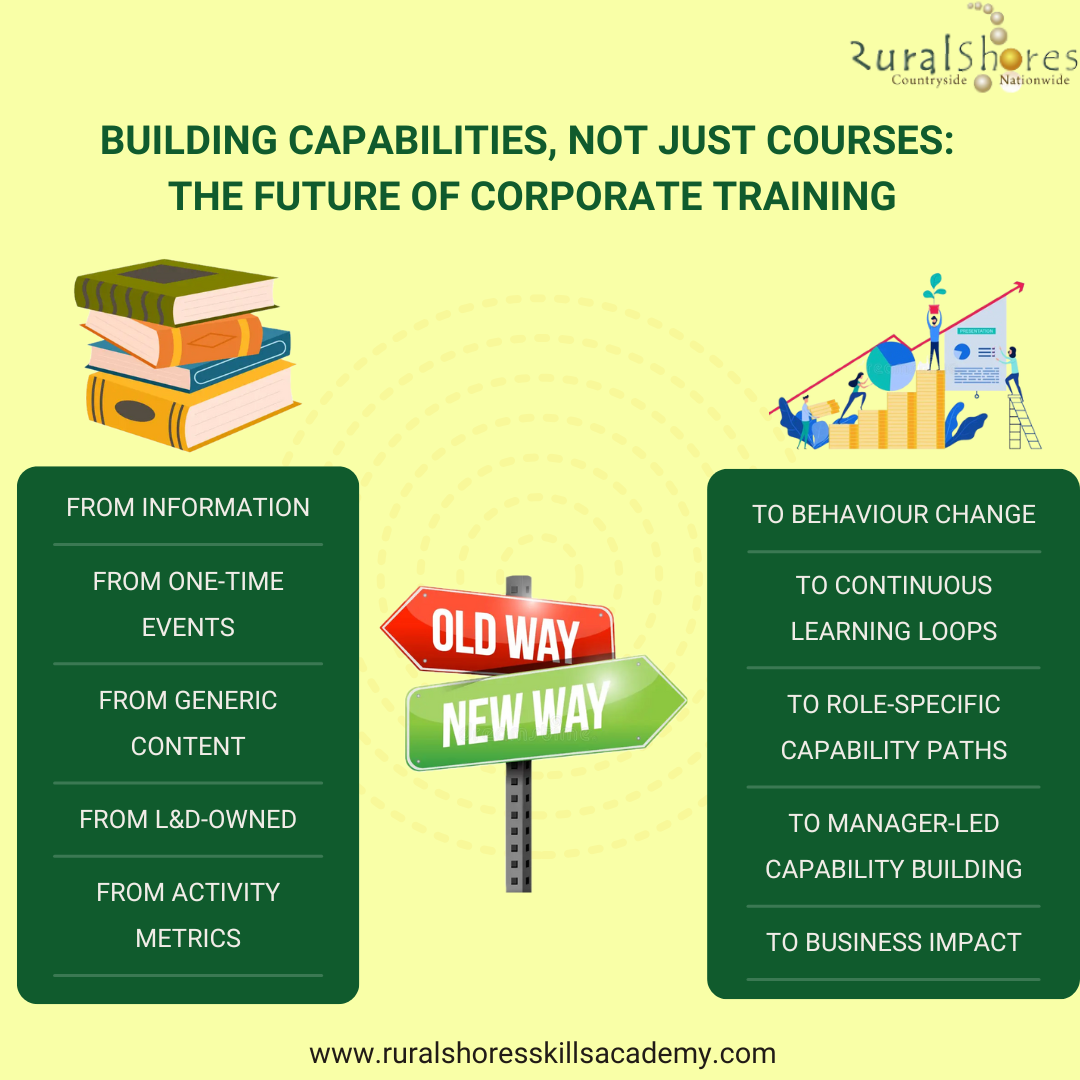
To build teams that execute reliably in a fast-changing world, organisations must shift from delivering content to building capability ecosystems. Here are five critical shifts that define the future of corporate training.
1. From Information Delivery → to Behaviour Change
In a world of instant content, social media overload, and GenAI, knowledge is no longer a differentiator. Application is.
Everyone – field staff, managers, supervisors – can Google the “what”.
Training must instead answer:
- Why does this matter?
- How do I apply it consistently?
- What will change in me that improves my work and results?
Training that doesn’t shift mindset, habits, and daily actions will not move business KPIs.
Example 1 – Telecom
Despite 90%+ product knowledge among field staff, upsell performance remained stagnant. A capability-building intervention focusing on habit routines, objection-handling role plays, and weekly coaching improved conversions by 23% in eight weeks – without adding a single new course.
Example 2 – Pharma
A pharmaceutical firm replaced generic product dumps with role-specific learning journeys anchored in real scenarios. Completion rose from 64% to 94%, and field audits recorded a 38% improvement in prescription influence within three months.
Global Insight
McKinsey (2023): Organisations with behaviour-focused programs deliver 2.5× higher performance outcomes.
What Organisations Must Do
Stop asking “What content should we deliver?”
Start answering: “What behaviour must change, and why will the learner care?”
2. From Training Events → to Continuous Learning Loops
Quarterly workshops and annual refreshers are inadequate for today’s pace.
Capability-building requires continuous reinforcement, built on Learn → Practice → Apply → Analyse → Refine loops.
Why This Matters
Skills especially soft skills like coaching, negotiation, or consultative selling – decay quickly without reinforcement.
Example – Global Retail Chain
Store manager workshops delivered concepts, but behaviour did not change. The company introduced a weekly 15-minute feedback loop:
- Managers coached one team member weekly
- Recorded a 3-minute clip
- Received structured peer feedback
- Participated in monthly reflection sessions
Results within 3 months:
- Leadership effectiveness +35%
- Employee engagement +22%
- Voluntary turnover –18%
Research
- Spaced learning improves retention by 170% (Journal of Applied Psychology)
- Distributed practice delivers 40% better outcomes (Sitzmann & Weinhardt)
What Organisations Must Do
Stop designing events. Build ecosystems – reinforced by coaching, reflection, practice, and feedback.
3. From Generic Content → to Contextual, Role-Specific Capability Building
Different roles need different capabilities and different contexts shape success.
Example – Telecom (Urban vs Rural)
Urban sales teams faced competitive, high-speed environments.
Rural teams dealt with trust-building, first-time users, and infrastructure challenges.
The company redesigned training into context-specific capability tracks—leading to better conversions, improved experience quality, and more consistent execution.
Data
- Bersin: Role-specific learning delivers 37% higher productivity
- Brandon Hall: Targeted, role-based learning improves revenue per employee by 26%
What Organisations Must Do
Define:
What makes a high performer successful in THIS specific role in THIS specific context?
Build capabilities around that – not around generic topics.
4. From L&D-Owned Learning → to Manager-Led Capability Ecosystems
Training teams can design frameworks – but managers build capability.
The shift:
- L&D becomes an architect of ecosystems
- Managers become daily capability coaches
Example – Toyota Kata
Toyota doesn’t rely on workshops. They embed daily coaching cycles where managers guide teams through structured problem-solving conversations. L&D provides tools; managers build capability on the ground.
Data
- McKinsey: Manager engagement increases skill application by 65%
- Gallup: Managers account for 70% of team engagement variance, directly impacting performance
What Organisations Must Do
Reposition L&D:
From content delivery → to enabling managers as capability multipliers
Reposition managers:
From task supervisors → to developers of people
5. From Activity Metrics → to Business Impact Measurement
Completion rates and attendance offer little meaning.
Training must be judged on business outcomes, such as:
- Productivity
- Sales lift
- Customer experience
- Safety metrics
- Error reduction
- Attrition reduction
Example – Manufacturing
Despite high training completion, safety incidents remained high. By linking training to leading indicators (near-misses, observations) and lagging indicators (incident rates), the organisation redesigned capability needs – and incidents dropped significantly.
Data
- McKinsey: Business-impact-driven training improves profit margins by 25%
- CEB: Such organisations are 37% more effective
- Training Industry: High-maturity learning cultures report 218% higher income per employee
What Organisations Must Do
Measure what matters:
Capability → Behaviour → Performance → Business Impact.
The Path Forward: Training Departments Must Become Capability Engines
The organisations that outperform in the next decade will not be those with the most content, platforms, or programs. They will be the ones that:
- Build capabilities specific to roles and contexts
- Integrate training with field audits, coaching, and performance systems
- Make managers the primary developers of people
- Measure business outcomes not learning activities
- Create cultures where learning is daily, iterative, and tied to execution
Conclusion: Training Matters Only When It Translates Into Action
Every field salesperson who closes a sale they would have lost…
Every manager who coaches instead of micromanaging…
Every employee who solves a customer problem with confidence…
That is capability in action.
And that is the future of corporate learning.
The question every leader must now answer is simple:
Is your organisation delivering courses or building capabilities?
The choice will determine whether training remains a cost, or becomes a strategic advantage.
Authored By: Neeraj Agarwal, RuralShores Skills Academy