

Subtitle:
By the time performance data shows a problem, execution has already started slipping. The earliest signals appear in how teams behave, communicate, and escalate.
By the time a metric turns red, the problem is rarely new.
It has usually been building quietly for a while.
Most leaders have seen this happen.
Things look fine on the dashboard, and then suddenly performance drops.
Deadlines slip. Output slows down. Targets are missed.
It feels sudden.
But it almost never is.
In one situation, performance dipped within a week.
But when we looked back, the signs were already there.
Responses were getting slower.
Conversations were shorter.
Engagement had started dropping days before.
The data did not miss it.
It just showed up late.
Why these signals are often missed
Not because leaders don’t care.
And not because they don’t see them.
But because most signals do not look serious when they first appear.
A delayed reply does not look like a risk.
A quieter meeting does not look like a problem.
A “no issues” update feels like progress.
Individually, these are easy to dismiss.
And even when leaders notice them, they often don’t act.
Because:
- It feels too early
- There is no hard data yet
- Or there are bigger priorities at the moment
So the signals are acknowledged, but not addressed.
Until they show up in performance.
Leaders who manage execution well don’t ignore data.
But they don’t wait for it either.
They pay attention to patterns, not just events.
Because one signal can be noise.
Repeated signals are usually a pattern.
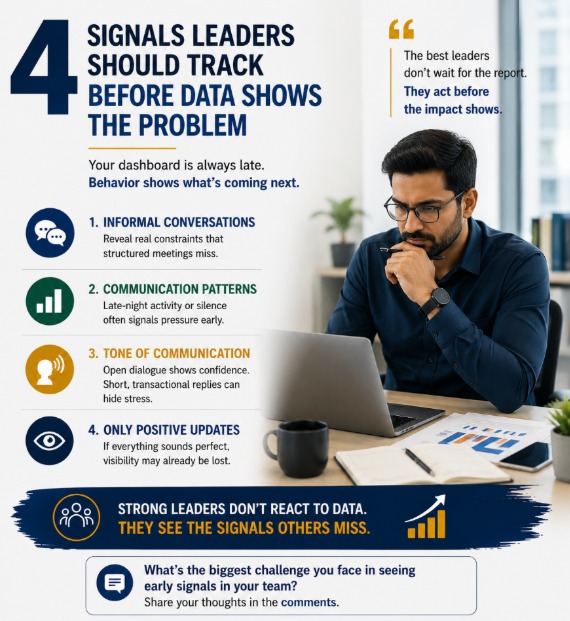
Four signals that show up early
1. Informal conversations reveal operational gaps early
In structured reviews, people share what is expected.
In informal conversations, they share what is real.
Workload pressure.
Dependencies getting delayed.
Small misalignments.
These rarely show up in reports first.
Business impact:
Catching this early allows leaders to intervene before timelines slip.
2. Changes in communication are rarely random
When someone who is usually responsive goes quiet, it usually means something has changed.
It could be workload.
It could be confusion.
It could be disengagement.
At the same time, constant late night activity is often a sign of pressure, not productivity.
Business impact:
If ignored, this leads to burnout, errors, and delivery risk.
3. The tone of communication reflects team confidence
Confident teams ask questions.
They challenge.
They discuss openly.
When communication becomes minimal and purely task-focused, it often means people are holding back.
Not always because they don’t know.
Sometimes because they are unsure if they should speak.
Business impact:
Less discussion slows decisions and hides problems longer.
4. Consistently positive updates can reduce visibility
If every update sounds smooth, it does not always mean everything is on track.
Sometimes it means issues are not being raised yet.
Most teams do not hide problems intentionally.
They wait for clarity, or the right moment.
That delay is where small issues become larger ones.
Business impact:
Late visibility increases the cost and effort required to fix issues.
The takeaway
Data tells you what has already happened.
Behavior tells you what might happen next.
But the real shift is this:
Leaders do not miss problems because they lack data.
They miss them because early signals rarely look urgent.
Execution does not fail in dashboards.
It weakens gradually in small, easy-to-ignore patterns.
A delayed response.
A shorter conversation.
A concern that was not raised.
The leaders who act early are not the ones who see more data.
They are the ones who take small signals seriously before they become big problems.