

Most organizational problems get diagnosed as execution failures.
A target was missed. A customer complaint went unresolved. A project slipped. A training program ran, but the business outcome it was supposed to influence barely moved. A field team completed the activity, but the quality on the ground or the market impact was not what leadership expected.
Leaders respond the way execution problems usually get handled: tighter deadlines, more reviews, another dashboard, another escalation call.
But in my experience, if you step back from enough of these situations, a different pattern starts to show up.
The strategy may have been sound. The people may have been capable. The market may not have been easy, but it was not impossible either. What often broke down was something quieter and far more difficult to see: the intent behind the decision changed shape as it moved through the organization. By the time it reached the person actually doing the work — the field manager, the trainer, the frontline associate, the auditor, the vendor partner, the center coordinator — it was no longer quite the instruction leadership thought it had given.
That is not primarily an execution problem. It is an interpretation problem.
I have seen this repeatedly in organizations where execution is spread across locations, managers, partners, vendors and frontline teams, and where the leadership office is often far away from the point where the customer, learner or beneficiary actually experiences the outcome. The intent at the top is often sensible. The teams are not incapable. But the original meaning gets translated differently at each layer, and by the time it reaches the last mile, the organization is sincerely working hard on a diluted version of the real goal.
That, in my view, is one of the most common and most underestimated reasons why otherwise sensible strategies underperform.
Why interpretation fails before execution does
In most organizations, intent does not travel in a straight line from the CEO’s mind to the last mile of delivery. It moves through layers: business/project heads, functional managers, project leads, field supervisors, support teams, vendor partners and frontline staff. At each layer, the message gets translated — sometimes consciously, often unconsciously.
A leader says, “Improve customer responsiveness.”
One manager hears, “Close issues faster.”
Another hears, “Reduce escalation volume.”
A field team hears, “Reply quickly, even if the issue is not fully resolved.”
A leader says, “Improve placement outcomes.”
One layer translates that into “increase batch completion.”
Another translates it into “push learners into more interviews.”
The frontline team ends up optimizing activity, while the original intent was to improve employability and conversion.
A leader says, “Strengthen delivery quality.”
One team starts sending more reports.
Another increases review calls.
But the actual quality failure on the ground — weak training, poor field supervision, inadequate surprise checks, inconsistent customer experience, poor follow-through with a vendor or partner — continues because nobody translated “quality” into the right operating behaviors.
This is how organizations end up executing hard and still executing the wrong thing.
The problem is not that people are careless. The problem is that ambiguity gets filled by local assumptions, and those assumptions are shaped by incentives, workload, capability, review structures and old habits. People do what the system appears to reward, what their manager visibly pays attention to, and what feels safest under pressure.
This is particularly true in organizations where delivery is not contained inside one office or one tightly supervised environment. When execution happens across branches, field teams, centers, partner organizations, vendors, client sites or distributed project teams, the room for distortion becomes much larger. The farther the last mile is from the original decision, the more important interpretation discipline becomes.
That is why execution failure is often diagnosed too late and at the wrong level. By the time a number misses, a customer complains, or a project slips, leaders focus on the visible symptom. The real failure may have happened much earlier — when the original intent was diluted, reinterpreted or quietly redefined in the journey downward.
Great organizations understand this. They do not only ask, “Did we execute?” They ask a harder question:
Did the original intent survive intact all the way to the person who had to act on it?
That is a very different discipline.
The difference between alignment and ownership
This, in my view, is where many organizations plateau.
Good organizations often create alignment. People know the broad priorities. They can repeat the strategy. They understand the annual goals and the language of the leadership team.
But alignment is not the same thing as ownership.
Alignment gets people moving in the same direction. Ownership gets people to close the gap between the stated priority and the messy reality of delivery.
A manager who feels aligned may say, “I understand the goal.”
A manager who feels ownership says, “I know what this means in my geography, my account, my center, my team. I know where it is likely to go wrong. I know what needs correcting before it becomes a visible failure. And I do not need to wait for the next review meeting to start acting.”
That is the real transition from good to great.
It requires more than a good townhall, which we call countryhall, or a clear strategy deck. It requires:
- clarity about what must not be lost in translation
- managers who know how to convert broad intent into practical action
- processes that carry meaning downward without distortion
- review mechanisms that bring reality back upward before problems become expensive
- and a culture where people own outcomes, not just activities
I have often felt that this is where leadership teams unknowingly overestimate organizational capability. A strategy can be well thought through. A communication can be clear. But if the layer of managers below cannot convert that into concrete decisions, review points and course correction on the ground, the strategy has not yet become operational.
In other words, leadership clarity is not real until it survives contact with the last person responsible for delivering it.
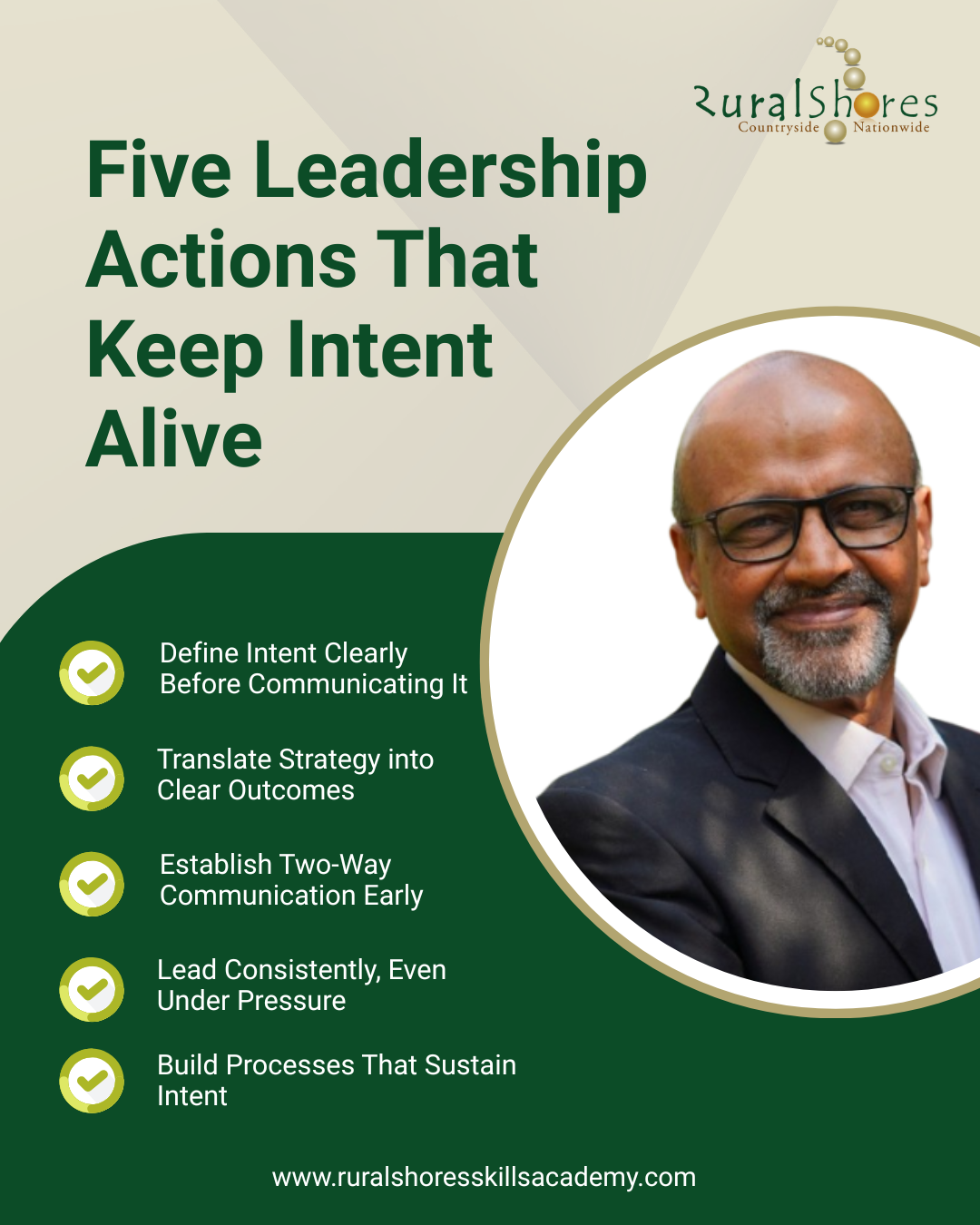
Five things leaders must do if they want intent to survive the journey
1. Define intent with precision before you communicate it
A surprising amount of distortion starts at the top.
Leaders often have a reasonably clear instinct about what they want, but they communicate it before pressure-testing it against the most important question of all:
If someone two levels below me heard only this sentence, what would they now go and do?
If the answer is unclear, the intent is not ready to be communicated.
Precision does not mean rigidity. It does not mean writing a script for every situation. It means the leader has already done the work of separating:
- the outcome that must not change
- the standard that must be protected
- the non-negotiables that define success from
- the local judgment calls that can and should remain flexible
Without that discipline, every layer fills the gaps differently. By the fourth or fifth handoff, the original meaning may be barely recognizable.
In practice, this matters a lot more than many leaders admit. I have seen managers receive a priority like “improve learner outcomes,” “be more proactive with customers,” or “improve delivery quality” and then quietly convert it into whatever metric, action or review point is easiest to measure. The language sounds aligned; the work on the ground is not.
Leaders often assume that because something is clear in their own mind, it will be clear in the organization. It rarely works that way.
2. Translate strategy into specific outcomes at every layer
Intent that stays abstract at the top stays abstract everywhere.
The real work of leadership is not only to define direction. It is to translate direction into owned outcomes at each layer of the organization.
That means making strategy concrete enough that a manager can answer four questions: 1. What does this mean for my team this month? 2. What does “good” look like in my account, project, territory or function? 3. What trade-offs should I make when priorities collide? 4. What should my team stop doing because this new priority matters more?
This is where many leadership messages fail. They sound sensible at the top but never become operational in the middle.
A CEO says, “We need to become more customer-centric.”
That is not yet an operating instruction.
A field leader needs to know whether that means:
- faster escalation closure
- more time with distributor partners or vendors
- more surprise visits
- tighter review of field execution quality
- different metrics in the review
- more empowerment for the person closest to the customer
- or a shift in how quality failures are handled
A training leader needs to know whether “improve learner outcomes” means redesigning sessions, coaching trainers differently, tracking learner readiness more carefully, or changing how placements are reviewed. A project manager needs to know whether “improve delivery quality” means more reporting, more supervision, better process design, or a sharper definition of what poor execution actually looks like on the ground.
The answer will not be the same in every unit, which is exactly why translation has to happen deliberately.
And that translation cannot only be pushed downward. It has to be co-built with the people who will execute it. When a field manager helps define what “good vendor performance,” “good training quality,” or “good placement readiness” looks like in their context, they are far more likely to catch drift early and correct it. If they are only handed a target, they will often wait to be told what to do next.
That is the difference between assigned accountability and felt ownership.
3. Build two-way communication before you hit a crisis
Clarity is not a one-way broadcast.
Leaders who only communicate downward eventually lose the ability to know whether their intent landed correctly — and, just as importantly, whether the intent still makes sense once it meets operational reality.
This is why the best organizations build structured upward communication, not only inspirational downward communication.
They create regular ways to hear:
- what the last mile is seeing
- what customers, learners, channel partners or frontline staff are reacting to
- where a policy is creating distortion
- where managers are compensating for a broken process
- where the organization is measuring the wrong thing and quietly driving the wrong behavior
This is not the same as “having an open-door culture.” It is much more operational than that.
It means creating rhythms where leaders routinely ask:
- What is being misunderstood?
- What is not working on the ground?
- What are we hearing from customers that is not visible in the dashboard?
- Where are people complying with the process but missing the purpose?
- What repeated issue are we treating as a people problem when it is really a design problem?
The organizations that sustain execution quality do not treat these questions as crisis questions. They treat them as normal management questions.
In my experience, some of the most valuable leadership conversations happen not in formal reviews, but in the gap between the formal story and the lived reality underneath it. A dashboard may show activity completed. A skip-level conversation, a field visit, or a candid conversation with someone closer to the last mile may reveal that the activity is being done mechanically, or that the customer problem has been “closed” but not really solved, or that a training batch has “completed” without meaningfully improving learner readiness.
That gap matters. Leaders ignore it at their own cost.
4. Model the behavior you expect, especially under pressure
Intent communicated in a townhall and contradicted in a review meeting the following week is not intent. It is noise.
People decide what leaders really mean by watching what leaders do under pressure.
If a leader says, “Do not hide bad news,” but reacts defensively when someone escalates a difficult problem, the organization learns very quickly that surface-level optimism is safer than truth.
If a leader says, “Customer outcomes matter more than activity,” but reviews only completion metrics and ignores quality signals, the organization learns what really counts.
If a leader says, “Take ownership,” but continues to solve every problem personally, managers learn that ownership is admired in theory but not actually transferred in practice.
This is why leadership consistency matters so much. The message is never only in the speech. It is in the review agenda, the escalation response, the questions asked, the metrics examined, the behaviors tolerated, and the trade-offs rewarded.
In that sense, great leaders are the first and most reliable process their organizations have for transmitting intent without distortion.
I would go one step further: leaders should assume that the organization is always watching what gets rewarded under pressure. Not what gets applauded in principle, but what gets protected, escalated, excused or corrected when something is difficult, late, politically inconvenient or commercially uncomfortable.
That is when the real message gets sent.
5. Build processes that carry intent even when the leader is absent
No leader can personally clarify intent to every person, every time, at scale.
This is where good organizations often stop — relying on the leader’s personal energy, clarity and follow-up to keep the system aligned. And this is where great organizations build something more durable.
They create processes, routines and checkpoints that carry the original intent even when the leader is not in the room.
That might mean:
- a weekly field-quality review that focuses not only on activity completed but on deviations, risks and corrective action
- a standard project kickoff rhythm that makes non-negotiables explicit before delivery starts
- a simple escalation path that surfaces bad news early
- a frontline empowerment rule that allows someone closest to the customer to solve a problem without waiting for permission
- a review format that forces managers to discuss outcomes, risks and learning, not just status
This is also where ownership becomes structural rather than personality-dependent.
When the process itself is designed to surface distortion early, leaders do not need to re-explain the same thing at every level. The organization begins to carry the meaning through its operating rhythm.
This matters because results do not come from meetings alone. They come from what meetings, reviews and routines make possible in the days that follow. In distributed organizations especially, a good process is not bureaucracy. It is one of the few reliable ways to keep intent from fragmenting across distance, layers and local interpretation.
Two examples of intent being protected all the way to the last mile
Toyota and the andon cord
Toyota’s andon cord is one of the most studied examples of leadership intent surviving all the way to the factory floor.
Toyota’s intent was never simply “produce more cars.” It was that quality is everyone’s responsibility, and no one should let a defect pass downstream.
Many organizations would have expressed that as a value statement. Toyota encoded it into the operating system. Any assembly line worker, regardless of level, could stop the line the moment a defect was spotted.
That is intent made concrete. It does not depend on whether a frontline worker had the confidence to interpret “quality matters” correctly in the moment. The system itself tells them what the organization means.
The point is not the cord. The point is the discipline behind it: the organization built a mechanism that made the desired behavior easy, legitimate and immediate.
Ritz-Carlton and frontline empowerment
In a service business, intent is harder to encode into machinery. It has to travel through human judgment, often with a customer standing in front of the employee at that exact moment.
The Ritz-Carlton’s famous practice of allowing employees to spend up to a defined amount to resolve a guest issue without managerial approval is powerful for that reason. It translated “deliver exceptional guest experience” into a clear, owned decision right at the last mile.
The frontline employee did not need to wait for a supervisor to define what “exceptional” meant in that specific situation. The organization had already translated the intent into an operating mechanism.
This is the broader lesson for service organizations. If frontline people need three levels of permission to act on the outcome the company claims to care about, the intent will almost always be distorted by delay, caution and escalation.
Products need services. Services need product discipline.
It is worth stating the broader point clearly.
This is not only a manufacturing problem. It is not only a services problem either.
Products reach the market through services: installation, support, distribution, channel execution, field quality, after-sales response, training, partner management. The product experience is often only as good as the service system carrying it.
And services scale sustainably only when they borrow some of the discipline of a product: repeatable methods, clear standards, teachable routines, visible checkpoints and operating mechanisms that reduce dependence on individual heroics.
I have come to believe that many service organizations underinvest in this discipline. They rely too much on good people, local firefighting and management heroics, and too little on mechanisms that make good execution repeatable. That works for a while. It does not scale well.
Whichever side an organization sits on, the underlying leadership challenge is the same:
Does intent survive, undistorted, all the way to the person actually facing the customer, the machine, the partner, or the market? Or does it dilute layer by layer until execution looks like failure, when the real failure happened much earlier?
The real work of leadership
Good organizations manage execution.
Great organizations manage the fidelity of intent.
They protect it from distortion at every handoff. They translate it into owned outcomes. They build managers who do not merely align with the plan but act as if they own their piece of it. They create review structures, escalation paths and operating mechanisms that surface reality before it becomes damage. And they remain disciplined enough to ask not only, “Are we executing?” but “Are we still executing what we actually meant?”
That is not a communications exercise.
It is one of the hardest, most underrated disciplines in leadership — and one of the clearest differences between organizations that remain merely busy and organizations that become genuinely great.
For leaders, that means the work is not finished when the strategy is decided or the message is delivered. In many ways, that is where the harder part begins. The real test is whether the meaning survives distance, layers, pressure and daily execution — and whether the person at the last mile is working from the same understanding the leader started with.